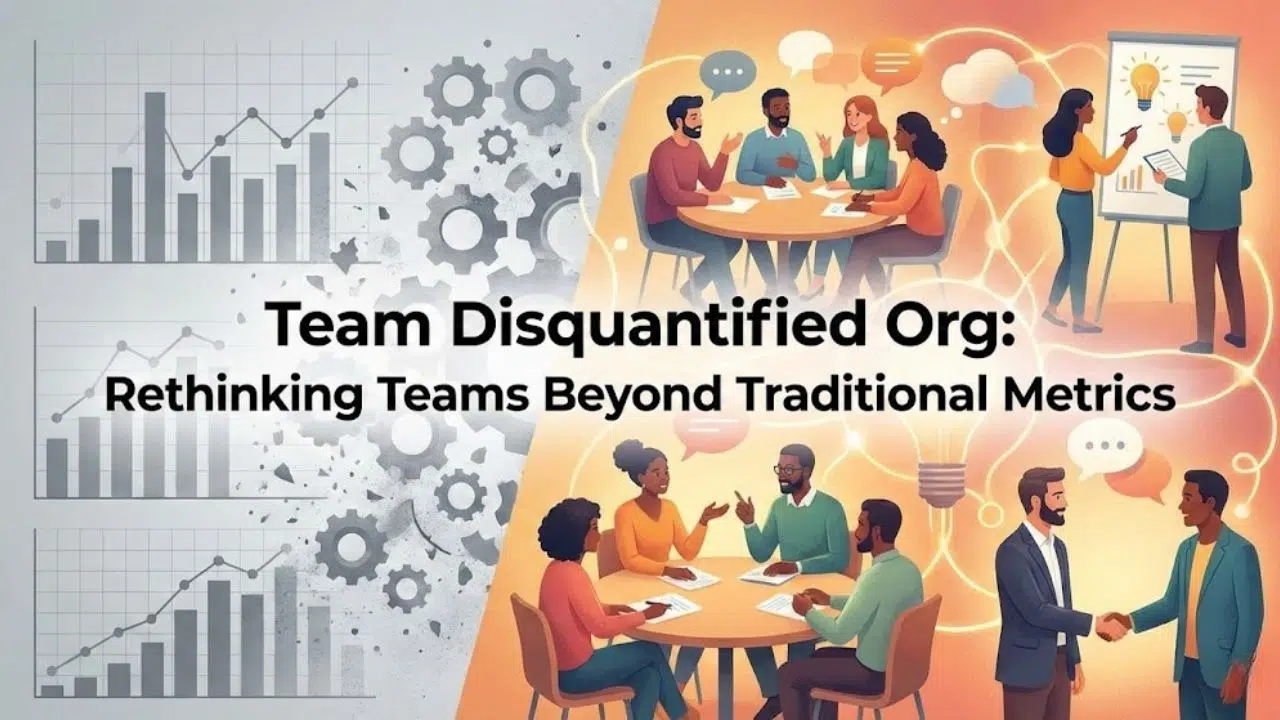
Modern organizations are increasingly questioning whether traditional performance metrics truly capture how teams create value. In this context, team disquantified org has emerged as a concept that reflects a deeper shift in how collaboration, productivity, and impact are understood. Rather than reducing teams to numbers alone, this approach emphasizes qualitative insight, context, and human judgment.
As businesses navigate complexity, remote work, and rapid change, leaders are discovering that over-quantification can obscure more than it reveals. This article explores what team disquantified org means, why it matters, and how organizations can apply its principles responsibly while maintaining clarity, accountability, and trust.
Understanding the Concept of Team Disquantified Org
At its core, team disquantified org refers to an organizational mindset where teams are not evaluated solely through rigid numerical indicators such as output counts, velocity scores, or utilization rates. Instead, performance is assessed through a broader lens that includes collaboration quality, decision-making effectiveness, adaptability, and long-term contribution.
This does not imply rejecting data altogether. Rather, it recognizes that numbers without context can mislead. Teams operate in dynamic environments, and their value often lies in problem-solving, creativity, and resilience, which are difficult to reduce to a single metric.
Organizations adopting this approach aim to balance quantitative signals with informed qualitative assessment, ensuring that evaluation aligns with real-world outcomes rather than surface-level activity.
Why Traditional Metrics Fall Short for Teams
Conventional performance frameworks often prioritize what is easiest to measure rather than what is most meaningful. Output volume, time tracking, or individual KPIs may provide structure, but they frequently miss critical aspects of team performance.
Complex projects require cross-functional collaboration, trade-offs, and learning from failure. When teams are pressured to optimize for narrow metrics, they may avoid experimentation, underinvest in knowledge sharing, or focus on appearances rather than impact. Over time, this can erode trust and reduce genuine effectiveness.
The team disquantified org perspective addresses this gap by encouraging leaders to ask better questions about outcomes, behaviors, and long-term value instead of relying on dashboards alone.
Key Principles Behind a Team Disquantified Org
A defining principle is contextual evaluation. Teams are assessed based on the environment they operate in, the constraints they face, and the nature of the problems they solve. This prevents unfair comparisons and supports more accurate decision-making.
Another principle is shared accountability. Instead of isolating individual metrics, performance is understood as a collective effort. This reinforces collaboration and reduces internal competition that can damage morale and results.
Finally, learning orientation plays a central role. Teams are encouraged to reflect on what worked, what did not, and why. Insight gained from these reflections becomes as valuable as numerical outcomes, supporting continuous improvement.
Practical Benefits for Modern Organizations
Organizations that apply team disquantified org thinking often report stronger alignment between strategy and execution. When teams are evaluated holistically, leaders gain clearer insight into systemic issues rather than blaming surface-level performance fluctuations.
Employee engagement also tends to improve. Professionals are more likely to feel trusted and respected when their contributions are understood in context. This trust supports psychological safety, which is essential for innovation and honest communication.
From a governance perspective, this approach can reduce the risk of metric manipulation. When success is not defined by a single number, teams are less incentivized to game the system and more motivated to focus on meaningful outcomes.
How to Implement a Team Disquantified Org Approach

Implementation begins with a leadership mindset. Executives and managers must accept that not all valuable work can be fully quantified. This requires comfort with judgment, dialogue, and nuanced evaluation.
Structured qualitative reviews are a practical starting point. Regular retrospectives, narrative performance summaries, and peer feedback can complement quantitative data without replacing it. The goal is to create a richer picture of team health and impact.
Clear expectations remain essential. Disquantification does not mean ambiguity. Teams should understand what success looks like in terms of outcomes, values, and responsibilities, even if those elements are not fully expressed in metrics.
Balancing Data and Judgment Responsibly
A common misconception is that disquantification leads to subjectivity or bias. In practice, the opposite can be true when implemented well. By making evaluation criteria explicit and documented, organizations can reduce hidden assumptions and improve fairness.
Data still plays an important role as a signal rather than a verdict. Trends, anomalies, and benchmarks inform discussion but do not replace it. This balance ensures decisions are evidence-informed while remaining grounded in human understanding.
Organizations that succeed with this balance often invest in manager capability, ensuring leaders are trained to evaluate performance thoughtfully and consistently.
FAQ
What does team disquantified org mean in practice?
It means evaluating teams using both quantitative data and qualitative judgment, focusing on real outcomes, collaboration quality, and long-term value rather than metrics alone.
Does the team disquantified org reject performance measurement?
No. It reframes measurement by treating metrics as indicators, not absolute truths, and combining them with contextual insight.
Why are organizations moving toward disquantified team models?
Because modern work is complex and knowledge-based, making it difficult for traditional metrics to capture true performance and impact.
Is team disquantified org suitable for large organizations?
Yes, but it requires clear frameworks, strong leadership capability, and consistency in how qualitative evaluations are conducted.
How does this approach affect accountability?
It strengthens accountability by aligning evaluation with meaningful outcomes and shared responsibility, rather than narrow individual targets.
Global Relevance
The principles behind team disquantified org apply across industries, cultures, and geographies. Whether teams operate in highly regulated environments or creative sectors, the challenge of over-reliance on metrics is universal.
By avoiding location-specific assumptions and focusing on human-centered performance evaluation, this approach remains relevant for multinational organizations, distributed teams, and cross-border collaborations. Its flexibility allows adaptation to local norms without losing strategic coherence.
Building Trust Through Better Evaluation
Team disquantified org represents a thoughtful evolution in how organizations understand performance. By moving beyond rigid metrics and embracing context, collaboration, and learning, leaders can make more accurate decisions and build stronger, more resilient teams.
For organizations seeking sustainable performance and genuine engagement, this approach offers a credible alternative to metric-driven management. Adopting it carefully, with clarity and discipline, can strengthen trust and align teams around what truly matters.