The relationship between high fiscal obligations and personal well-being in Northern Europe is often misunderstood as a simple trade-off. As we move into 2026, the Nordic countries continue to hold the highest positions in global satisfaction rankings, despite maintaining some of the highest tax-to-GDP ratios in the world. This synergy between Scandinavian tax and happiness is driven by a profound social contract that treats taxation not as a loss of income, but as a collective investment in high-quality public services and long-term security.
To uncover the most relevant and surprising aspects of this model for 2026, we filtered through the latest World Happiness Report data and the 2026 fiscal budget updates from Sweden, Denmark, and Norway. We prioritized facts that challenge common misconceptions, such as the actual burden on corporations and the unique psychological pressures of living in a “happy” society. Our selection focuses on new 2026 legislative shifts, like the temporary VAT reductions and pay transparency directives, to provide a current and actionable perspective on why these systems remain so resilient.
Understanding how these nations maintain their lead requires looking past the high headline tax rates. The following points detail the specific mechanisms and cultural shifts that define the Nordic success story in the current year.
1. High Social Trust as Economic Capital
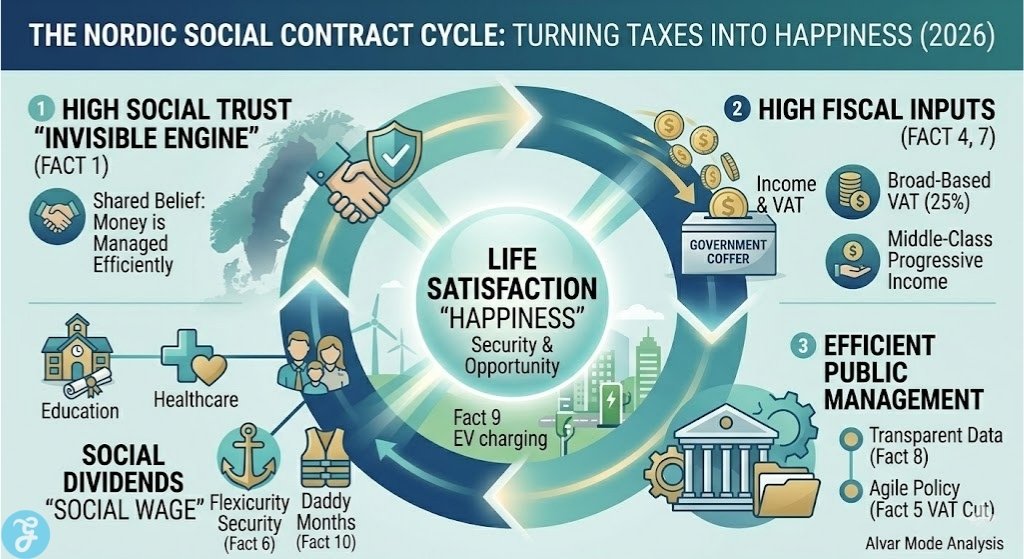
The primary driver of the Nordic model is not the tax rate itself, but the exceptionally high level of social trust, often called “Nordic gold.” Citizens generally believe that their tax money is managed efficiently and that their neighbors are contributing fairly. This trust reduces the psychological “pain” of paying taxes because the benefits, such as free healthcare and education, are visible and reliable for everyone.
Best for: understanding the cultural foundation of the Nordic model.
Why We Chose It:
-
Trust is the most significant statistical predictor of national happiness levels in 2026.
-
It explains why tax compliance remains high even with significant financial pressure.
Things to consider:
-
Declining trust in institutions globally makes this Nordic characteristic increasingly rare and valuable.
2. Low Corporate Taxes for Business Growth
Contrary to the image of a “socialist” high-tax state, Scandinavian countries maintain highly competitive corporate tax rates. In 2026, Sweden’s corporate tax rate is approximately 20.6%, which is lower than the statutory rate in many other Western nations. This ensures that while individuals are taxed heavily on consumption and income, businesses have the liquidity needed to innovate and compete globally.
Best for: entrepreneurs and international business observers.
Why We Chose It:
-
It corrects the misconception that Scandinavia is “anti-business.”
-
This pro-business stance provides the economic growth that funds the welfare state.
Things to consider:
-
The focus is on taxing the wealth generated by individuals rather than the productive capacity of the company.
3. The 2026 “Happycondria” Phenomenon
A new phenomenon identified in 2026 studies is “happycondria,” the psychological pressure individuals feel to be happy because they live in the “happiest” country. Researchers have found that as Finland continues its multi-year run at number one, some citizens report a decrease in satisfaction as they compare their own mediocre days to the national “ideal.” This suggests that the Scandinavian tax and happiness link has complex emotional side effects.
Best for: psychological and sociological enthusiasts.
Why We Chose It:
-
It is a cutting-edge 2026 insight that adds nuance to the happiness rankings.
-
It highlights that the “happiness” being measured is often life satisfaction, not constant joy.
Things to consider:
-
High expectations for well-being can lead to feelings of personal failure if one feels “only okay.”
4. Consumption Taxes Fund the Welfare State
The heavy lifting of the Nordic budget is done by Value-Added Tax (VAT), not just personal income tax. With standard VAT rates around 25% in Denmark, Sweden, and Norway, the system captures revenue from every transaction. This broad-based consumption tax ensures a steady stream of income for public services that is less volatile than income tax alone.
Best for: understanding the mechanics of Nordic revenue collection.
Why We Chose It:
-
It shows that everyone, including tourists and high-wealth individuals, contributes to the system daily.
-
High VAT allows for a more “flatter” tax experience across different income brackets.
Things to consider:
-
High VAT can increase the cost of living for lower-income households if not offset by transfers.
5. April 2026: The Temporary Food VAT Cut
In a significant move for 2026, Sweden has implemented a temporary reduction in food VAT from 12% to 6% starting in April. This measure was designed to provide immediate relief to households facing rising grocery costs while maintaining the broader high-tax structure. It demonstrates how Nordic governments use their tax flexibility to protect citizen well-being during economic shifts.
Best for: current events and cost-of-living analysis.
Why We Chose It:
-
It is a direct 2026 policy intervention aimed at maintaining happiness through affordability.
-
It illustrates the pragmatic, rather than ideological, nature of Scandinavian tax and happiness policies.
Things to consider:
-
This is a temporary measure scheduled to expire at the end of 2027.
6. Flexicurity: The Safety Net for Risk-Takers
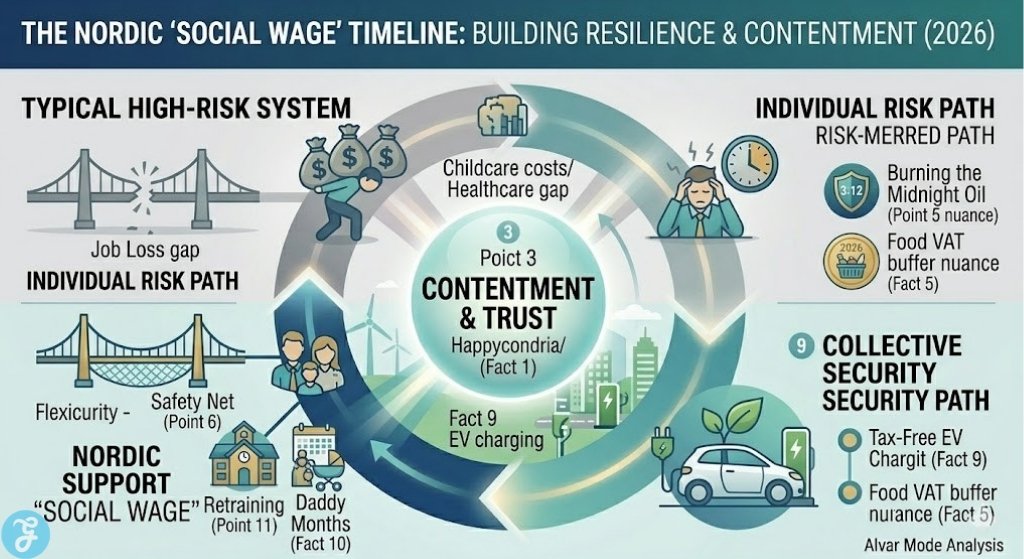
The “flexicurity” model—most famous in Denmark—combines flexible labor markets with high security for workers. It is easy for companies to hire and fire, but the state provides massive support for those who lose their jobs, including up to 90% of previous salary and intensive retraining. This makes losing a job a temporary hurdle rather than a life-altering catastrophe, which significantly boosts national happiness.
Best for: labor market specialists and career-focused readers.
Why We Chose It:
-
It removes the “fear factor” associated with entrepreneurship and career changes.
-
It allows the economy to adapt quickly to new technologies without leaving workers behind.
Things to consider:
-
This system requires high trust from both employers and employees to function effectively.
7. Top Tax Rates Hit the Middle Class Early
A surprising fact for many is that the highest marginal tax rates in Scandinavia kick in at relatively low income levels compared to the U.S. In Denmark, for example, the top tax bracket of over 55% can apply to individuals earning just 1.3 times the average national income. This means the middle class, not just the “1%,” is the primary financier of the social safety net.
Best for: income tax and wealth distribution comparison.
Why We Chose It:
-
It highlights the “broad shoulders” philosophy where everyone contributes significantly.
-
It explains why Nordic countries have some of the lowest income inequality in the world.
Things to consider:
-
This structure relies on citizens perceiving the high-quality services they receive as a “fair trade.”
8. 2026 Pay Transparency Mandates
By June 2026, Nordic countries are leading the implementation of new EU-wide pay transparency directives. Companies are now required to share salary information with job applicants and provide employees with access to data on pay gaps. This move is intended to close the gender pay gap and improve workplace satisfaction, further strengthening the link between Scandinavian tax and happiness.
Best for: workplace equality and modern corporate governance.
Why We Chose It:
-
It is a major 2026 regulatory milestone that impacts the daily life of workers.
-
Transparency is a key component of the high-trust Nordic culture.
Things to consider:
-
Larger companies must now report regularly on their gender pay gaps and take corrective action.
9. Workplace EV Charging is Now Tax-Free
To accelerate the green transition, Sweden has made workplace electric vehicle (EV) charging a tax-free benefit as of 2026. This policy encourages citizens to switch to sustainable transport by making it financially advantageous to charge at work, effectively using the tax code to promote both environmental health and citizen convenience.
Best for: environmental enthusiasts and tech-forward commuters.
Why We Chose It:
-
It shows how the tax system is used to nudge behavior toward collective goals.
-
It is a specific 2026 update that reflects the region’s focus on future-proofing.
Things to consider:
-
This benefit is particularly valuable as EV infrastructure continues to expand across the region.
10. Generous “Daddy Months” and Parental Leave
Scandinavian countries offer some of the most comprehensive parental leave in the world, often exceeding 400 days per child. Crucially, a portion of this leave—often called “Daddy Months“—is reserved specifically for the non-birthing parent. If not used, the leave is lost, which has successfully normalized men taking an active role in early childcare and improved family well-being.
Best for: families and advocates for work-life balance.
Why We Chose It:
-
It is a fundamental pillar of the happiness model that supports gender equality.
-
It provides a long-term benefit that outweighs the cost of the taxes used to fund it.
Things to consider:
-
This policy has long-term positive effects on child development and marital stability.
11. The 3:12 Rules Reform in Sweden
Starting in January 2026, Sweden simplified the “3:12 rules,” which govern how owners of closely held companies are taxed on dividends. The reform increased the basic allowance and shortened the qualifying period for certain tax benefits. This change was designed to make it more attractive for small business owners to take dividends at a lower tax rate, rewarding local entrepreneurship.
Best for: small business owners and private investors.
Why We Chose It:
-
It is a technical but high-impact 2026 update for the business community.
-
It demonstrates the government’s effort to simplify complex tax legislation.
Things to consider:
-
Proper governance and planning are still required to maximize these new tax-efficient outcomes.
12. SINK Rate Reductions for Non-Residents
In a bid to attract international talent, Sweden has reduced the Special Income Tax for Non-residents (SINK) rate from 25% to 22.5% for 2026, with a further reduction to 20% planned for 2027. This makes it more affordable for foreign specialists to work in Sweden on a short-term or cross-border basis, ensuring the high-tax environment remains porous enough to attract global skill.
Best for: digital nomads, expats, and international recruiters.
Why We Chose It:
-
it signals a 2026 shift toward greater openness in the Nordic labor market.
-
It directly impacts the “net take-home pay” for non-resident workers.
Things to consider:
-
Correct withholding must be managed by employers following this mid-year reduction.
The success of the Nordic model in 2026 is built on the realization that happiness is a infrastructure project. By taxing consumption heavily and income progressively, these nations have built a “soft money” loop where taxes return to citizens in the form of security, education, and health. This creates a cycle where the collective well-being of the population provides the stable foundation necessary for individual and business growth to thrive.
Understanding how these elements differ across the region can help clarify why some nations consistently rank higher than others. The following data points provide a snapshot of the primary fiscal and social metrics across the Nordic “Big Three” as of early 2026.
Overview Comparison Table
The comparative data below highlights the variations in tax strategy and happiness rankings that define the Scandinavian landscape this year.
| Feature / Metric | Denmark | Sweden | Norway |
| 2026 Happiness Rank | 3rd | 4th | 7th |
| Standard VAT Rate | 25% | 25% | 25% |
| Corp. Tax Rate 2026 | 22% | 20.6% | 22% |
| Top Income Tax Rate | ~55.9% | ~52.4% | ~39.6% |
| Primary Happiness Driver | Social Security | Trust & Innovation | Natural Wealth / Safety |
| New 2026 Benefit | Expanded Green Credits | Food VAT Reduction | Payroll Tax Simplification |
Our Top 3 Picks and Why?
-
High Social Trust: This is our top pick because it is the “invisible engine” of the entire model. Without it, the high tax rates would likely lead to social unrest rather than world-leading happiness.
-
Flexicurity: We chose this because it solves the modern fear of job loss. It allows for a dynamic economy where people are not afraid to take risks, knowing they won’t fall into poverty.
-
The 2026 Food VAT Cut: This is a vital pick for 2026 as it shows the system’s ability to be agile. It demonstrates that the government is willing to sacrifice tax revenue in the short term to protect the immediate well-being of its citizens.
If you are considering moving to or doing business in Scandinavia, you must look beyond the surface-level tax rates. Your “strategy” should be based on your long-term life goals and how much you value collective security over individual wealth accumulation.
The Selection Framework
-
Identify Your Life Stage: If you are planning a family, the parental leave benefits of Sweden or Denmark may outweigh the higher taxes. If you are an entrepreneur, Sweden’s lower corporate rates and 3:12 rules may be the priority.
-
Assess Your Risk Tolerance: If you value the ability to fail and restart, Denmark’s flexicurity system provides the best “Plan B” infrastructure.
-
Calculate the “Social Wage”: Don’t just look at your take-home pay. Add the value of free high-quality healthcare, university education for your children, and subsidized childcare to see your true “net” benefit.
-
Consider the VAT Impact: If you have high consumption habits, the 25% VAT will impact your lifestyle more than the income tax. Factor in the local cost of living before making a decision.
To help you decide which Nordic nation fits your profile, refer to the decision matrix below.
Decision Matrix Table
This guide compares common priorities with the country that most effectively delivers on those needs in 2026.
| If your priority is… | Choose X if… | Choose Y if… |
| Starting a Business | Choose Sweden for its low corporate tax and new 3:12 reforms. | Choose Denmark for the best labor market flexibility. |
| Max take-home pay | Choose Norway for its lower top-tier marginal income tax rate. | Choose Sweden if you are a non-resident utilizing the SINK reduction. |
| Raising a Family | Choose Denmark for its world-class childcare and security. | Choose Sweden for its extensive “Daddy Months” and leave days. |
| Immediate Cost Relief | Choose Sweden for the 2026 food VAT reduction. | Choose Norway for its stable, state-funded energy subsidies. |
The Final Checklist: 5-Point Nordic Integration Plan
-
Calculate your “net take-home” including the value of public services you will actually use.
-
Check the latest 3:12 rule updates if you are an owner-manager in Sweden.
-
Confirm if you qualify for the reduced SINK rate as a non-resident specialist.
-
Research the specific Pay Transparency data for your industry before negotiating a salary.
-
Verify the VAT status of your major planned purchases to avoid price shock.
The Enduring Strength of the Nordic Social Contract
The Scandinavian tax and happiness model is not a miracle; it is a meticulously maintained machine designed for long-term human flourishing. By 2026, these nations have shown that high taxes do not stifle joy—they provide the air in which it breathes by removing the existential anxieties of modern life. While the system faces new challenges like “happycondria” and inflationary pressures, its ability to adapt through targeted VAT cuts and transparency mandates ensures that Scandinavia remains the global benchmark for what a successful, high-trust society can look like.