BrainBridge, a neuroscience and biomedical engineering startup from the US, has claimed they are developing the world’s first head transplant system.
According to their website, it is “a groundbreaking device that will represent a landmark achievement in the fields of neuroscience, human engineering, and artificial intelligence.”
Unveiling the Revolutionary Technology
BrainBridge’s ambitious project involves using advanced robotics and artificial intelligence (AI) to perform head transplants, a procedure that has never been attempted on humans before.
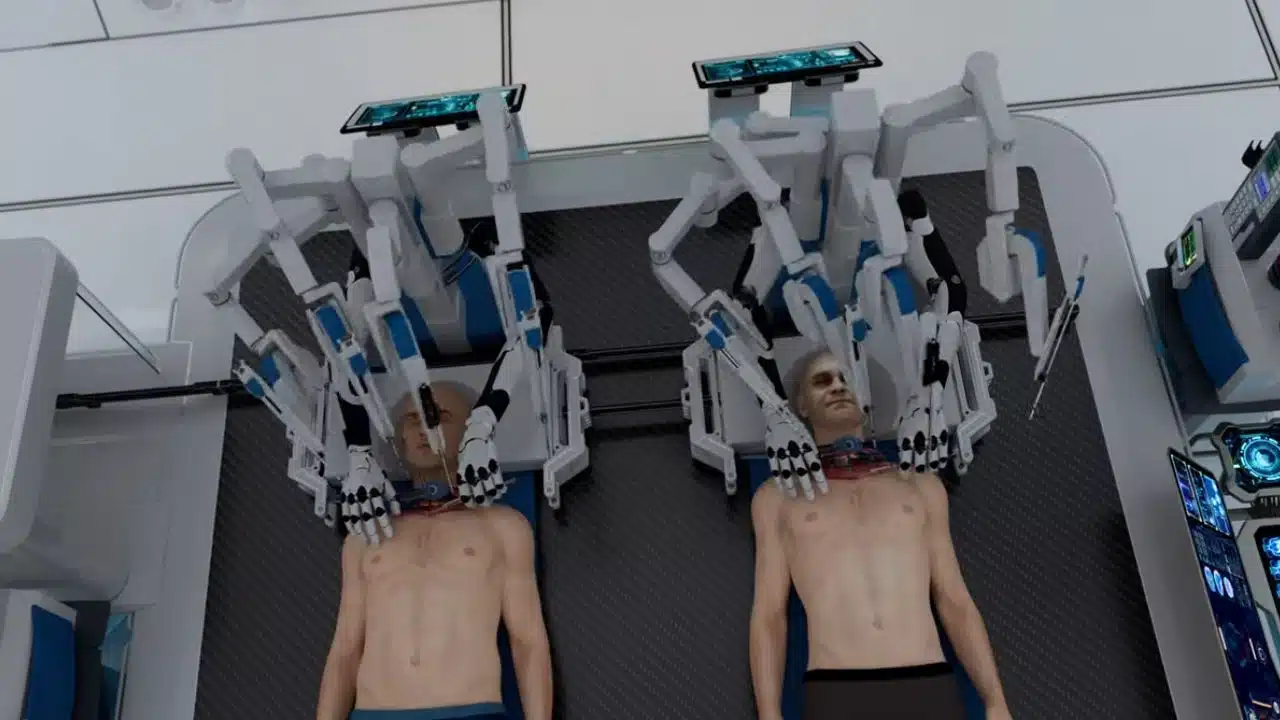
The company recently released an animated video showing how two surgical robots would operate simultaneously on two bodies, removing the head from one and attaching it to the other.
This video quickly went viral, amassing close to nine million views and sparking intense discussions online.
The Concept and Technology
According to Bainbridge, their system is a “revolutionary concept for head transplant system, employing cutting-edge robotics and artificial intelligence to ensure successful head and face transplantation procedures with improved outcomes and faster recoveries.”
The procedure aims to help patients with untreatable medical conditions like paralysis, cancer, or neurodegenerative diseases by transplanting their heads onto a brain-dead, healthy donor body.
This ambitious project aims to preserve the patient’s cognitive abilities, memories, and consciousness.
Public Reaction and Skepticism
The animated video shared on social media has generated a mix of intrigue and skepticism.
Many people have expressed their doubts about the feasibility of such a procedure.
One commenter noted, “To date, there has been no surgery or therapy capable of rejoining a severed spinal cord within the same individual, let alone between different individuals.”
Another skeptic said, “Just to be clear, this robot, not a human, is going to be doing neurosurgery, plastic surgery, a tracheostomy, vascular surgery, anesthesia.
We don’t have a robot that can do any of those things by themselves, let alone a procedure like this, which has never been done to a human.”
The Science Behind the Procedure
BrainBridge plans to employ sophisticated medical robots and AI to carry out the entire procedure autonomously.
The company explained that advanced, high-speed robotic systems would prevent brain cell degradation and ensure seamless compatibility between the head and the donor body.
The procedure would involve real-time molecular-level imaging and AI algorithms to facilitate the precise reconnection of the spinal cord, nerves, and blood vessels.
Addressing the Challenges
One of the major obstacles to this revolutionary procedure is the current inability of medical science to repair spinal cord and nerve damage adequately.
If this issue is not resolved, any recipient of a head transplant could end up paralyzed from below the neck. Additionally, there are concerns about potential “organ” rejection between the donor body and the transplanted head.
Bainbridge is currently hiring specialists to address these issues and hopes to attract global talent to overcome these significant challenges.
Future Plans and Expectations
Bainbridge has set an ambitious timeline, aiming to conduct the first human head transplant within the next eight years.
The company is also planning to use surgical robots and AI to reconstruct facial features and enable full facial muscle use, ensuring a comprehensive post-surgery care plan to prevent rejection and promote healing.
This includes a four-week period of induced coma to facilitate healing at the transplant sites.
Broader Implications and Ethical Considerations
While BrainBridge’s project is groundbreaking, it also raises numerous ethical and medical questions.
The concept of a head transplant pushes the boundaries of medical science and human ethics, requiring careful consideration and regulatory oversight.
The potential for such a procedure to revolutionize medicine is immense, but it also demands rigorous testing and validation to ensure safety and efficacy.
BrainBridge’s claim to develop the world’s first head transplant system with robotic surgeons is a bold and revolutionary step in the fields of neuroscience, biomedical engineering, and artificial intelligence.
While the concept is fascinating and holds tremendous potential for treating severe medical conditions, it faces significant scientific, ethical, and practical challenges.
As the project progresses, the world will be watching closely to see if this ambitious vision can become a reality and what it will mean for the future of medicine.
The Information is Collected from Daily Mail and MSN