The era of the “AI whisperer” is officially over. In the early days of 2023, anyone who could coax a clever haiku out of a chatbot could claim the title of a prompt engineer. But as we settle into 2026, the landscape has hardened into a rigorous engineering discipline. Prompt Engineering Certifications are no longer just a “nice-to-have” badge for freelancers; they have become the critical gatekeeper for high-level roles in tech, finance, and enterprise operations.
Corporations today don’t just need creative inputs; they need reliable, scalable, and secure systems that integrate with complex data pipelines. This shift wasn’t accidental. With the full enforcement of the EU AI Act and stricter corporate governance policies globally, companies can no longer afford the liability of “hallucinating” models.
They need certified professionals who understand the mechanics of Large Language Models (LLMs), the nuances of retrieval-augmented generation (RAG), and the ethical frameworks that keep automated systems compliant. In 2026, you aren’t just writing text; you are architecting behavior. This article explores the definitive certifications you need to prove your worth in this mature industry.
Key Takeaways
- Shift to Engineering: The field has moved from creative writing to technical system design.
- Verify Your Skills: Employers in 2026 prioritize certifications from major providers (Microsoft, DeepLearning.AI, and Universities) over bootcamps.
- Specialization is Key: Don’t just be a generalist. Pick a lane—Technical, Strategic, or Governance.
- Ethics are Mandatory: Understanding safety and compliance is no longer optional; it is a core job requirement.
The New 2026 Standard: From Art to Engineering
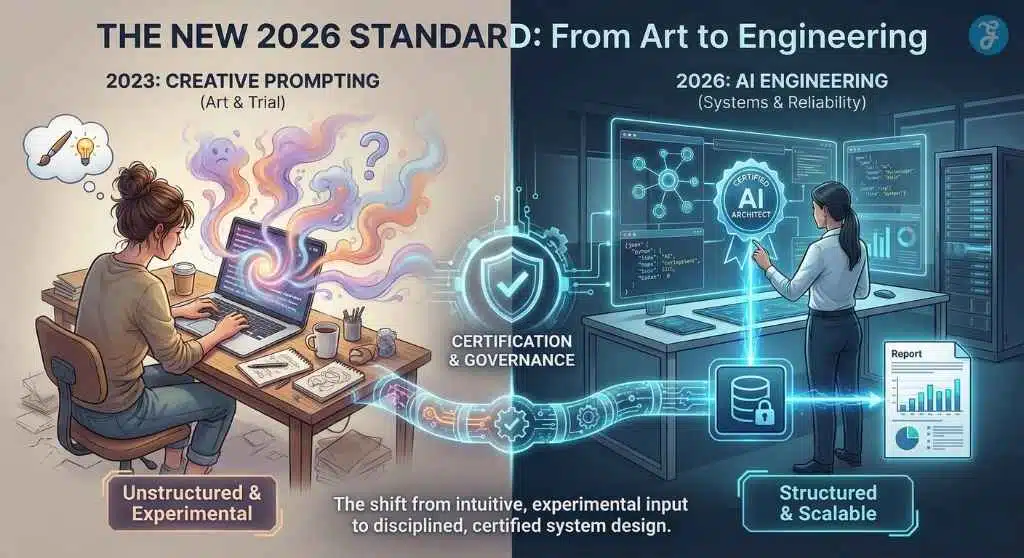
For years, prompt engineering was treated as a “soft skill”, a linguistic art form closer to poetry than programming. However, the last two years have seen a massive convergence between Practical prompting and traditional software engineering. We are now in the age of “Systematic Prompt Engineering.”
Why Certifications Are the New Degree
In 2026, a portfolio of “cool prompts” is insufficient. Hiring managers at Fortune 500 companies are looking for standardized proof of competence. Why? Because AI is now infrastructure.
- Standardization of Skills: Just as cloud computing coalesced around AWS and Azure certifications a decade ago, AI has coalesced around specific frameworks. Employers need to know you understand the specific syntax of GPT-5, Claude, or Llama 4 enterprise environments.
- The “Human-in-the-Loop” Mandate: Regulatory bodies now require that any automated decision-making system have a certified human overseer. This “Human-in-the-Loop” (HITL) requirement means that being certified is often a legal necessity for the company to deploy its tools.
- The Reliability Factor: A hobbyist prompts until they get a good result once. A certified engineer designs a prompt that delivers the correct result 1,000 times in a row, often outputting machine-readable code (JSON/SQL) rather than conversational text.
Industry Stat (2026): According to recent labor market analysis, 75% of senior IT and Data roles now list “AI Literacy or Certification” as a mandatory requirement, up from just 15% in 2024.
Top 5 Prompt Engineering & AI Certifications for 2026
If you are looking to future-proof your career, these are the credentials that carry weight. We have categorized them by professional track so you can choose the one that aligns with your career goals.
1. The Gold Standard: DeepLearning.AI – “Generative AI for Everyone” & Specializations
Best For: Managers, Executives, and Product Leaders.
Andrew Ng’s DeepLearning.AI remains the most trusted educational body in the artificial intelligence space. While they offer deep technical courses, their “Generative AI for Everyone” has become the MBA equivalent for the AI age.
- Curriculum Focus:
- Core Concepts: Demystifying how LLMs actually work (predicting the next token vs. “thinking”).
- Strategic Application: Identifying where AI adds value in a business workflow and where it is a distraction.
- Prompting Paradigms: Moving beyond basic instruction to “Chain of Thought” reasoning.
- Why It Matters: This certification signals to employers that you have a grounded, realistic understanding of AI capabilities. It strips away the hype and focuses on economic value. In 2026, being the person who knows what to build is just as valuable as being the person who builds it.
- Assessment: rigorous quizzes and peer-graded case studies on AI deployment strategy.
2. The Technical Choice: Microsoft Certified: Azure AI Engineer Associate (AI-102)
Best For: Developers, System Architects, and IT Professionals.
As Microsoft continues to dominate the enterprise AI space through its OpenAI partnership, the AI-102 exam has become the standard for technical implementation. This is not for the faint of heart; it requires coding skills.
- Key Skills Tested:
- Prompt Flow: Using Microsoft’s specific tools to test and evaluate prompts at scale.
- RAG Implementation: Connecting LLMs to Azure SQL databases to answer questions based on private company data.
- Content Safety: Configuring filters to prevent the AI from generating toxic or biased content.
- The 2026 Update: The latest version of this exam places heavy emphasis on “Agentic AI”—building systems where the AI can autonomously use tools (like a calculator or a calendar) to complete tasks.
- Prerequisites: Proficiency in Python or C# and a solid understanding of REST APIs.
3. The Specialist: Vanderbilt University – “Advanced Prompt Engineering for ChatGPT”
Best For: Content Strategists, Marketers, and Linguists.
Offered via Coursera, this certification from Vanderbilt University was one of the first to treat prompting as a serious academic discipline. In 2026, it remains the premier course for mastering the linguistic and structural side of model interaction.
- Advanced Techniques Covered:
- The Persona Pattern: Forcing the model to adopt a specific psychological stance (e.g., “Act as a skeptic security auditor”).
- The Template Pattern: Creating fill-in-the-blank structures that standard users can fill out to generate complex reports.
- Cognitive Verifiers: Teaching the model to ask clarifying questions before it attempts to answer a vague prompt.
- Why It Matters: This is the certification for the “AI Architect” who focuses on the quality of the output. If your job involves generating high-quality text, code documentation, or legal summaries, this is your toolkit.
4. The Data Path: DataCamp – “AI Engineer Certification”
Best For: Data Scientists and Analysts.
DataCamp has bridged the gap between traditional data science (numbers) and the new world of generative AI (text). Their certification is essential for anyone who wants to use AI to analyze data rather than just write emails.
- Curriculum Focus:
- Python Integration: How to use the OpenAI API within a Python environment.
- Fine-Tuning: The process of taking a generic model (like Llama 3) and training it further on your specific industry data.
- Vector Databases: Understanding how to store text so that an AI can “remember” it later (essential for long-term memory in AI agents).
- The Value: In 2026, data is the moat. A DataCamp certification proves you know how to leverage your company’s proprietary data to build a competitive advantage.
5. The Governance Role: IAPP – Certified AI Governance Professional (AIGP)
Best For: Legal, HR, Compliance Officers, and Risk Managers.
This is the fastest-growing certification of 2026. As governments crack down on “Black Box” algorithms, companies are scrambling to hire professionals who understand the laws.
- Key Domains:
- Global AI Laws: Understanding the EU AI Act, US Executive Orders, and regional privacy laws.
- Risk Management: How to audit an AI system for bias (e.g., ensuring a hiring bot doesn’t discriminate against women).
- Accountability: Establishing clear lines of responsibility when an AI makes a mistake.
- Why It Matters: You cannot deploy an AI system in a bank or hospital in 2026 without a governance sign-off. This certification makes you the person who holds the stamp of approval.
Comparison Table: Choosing Your Path
| Certification | Focus Area | Difficulty | Best Job Role |
| DeepLearning.AI | Strategy & Foundations | Beginner/Intermediate | Product Manager, Exec |
| Microsoft AI-102 | Engineering & Deployment | Advanced (Coding Req.) | AI Engineer, Developer |
| Vanderbilt Univ. | Prompt Structure & Logic | Intermediate | Content Lead, Analyst |
| DataCamp AI | Data & API Integration | Intermediate/Advanced | Data Scientist |
| IAPP AIGP | Law, Ethics & Safety | Advanced (Theory) | Legal, HR, Compliance |
Beyond the Prompt: Essential Skills for 2026
Getting certified is the first step, but the actual day-to-day work of an AI professional in 2026 involves skills that go beyond simple text inputs. To truly excel, you must master the “Engineering” side of Prompt Engineering.
1. Structured Output Mastery
In 2023, we were happy if the AI wrote a poem. In 2026, we need the AI to write a JSON file that triggers a bank transfer.
- The Skill: Writing prompts that constrain the AI to output only valid code or data formats.
- The Tool: Familiarity with “schemas” and “function calling” (telling the AI it has access to specific software tools).
2. RAG (Retrieval-Augmented Generation)
Models hallucinate. They make things up. RAG is the antidote.
- The Skill: You don’t ask the AI, “What is our company vacation policy?” (It doesn’t know). You build a prompt that says: “Read the attached PDF about vacation policy. Answer the user’s question using ONLY that PDF.”
- The Certification Connection: Microsoft and DataCamp certifications heavily test this skill.
3. Model Agnosticism
A true professional doesn’t just know ChatGPT.
- The Skill: Understanding that Claude is better for writing, GPT-5 is better for logic, and Llama is cheaper for simple tasks.
- The Optimization: You must know how to route tasks to the cheapest model that is “good enough” to save your company money.
Building a “Certified” Portfolio: What Hiring Managers Look For
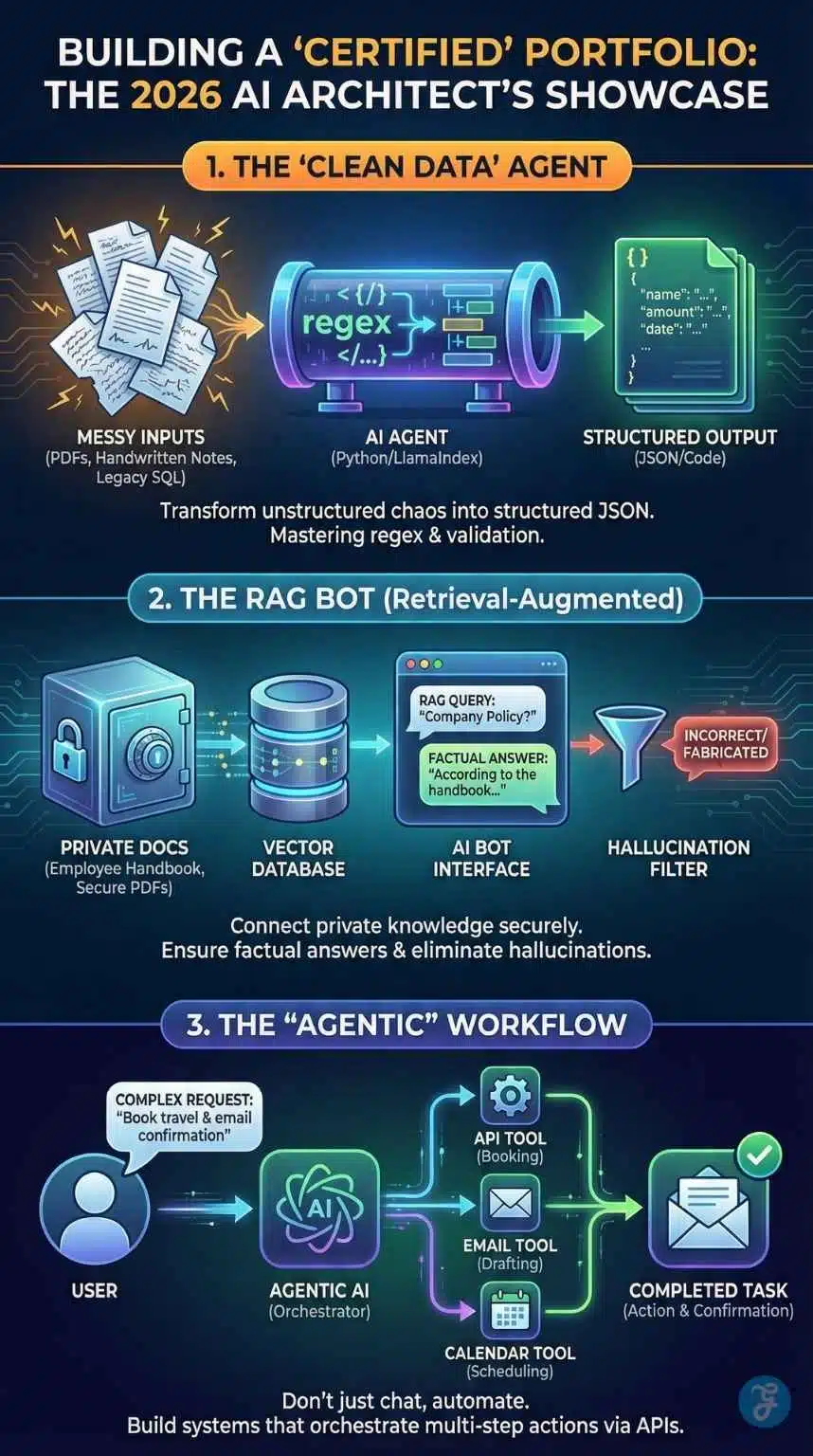
In 2026, a screenshot of a funny conversation with a chatbot is not a portfolio. Hiring managers at top tech firms like Google, Anthropic, and Salesforce want to see System Thinking. They want proof that you can build reliable, agentic workflows that solve boring, expensive business problems.
If you are applying for roles today, your GitHub or personal site must showcase these three specific projects:
1. The “Clean Data” Agent
- The Problem: Companies have messy data (PDFs, handwritten notes, legacy SQL).
- The Project: Build a Python-based script using LlamaIndex that takes a messy PDF invoice, extracts specific line items, and formats them into a perfect JSON object for an accounting system.
- Why it works: It demonstrates Structured Output mastery and regex validation skills—two of the most demanded skills in fintech.
2. The RAG (Retrieval-Augmented Generation) Bot
- The Problem: AI models don’t know company secrets.
- The Project: Create a customer support bot that answers questions only based on a specific “Employee Handbook” document you upload. Ensure it says “I don’t know” if the answer isn’t in the document.
- Why it works: This proves you understand Hallucination Control and Vector Databases (like Pinecone or Milvus).
3. The “Agentic” Workflow
- The Problem: Humans hate multi-step tasks.
- The Project: Build an agent that doesn’t just “talk” but “does.” For example, a travel agent bot that doesn’t just suggest a hotel but actually checks real-time availability via an API and drafts the booking email.
- Why it works: “Agentic AI” (AI that uses tools) is the defining trend of 2026.
The 2026 Toolkit: Essential Software for AI Engineers
A carpenter has a hammer; an AI Architect has a stack. If you walk into an interview and say you only use the “ChatGPT web interface,” you will likely be rejected. You need familiarity with the “IDE for Prompts.”
| Tool Category | The 2026 Industry Standard | Why You Need It |
| Orchestration Frameworks | LangChain / LangGraph | The “glue” code that connects prompts to data and APIs. |
| Data Frameworks | LlamaIndex | Essential for connecting AI to PDFs, Excel sheets, and SQL databases. |
| Prompt Management | PromptLayer / Helicone | Tools that track your prompt versions and costs (e.g., “Version 3 saved us $500”). |
| Evaluation (Evals) | Maxim AI / Ragas | Automated testing tools that grade your AI’s answers for accuracy before humans see them. |
| Playgrounds | OpenAI Playground / Anthropic Console | Where professional testing happens (setting Temperature, Top-P, and Stop Sequences). |
Career Outlook & Salary Trends [2026]
The job market has bifurcated. The role of “Prompt Writer” (freelance, low-skill) has largely disappeared, replaced by high-value technical roles.
- AI Content Strategist: $90,000 – $130,000
- Role: Managing the brand voice of AI agents and chatbots.
- AI Application Engineer: $140,000 – $220,000
- Role: Building the actual software pipelines that connect AI to users.
- AI Governance Officer: $120,000 – $180,000
- Role: Ensuring compliance and safety.
Salary Premium: Data shows that professionals with a recognized AI Certification earn, on average, 18-22% more than their non-certified counterparts in the same role.
Final Thought
The “Wild West” of AI is closed. We are now building the cities of the future. The question is no longer “Can you use AI?” It is “Can you build reliable systems with it?” Prompt Engineering Certifications in 2026 are your blueprint for answering “Yes.” Start with the foundation, choose your specialization, and position yourself as the architect of this new digital reality.