New Zealand’s energy landscape is undergoing its most aggressive transformation in decades. As of early 2026, the nation has shifted from being a hydro-dependent pioneer to a diversified renewable powerhouse, leveraging geothermal baseload and a record-breaking surge in utility-scale solar. With legislative targets now firmly anchored in the 2026-2030 emissions budget, the “New Zealand Renewable Energy Story” is no longer just about environmental stewardship—it is a blueprint for national energy security and economic resilience.
How We Selected Our 7 Best New Zealand Renewable Energy 2026 Facts
To identify the most impactful markers of this transition, we analyzed the March 12, 2026, Energy Quarterly release from the Ministry of Business, Innovation & Employment (MBIE) and the January 2026 amendments to the Second Emissions Reduction Plan (ERP2). Our selection criteria prioritized three key factors: measurable generation records, the commissioning of “weather-independent” baseload infrastructure, and the strategic rollout of the 2030 EV charging network. These seven facts represent the current reality of a grid that is arguably the cleanest in the OECD.
The following pillars define the state of New Zealand’s energy sector as it navigates the mid-2020s transition.
The 7 Most Essential Facts About New Zealand Renewable Energy 2026
Understanding the mechanics of New Zealand’s grid requires a look beyond simple percentages to the technologies and policies driving the 2026 surge.
1. The 96.4% Renewable Electricity Generation Record
In the quarter ending December 2025—with data officially released in March 2026—New Zealand achieved a record high of 96.4% of electricity generation from renewable sources. This milestone was driven by exceptionally favorable hydro conditions and a 70.4% year-on-year increase in solar output. This achievement effectively pushed natural gas-fired generation to its lowest quarterly level since 1980.
Best for: Investors and policymakers looking for empirical proof that a near-total renewable grid is achievable without compromising demand.
Why We Chose It:
-
It represents the highest quarterly renewable share in New Zealand’s recorded history.
-
It demonstrates the successful integration of new solar assets alongside traditional hydro.
-
It led to the lowest recorded quarterly emissions from electricity generation since 1990.
Things to consider: While 96.4% is a record, maintaining this level depends heavily on seasonal hydro inflows, which can vary year to year.
2. The Commissioning of the 49MW TOPP2 Geothermal Plant
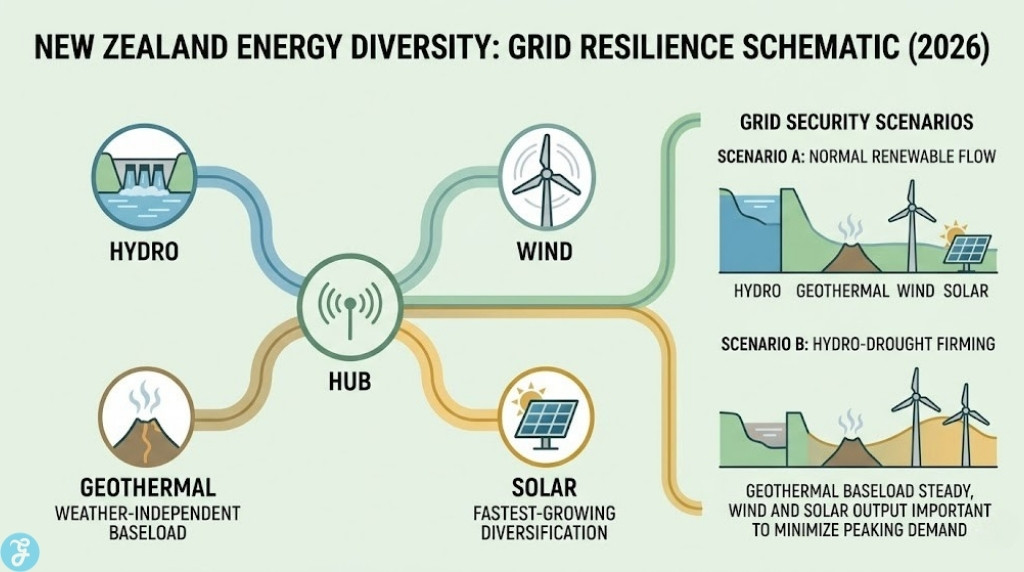
On March 20, 2026, the 49MW TOPP2 geothermal power plant was officially opened on the Kawerau Geothermal Reservoir. This project, a unique partnership between Eastland Generation and Ngāti Tūwharetoa Geothermal Assets, is capable of powering 55,000 homes. It highlights the growing role of iwi-led leadership in New Zealand’s renewable infrastructure.
Best for: Regional energy planners and community leaders interested in the “partnership model” for sustainable infrastructure.
Why We Chose It:
-
It provides critical baseload power that operates 24/7, independent of weather conditions.
-
It showcases successful indigenous commercial partnership and environmental stewardship.
-
It is the largest project completed in Eastland Generation’s current portfolio.
Things to consider: Geothermal resources must be managed carefully to ensure the long-term sustainability of the reservoir’s heat and pressure.
3. The $220 Million Ngā Tamariki Geothermal Expansion
March 2026 also saw the official opening of a new 55MW generation unit at the Ngā Tamariki Geothermal Station near Taupō. This expansion project, completed by Mercury Energy, lifts the station’s annual output to 1120GWh—enough to power all residential homes in Christchurch. The technology used here allows for the reinjection of non-condensable gases, significantly reducing carbon emissions.
Best for: Tech-focused energy analysts interested in the latest carbon reinjection and fifth-generation geothermal technology.
Why We Chose It:
-
It reflects the fastest rate of renewable generation development in New Zealand’s history.
-
The carbon reinjection system helps the station target a 70% reduction in emissions by 2030.
-
It adds significant stability to the national grid during winter peak demand periods.
Things to consider: The capital-intensive nature of these projects requires long-term regulatory certainty to attract continued investment.
4. The Solar Tipping Point and 1,100 MW Milestone
By early 2026, New Zealand’s total solar capacity reached over 1,100 MW. The completion of utility-scale projects like the Lauriston Solar Farm in late 2025 has shifted the country’s solar narrative from small-scale rooftop installations to massive grid-connected assets. Solar generation grew by over 70% in the last year, making it the fastest-growing sector in the energy mix.
Best for: Commercial developers and energy retailers looking for the next “growth frontier” in NZ energy.
Why We Chose It:
-
It marks the transition of solar from a “niche” supplement to a primary contributor.
-
Utility-scale solar provides a lower-cost alternative to traditional thermal firming.
-
It helps diversify the generation mix, providing power during summer hydro droughts.
Things to consider: Grid transmission upgrades are increasingly necessary to handle the influx of solar power from rural regions to urban centers.
5. The “100% by 2035” Statutory Framework
New Zealand remains legally committed to a 100% renewable electricity target by 2035. While the 2026 grid frequently operates above 90%, the final “5% challenge” is the current focus of the Second Emissions Reduction Plan (ERP2). This involves strategic “overbuilding” of wind and solar and the potential use of green hydrogen for long-term storage.
Best for: Long-term strategic planners and ESG (Environmental, Social, and Governance) investors.
Why We Chose It:
-
It provides the legislative “anchor” for all energy policy and investment in the country.
-
It mandates a move away from fossil fuel “peaker” plants that currently fill the gaps.
-
It aligns the energy sector with the 2050 Net Zero greenhouse gas goals.
Things to consider: Reaching the final few percent of a renewable grid is exponentially more expensive and requires advanced storage technology.
6. The January 2026 Amendment to ERP2
In January 2026, the New Zealand government released an amended Second Emissions Reduction Plan (ERP2) for the 2026–2030 period. This updated plan emphasizes a “market- and technology-led” approach. It formally moved the country into Emissions Budget 2 (EB2) and added new sections on technology innovation and construction decarbonization.
Best for: Business owners and industrial energy users who need to align their 5-year plans with national climate policy.
Why We Chose It:
-
It sets the specific “rules of engagement” for the 2026–2030 emissions period.
-
It focuses on reducing the cost of mitigation while maintaining energy security.
-
It incorporates a revised approach to agricultural emissions and biogenic methane.
Things to consider: The shift toward technology-led decarbonization requires significant private sector co-investment to be successful.
7. The 10,000-Charger “EV Highway” Surge
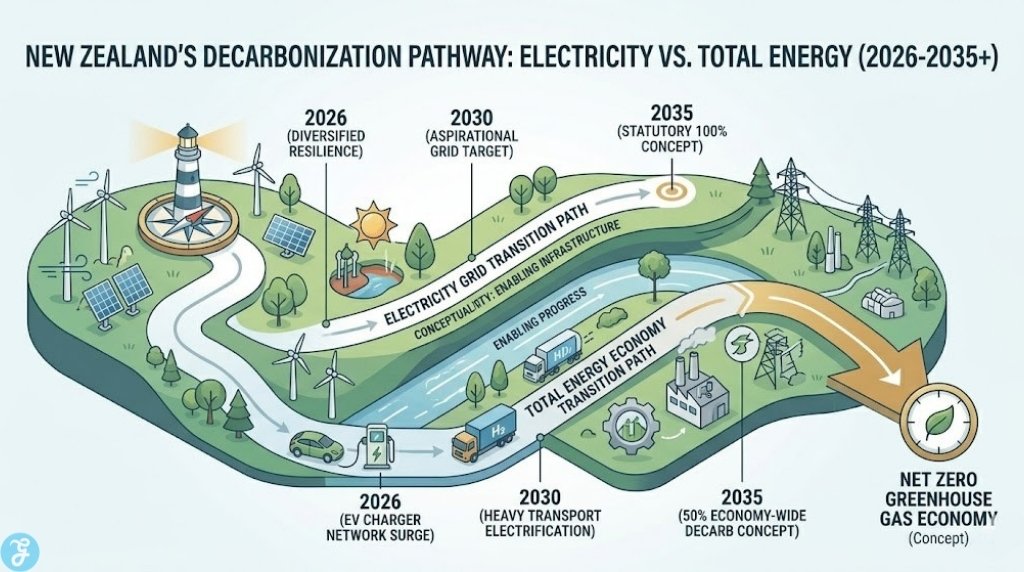
To support the transition of the transport sector, the New Zealand government announced a NZ$52.7 million loan initiative in March 2026 to more than double the country’s EV charging network. The goal is to reach 10,000 public chargers by 2030. This infrastructure is vital as transport still accounts for a large portion of New Zealand’s total energy (non-electricity) consumption.
Best for: Logistics companies, fleet managers, and EV owners planning long-distance travel.
Why We Chose It:
-
It addresses the “range anxiety” that has historically limited EV adoption in rural NZ.
-
It links the renewable electricity grid directly to the decarbonization of the transport sector.
-
It includes smart-charging standards to protect grid stability during peak hours.
Things to consider: Increasing EV demand will require “smart” grid management to avoid localized outages in older residential neighborhoods.
The 2026 New Zealand Energy Mix Comparison
To understand where New Zealand stands today, it is essential to look at the contribution of each energy source. The 2026 landscape is defined by the decline of gas and the rise of geothermal and solar.
The table below outlines the estimated contributions to the national grid based on the latest 2026 quarterly data.
| Energy Source | Estimated Share (2026) | 2-Year Growth Trend |
| Hydro | ~57.0% | Stable / Weather Dependent |
| Geothermal | ~26.5% | High (Driven by TOPP2/Mercury) |
| Wind | ~7.5% | Moderate (Steady Pipeline) |
| Solar | ~1.5% | Exponential (70%+ Growth) |
| Natural Gas | ~7.0% | Rapid Decline (Lowest since 1980) |
| Coal / Other | ~0.5% | Minimal / Emergency Only |
Our Top 3 Picks and Why?
Of the seven facts discussed, the 96.4% Generation Record, the TOPP2/Ngā Tamariki Geothermal Commissioning, and the 10,000-Charger Infrastructure Goal are the most critical. The 96.4% record proves the system’s potential, the geothermal expansions provide the “weather-independent” spine that makes such a record sustainable, and the charger rollout ensures that this clean electricity is actually used to replace oil in the transport sector. Together, these three elements turn a “clean grid” into a “clean economy.”
For businesses and individuals in New Zealand, the 2026 transition requires a proactive approach to energy procurement and technology adoption.
The Selection Framework:
-
Identify Baseload Needs: For high-uptime industries, geothermal-backed contracts are now more reliable than wind-only options.
-
Audit Transport Energy: With 10,000 chargers coming, 2026 is the strategic year to begin full-scale fleet electrification.
-
Utilize ERP2 Incentives: Check for new technology and innovation grants under the amended January 2026 plan.
Decision Matrix (Table):
The matrix below helps determine the best renewable energy strategy based on your 2026 goals.
| If your primary goal is… | Then your 2026 strategy should be… |
| Maximum Cost Reduction | Invest in On-site Solar (Rapidly falling hardware costs). |
| 24/7 Energy Security | Secure Geothermal-backed PPAs (Power Purchase Agreements). |
| Decarbonizing Logistics | Transition to Electric Fleets (Utilizing the new charger network). |
Final Audit: 5-point Checklist for NZ Energy Readiness
-
Have you reviewed the January 2026 ERP2 Addendum for relevant industry changes?
-
Is your business utilizing Smart Charging for its EV fleet to save on peak rates?
-
Have you checked the latest Transpower Grid Maps for local solar connection capacity?
-
Are your energy contracts aligned with 100% Renewable verification standards?
-
Have you evaluated the Cost-Benefit of On-site Battery Storage to complement solar?
The Future of Aotearoa’s Energy Landscape
As New Zealand moves deeper into 2026, the conversation is shifting from whether a renewable future is possible to how quickly we can scale it. The record-setting 96.4% renewable generation and the launch of massive geothermal assets like TOPP2 and Ngā Tamariki expansion prove that the infrastructure is ready. The challenge for the remainder of the decade lies in the “Total Energy” gap—ensuring that our transport and industrial heat sectors can tap into this clean grid. With a statutory target of 100% by 2035, New Zealand is not just participating in the global energy transition; it is leading it.
Frequently Asked Questions (FAQ)
Is New Zealand’s electricity really 100% renewable in 2026?
Not yet, but it is close. In Q4 2025 and Q1 2026, the grid hit peaks of 96.4%. On average, it fluctuates between 85% and 95% depending on rainfall. The goal is to reach a consistent 100% by 2035.
What happens if there is a dry year and the hydro lakes are low?
This is where geothermal energy and the “overbuilding” of wind and solar come in. Geothermal provides a steady 26% baseload that doesn’t depend on rain. In 2026, natural gas is still used as a “peaker” backup, though its use is declining rapidly.
Why is geothermal called “the new baseload” in New Zealand?
Geothermal is unique because it generates power 24/7, regardless of wind, sun, or rain. With the new TOPP2 and Ngā Tamariki units online in 2026, geothermal is now the primary source of “firm” renewable power that keeps the grid stable.
Can I get a subsidy for solar panels in New Zealand in 2026?
While direct federal subsidies for residential solar are limited, many banks now offer “Green Loans” with 0% or very low interest for solar and battery installations. Additionally, the falling cost of hardware in 2026 makes the “payback period” shorter than ever.
What is the significance of the 10,000 charger goal?
Electricity is clean in NZ, but transport is still mostly powered by oil. The 10,000 charger goal ensures that anyone in New Zealand can switch to an EV without fear of running out of power, which is essential for reaching the 2050 Net Zero target.