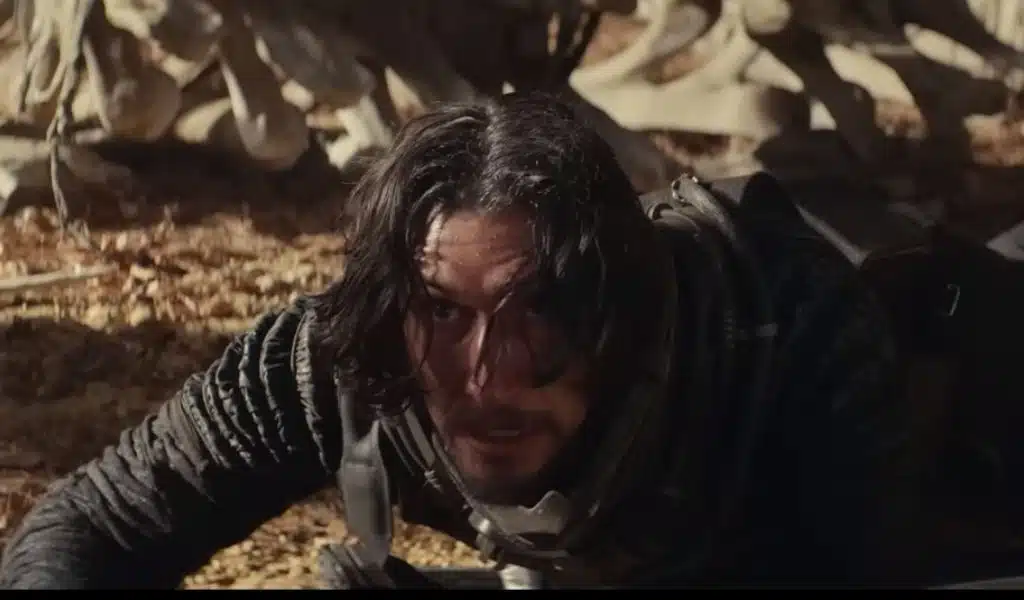
65 certainly passed by quietly for a movie about Adam Driver battling dinosaurs. The sci-fi survival movie, written by Scott Beck and Bryan Woods, was released in theaters in March but was quickly eclipsed by coverage of the Academy Awards.
But now that the film is available on Netflix, brand-new viewers will quickly learn what the small number of theatergoers already knew: 65 presents a distinctive world that perfectly combines analog and modern technologies.
Each franchise director ought to watch this movie: It’s a how-to manual with a distinct vision for creating a real world reminiscent of classic science fiction, but with all the advantages of contemporary technology. The way in which technology is shown in 65 should set the bar for future production designers because, unlike so many of its contemporaries, it borrows equally from all eras of Hollywood science fiction.
Our perception of the future has changed over the past century as a result of developments in physical and digital impacts. The retrofuturism of Star Trek and Star Trek: The Next Generation is completely at odds with everything in the Kelvin universe films set in the Star Trek world. Similar to this, the Star Wars prequels’ production design makes extensive use of green screen technology to insert new characters and settings into a galaxy that has already been practically constructed. This creates a visual disconnect that contemporary Star Wars shows like The Mandalorian and Andor are still attempting to bridge.
Given that both Prometheus and Alien were directed by Ridley Scott, this contrast between the two films may be the most obvious. Despite the fact that the latter is meant to take place nearly 30 years before Scott’s groundbreaking sci-fi horror movie, the anachronisms brought about by 40 years of VFX advancements are only mildly funny.
So how do directors revisit established properties in the age of IP while also paying homage to the technological innovations of movies launched decades ago? Retrofuturism, a design framework that broadens the reach of futurism on screen by reclaiming design concepts from outdated futuristic ideals, is the solution for many producers.
Retrofuturism takes its cues from historical predictions of the future, particularly from the American Atomic Age, in contrast to traditional futurism, which makes predictions about future technology based on present trends. The analog technology that would be produced if you filmed a contemporary film in the Atomic-era style—reclaiming 1950s science fiction like Forbidden Planet or This Island Earth—would be retrofuturistic design ideas at work.
Retrofuturism can be employed to give movies a lived-in feel in the hands of a skilled production crew, demonstrating that rather than evolving, the future is, for better or worse, a reflection of current contemporary concerns. Pedro Pascal’s internet fandom helped Prospect, a movie by Zeek Earl and Chris Caldwell set in a realistic future for humanity, to gain new viewers. The best science fiction set designs from the 1970s are combined with modern special effects in Duncan Jones’ Moon.
There are still movies that capitalize on the limitless potential of the space race, even though modern retrofuturism is sometimes used to comment on the broken promise of post-war optimism in America – there are no flying automobiles and no robot butlers in retrofuturist civilizations. Both Cargo by Arati Kadav and Space Station 76 by Jack Plotnick encourage us to place our faith in people rather than technology and discover warmth where other science fiction works do not.
But these movies also emphasize the underlying division in Hollywood futurism by embracing our past. Movies that strive to combine both — with production aesthetics that look for the best in both analog and digital visions of the future — are few and far between. Filmmakers can choose to look to our history or anticipate a more advanced tomorrow. That is what makes 65 such an intriguing example of world-building on film.
Set 65 million years in the past, 65 distinguishes itself from its contemporaries. The long-haul trucker of the galaxy 65, played by Adam Driver, lives in a world that is very similar to our own. He explains in the first few minutes of the movie that the sole reason he’s taking this specific delivery job is to get some much-needed assistance with his daughter’s medical expenses.
However, in a novel with so little context and conversation, the way technology is presented becomes more significant than it otherwise would. The architecture of Mills’ ship and its machinery must feel both futuristic and antiquated at the same time in order to reflect an interplanetary civilisation where access to inexpensive healthcare is still the stuff of science fiction.
Therefore, there are legitimate narrative reasons why 1965 technology blends futuristic and retrofuturistic elements equally. It shouldn’t be surprising to hear that Kevin Ishioka, a production designer, has a solid foundation in science fiction. Ishioka has worked as the art director on movies like Oblivion, James Cameron‘s Avatar, and The Chronicles of Riddick, helping to create futuristic worlds that range from clean to unkempt. His team creates tools and equipment in 65 that combine the known and the unknown.
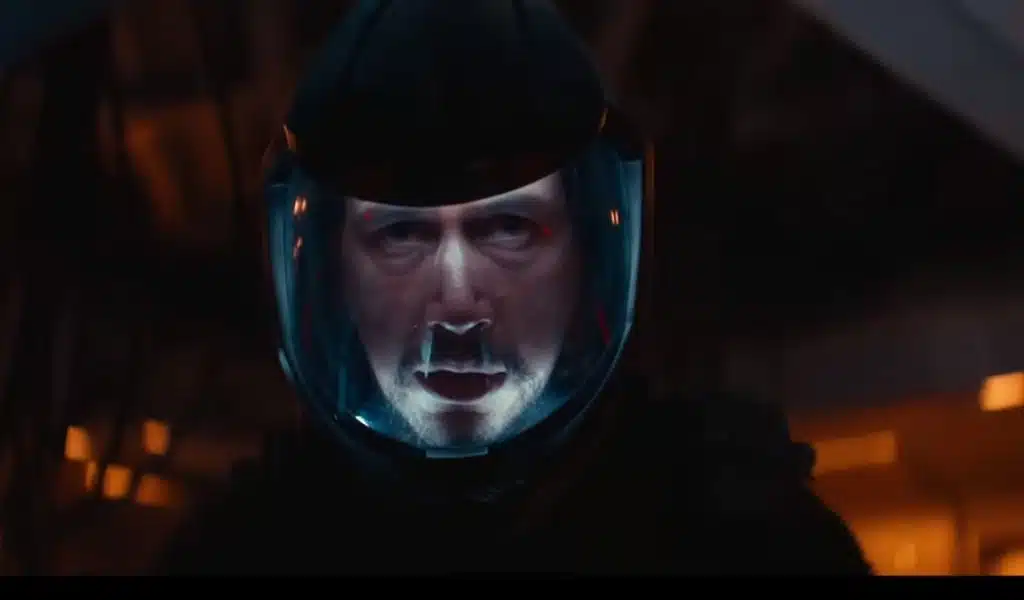
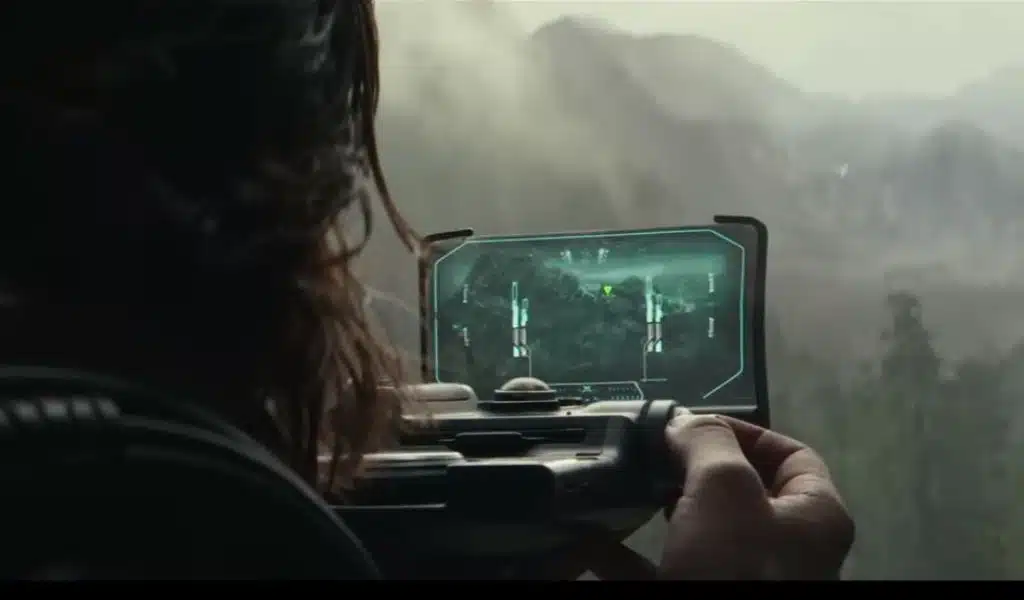
Everywhere you look, you may find these small details. The movie blends a digital touchscreen with boxy buttons and a mouthpiece the size of a phone when Mills records an emergency message. The end product is a dashboard that is really haptic and seems futuristic. Driver’s performance combines a digital touchscreen and voice-over from the ship’s artificial intelligence with the analog action we might anticipate from a ’70s or ’80s movie—an actor controlling a real prop. 65 has a remarkably ageless aspect due to this fusion of today and future.
The small scanner Mills uses to chart his route across the valley is the greatest illustration. The scanner resembles a displaced Star Trek character in terms of size and shape. In one scene, Mills is forced to decide between holding his weapon and the scanner because he cannot handle both at once. However, as soon as the equipment is turned on, it takes on a life of its own. The first time Mills turns it on, the physical screen is clearly smeared with grime, but it also features a holographic display and sophisticated 3D environmental rendering. The latter is really creative. When Mills’ equipment clatters on a cave floor, one of the best human-dinosaur battles in the movie takes place almost entirely as a digital projection.
Then there are production components that have nothing to do with any science fiction era. While Mills’ slide projector’s pixelated screen brings to mind low-budget hacker flicks from the 1980s, the actual hardware is a replica of the carousel slide projectors that were once commonplace in classrooms across the nation. The dining hall’s tier-style glass cases, which house the handwritten letters between Mills and his unintentional ward Koa (Ariana Greenblatt) about their trip to the mountains, are reminiscent of the automats that were popular in early 20th-century New York City. These aesthetic decisions give off a hazy impression of anachronism, which only serves to highlight the film’s singularity.
The use of technology in 65 is impressive, whether it is regarded as a subtle classic or just another streaming application. The movie successfully connects the past and present, guaranteeing that viewers in the future would recognize a portion of their world in the film. I hope Hollywood looks beyond the box office and takes the proper lessons from the production crew as there are presently no plans for a sequel or prequel any time soon. The model for preserving science fiction in the midst of the special effects industry’s rapid change is found in 65.