The Iran Mosaic Defense doctrine has fundamentally altered the calculus of modern warfare in the Middle East following the recent barrage of Western airstrikes. When American and Israeli forces launched Operation Epic Fury in 28th February 2026, the explicit goal was to shatter the Iranian political and military establishment. Planners in Washington and Jerusalem envisioned a swift collapse of the clerical system. They believed that decapitating the leadership would send shockwaves through the nation and fracture the regime from within. Instead, the skies over Tehran rained fire, and the exact opposite occurred.
The nation did not splinter. It united. This profound misjudgment stems from a failure to comprehend the deep cultural resilience and the decentralized military architecture that Iran has spent decades perfecting. The world is now witnessing a monumental geopolitical shift that will reshape global security protocols for a generation.
To grasp why these massive military operations have failed to achieve their primary objectives, we must look closely at the underlying military framework governing the nation.
Unpacking the Iran Mosaic Defense Doctrine and Its Impact
The strategic reality on the ground has proven that traditional warfare models are insufficient when dealing with a heavily decentralized adversary. This system relies on localized autonomy and shared ideological commitment to survive overwhelming external pressure. The events of the past few weeks provide a stark lesson in how this defensive strategy operates in real time.
The Catalyst of Operation Epic Fury
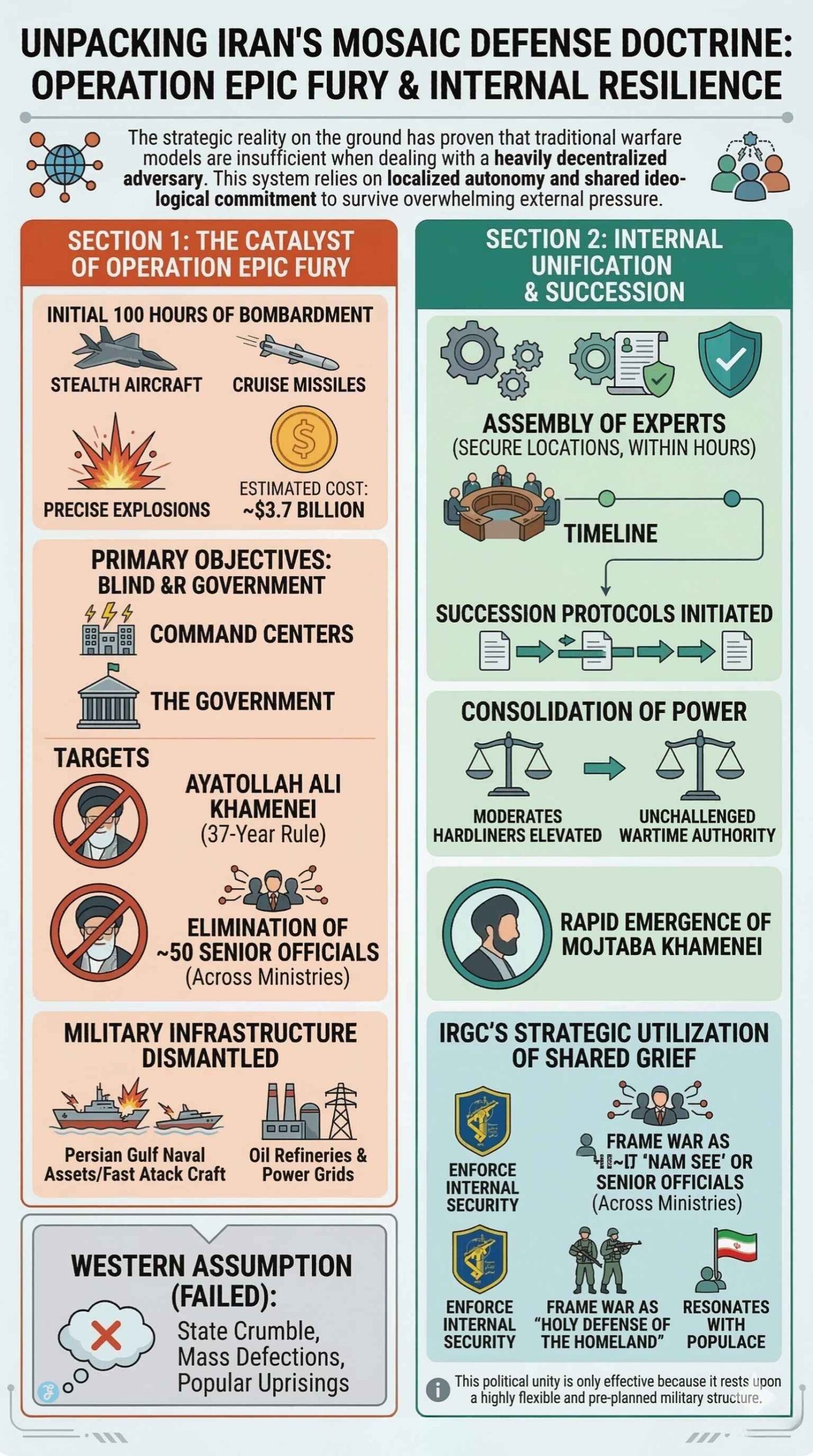
The sheer scale of Operation Epic Fury was designed to be paralyzing. Over the course of the initial 100 hours of bombardment, coalition forces utilized a staggering array of stealth aircraft, cruise missiles, and precision-guided munitions. The financial toll of this opening salvo alone is estimated at nearly 3.7 billion dollars. The targets were carefully selected to blind the military and silence the government. Missiles struck key command centers in Tehran.
They successfully assassinated Supreme Leader Ayatollah Ali Khamenei, who had ruled the country for 37 years. The strikes also eliminated approximately 50 other senior Iranian officials across various ministries. The sheer volume of firepower was unprecedented in modern regional conflicts. Moving beyond the political leadership, the operation also focused heavily on crippling physical assets.
The Systematic Targeting of Military Infrastructure
Beyond the political leadership, the operation systematically dismantled critical military infrastructure. Naval assets in the Persian Gulf were heavily targeted to neutralize the threat of fast attack craft, with over 50 Iranian vessels damaged or destroyed in the opening days. Power grids and specific industrial sites were bombed to cripple the domestic economy.
Interestingly, major energy hubs like Kharg Island have remained untouched, suggesting a calculated effort to avoid a total collapse of the global oil supply. Western intelligence agencies operated under the assumption that such a concentrated loss of leadership and infrastructure would cause the entire state apparatus to crumble into chaos.
They anticipated mass defections within the armed forces and popular uprisings in the streets. However, this assessment completely underestimated the systemic redundancies built into the government. The physical destruction of leadership buildings immediately triggered a complex political reaction across the country.
The Succession Crisis and Internal Unification
Rather than plunging the nation into a chaotic void, the decapitation strike activated a highly choreographed political defense mechanism. The Islamic Republic possesses flexible constitutional contingencies designed specifically for catastrophic scenarios. Within hours of the confirmed assassination, the Assembly of Experts convened in secure, undisclosed locations. They swiftly initiated succession protocols to ensure the continuity of government.
The crisis effectively silenced any moderate or reformist factions that had been advocating for diplomatic engagement with the West. The atmosphere of national emergency elevated hardliners, giving them unchallenged authority to dictate the state’s response. This swift consolidation of power paved the way for new leadership to take the helm.
The Rapid Emergence of Mojtaba Khamenei
Mojtaba Khamenei, the son of the late Supreme Leader, rapidly emerged as the central figure of this new unified front. His elevation represents a symbol of unbroken continuity amid the wartime chaos. However, his elevation has been clouded by recent intelligence suggesting he was critically wounded in the strikes and is currently receiving intensive care. Regardless, the Islamic Revolutionary Guard Corps seized upon the shared national grief, transforming it into a potent political tool.
They are strictly enforcing internal security while framing the war not merely as a battle for regime survival, but as a holy defense of the sovereign homeland against imperialist aggression. This narrative resonates deeply with a population historically wary of foreign intervention, uniting disparate civilian groups under a single cause. This political unity is only effective because it rests upon a highly flexible and pre-planned military structure.
Standout Features of the Decentralized Command
The core strength of the Iranian military response lies in its deliberate departure from traditional, top-down command hierarchies. Following the rapid and catastrophic collapse of highly centralized governments in Iraq and Libya during previous Western interventions, Iranian military planners completely overhauled their defensive architecture.
They adopted a concept of distributed power. This structure distributes authority across multiple regional and semi-independent layers. It involves a complex web of the Islamic Revolutionary Guard Corps, regular army units, and localized mobilization forces known as the Basij. This overarching philosophy is supported by several distinct operational pillars.
Key Structural Elements of the Defense Network
This specific organizational design neutralizes the effectiveness of decapitation strikes through several key structural elements. Autonomous Regional Commands divide the country into distinct geographic sectors, each with its own self-sufficient military infrastructure. Independent Arsenals ensure that missile caches and drone deployment facilities are scattered and hidden in deeply fortified subterranean bases, meaning no single strike can deplete their offensive capabilities.
Delegated Authority dictates that if the central leadership in Tehran is eliminated or communication lines are severed, local commanders have the pre-authorized mandate to continue operations independently. Finally, an Asymmetric Focus relies heavily on cost-effective, high-impact weapons like swarm drones and ballistic missiles rather than expensive conventional air forces.
The military does not rely on a single brain to function, but operates like a network of independent cells that instinctively react when the larger body is threatened. The practical application of this decentralized command has resulted in a furious and widespread counterattack.
Unprecedented Regional Retaliation Tactics
The theoretical resilience of this decentralized structure has now manifested in a highly active, lethal, and widespread counteroffensive. Iran’s response has proven beyond a doubt that its operational capabilities remain largely intact despite the historical magnitude of Operation Epic Fury. Tehran has launched thousands of ballistic missiles and suicide drones targeting American and Israeli military installations across the Persian Gulf and the broader Middle East.
These retaliatory strikes are not random. They are precisely coordinated efforts by regional commanders to inflict maximum pain on coalition forces, utilizing advanced targeting systems to bypass traditional defense measures. The sheer volume of these strikes covers an immense geographic footprint.
The Massive Geographical Spread of the Counteroffensive
The geographical spread of the retaliation is immense. Missile barrages have successfully penetrated air defense systems, hitting bases in Bahrain, Qatar, Oman, and the United Arab Emirates. The human cost of these counterstrikes is steadily mounting. While initial reports claimed American casualties at Port Shuaiba, recent updates confirm that drones targeted Kuwait International Airport, resulting in material damage but zero casualties.
Furthermore, Iran has expanded its targeting parameters to include critical economic and maritime chokepoints. By harassing commercial shipping and threatening to mine the Strait of Hormuz, they are successfully stifling global oil and gas exports. The scale of this pushback reaches even further into allied networks.
Mobilizing the Axis of Resistance Across Borders
This defensive doctrine extends far beyond the physical borders of the nation. It deeply integrates a vast network of allied militia groups across the Middle East. When the leadership in Tehran was struck, these proxy forces immediately activated their own localized offensive operations. Hezbollah in Lebanon launched heavy rocket barrages into northern Israel.
Houthi forces in Yemen escalated their blockade of the Red Sea by launching anti-ship ballistic missiles at commercial and military vessels. Iraqi and Syrian militias simultaneously intensified their ground assaults on remote American outposts. This coordinated regional uprising forces the Western coalition to fight a multi-front war. It stretches their military resources thin and complicates any focused tactical objectives. The retaliation also extends deeply into the digital realm.
Launching an Asymmetric Cyber Counter-Offensive
Physical missiles represent only one component of the retaliatory framework. The Islamic Revolutionary Guard Corps possesses a highly sophisticated cyber warfare division that operates with complete autonomy. In the hours following the initial airstrikes, Western intelligence agencies detected massive distributed denial of service attacks targeting critical financial and utility sectors in the United States and Europe.
State-sponsored hackers infiltrated municipal water systems and disrupted major hospital networks. This invisible front line is explicitly designed to inflict immediate domestic pain on the populations of the attacking nations. By bringing the cost of the war directly to Western civilians, Tehran aims to fracture the political will required to sustain a long military campaign overseas. Observing this fierce and multi-layered retaliation forces a critical reevaluation of the initial decision to strike.
The Strategic Miscalculation by Western Powers
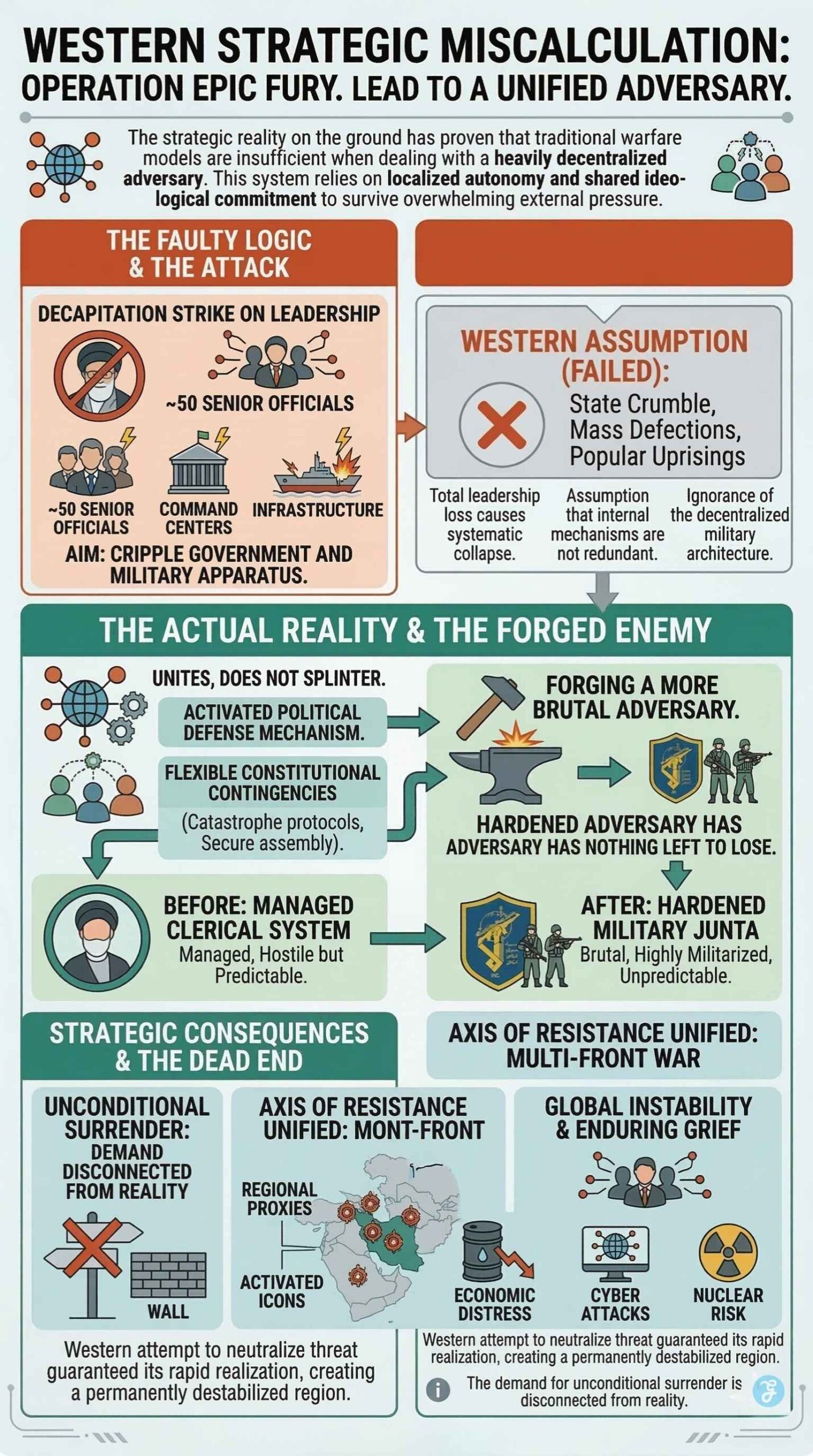
Analysts are increasingly pointing out that the entire Western strategy was built upon a fatally flawed foundation. The United States and Israel projected their own vulnerabilities onto their adversary, assuming that eliminating the top tier of leadership would automatically result in institutional paralysis. Experts argue this reflects a profound and dangerous ignorance of the Iranian state structure.
By launching overwhelming airstrikes and eliminating the Supreme Leader, the West inadvertently validated the regime’s long-standing domestic narrative. For decades, the clerical establishment has warned its citizens that Western powers seek nothing less than the total destruction of the Iranian nation. Operation Epic Fury provided undeniable proof to support that claim. This fundamentally flawed approach carries a massive strategic risk moving forward.
The Strategic Risk of Forging a Hardened Adversary
This approach carries a massive strategic risk. Planners aimed to remove a managed clerical system that, while hostile, operated with a certain degree of predictable statecraft. Instead, the airstrikes are forging a brutal, highly militarized, and unpredictable junta led directly by the Islamic Revolutionary Guard Corps. This hardened adversary has nothing left to lose and no incentive to negotiate.
The current Western demand for unconditional surrender is entirely disconnected from the reality on the ground. It guarantees a prolonged, bloody, and asymmetrical war of attrition that coalition forces are poorly positioned to win. This intense escalation inevitably leads to the most dangerous geopolitical consequence of the entire conflict.
Accelerating the Nuclear Breakout Timeline
The most alarming consequence of the airstrikes is the rapid shift in the nation’s nuclear calculus. Prior to the attack, intelligence assessments suggested Tehran was maintaining a threshold status without actively assembling a warhead. The decapitation strikes completely erased any strategic benefit to nuclear restraint. Hardliners in the new leadership structure now argue that only a verifiable nuclear deterrent can prevent future foreign military interventions.
Enrichment facilities buried deep within the Zagros Mountains largely survived the initial bombardment and have reportedly accelerated uranium enrichment to weapons-grade levels. The Western attempt to neutralize the nuclear threat through conventional bombing has ironically guaranteed its rapid realization. Looking ahead requires an honest assessment of the fallout from these profound strategic errors.
Things To Consider for Long-Term Geopolitical Stability
The final analysis of this conflict must look far beyond the immediate tactical exchanges of missiles and drones. The global consequences of this miscalculation will be felt for decades. We are already witnessing a rapid depletion of global munitions stockpiles.
The defense industrial bases in the United States and Europe are struggling to manufacture advanced interceptor missiles at the rate they are being consumed in the Middle East. This leaves Western powers vulnerable to other global threats, stretching their defense capabilities to the absolute breaking point. The financial impacts are equally devastating.
The Severe Economic Ramifications and Global Impact
Furthermore, the economic ramifications are severe. An extended military operation lasting months rather than weeks will continue to send global energy markets into absolute turmoil. The cost of crude oil has skyrocketed, threatening to trigger a severe global recession. Ultimately, the idea that foreign powers can impose a new, friendly leadership structure from the outside through military force has been thoroughly discredited.
The legacy of Operation Epic Fury will likely be the creation of a permanently destabilized region, perpetually hostile to Western interests, and unified by a deep, enduring grief. This enduring reality will shape foreign policy for the foreseeable future.
Finally: The Enduring Legacy of a Unified Resistance
The reliance on decapitation strikes has proven to be a catastrophic miscalculation by Western military strategists. By misunderstanding the deep resilience of their adversary, the coalition ignited a firestorm that conventional weapons cannot extinguish. The decentralized military framework ensured that the sudden loss of top leadership catalyzed fierce national unity instead of systemic collapse.
This misstep unleashed a multi-front war across the Middle East and pushed the global economy toward recession. Western powers are now trapped in an unwinnable war of attrition against a newly hardened military junta. The ultimate tragedy of this intervention is that it forged the exact enemy it sought to destroy. The world must now navigate a reshaped geopolitical landscape where the resistance is bolder and more unified than ever before.