

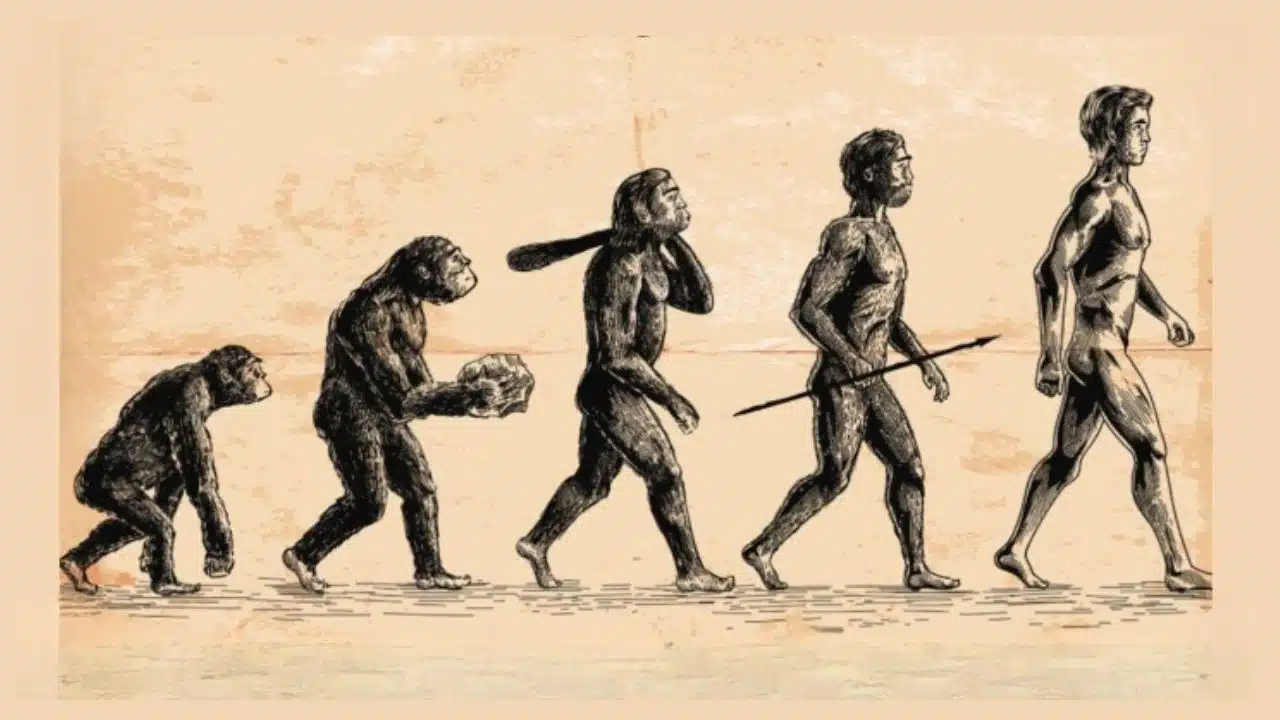
The Evolution of Human Walking: How Humans Learned to Walk

The Evolution of Human Walking

For a long time, evolutionary biologists have speculated that walking upright preceded the growth of larger brains in primates. The rationale behind this theory was that the ability to walk on two legs freed up our ancestors’ hands for tool use. This idea was introduced by Charles Darwin, the pioneer of modern evolutionary biology, and has persisted over the years.

Karl Ernst von Baer, a prominent scientist in the early 19th century and a founder of embryology, confidently stated in 1828 that walking upright was a consequence of a more developed brain.

However, a recent study published in Science Advances in 2022 challenges this traditional notion. After observing wild chimpanzees in Tanzania, researchers propose that our early human ancestors might have adopted bipedalism not primarily to use tools but to navigate through tree branches.

This novel perspective completely contradicts the Savanna Hypothesis, the previous belief that bipedalism evolved as our ancestors left trees’ safety to roam the grassy savannas of ancient Africa.

Related Read: Scientist Discovers New Structure in Earth’s Inner Core 

According to study co-author Alexander Piel, the shift from forests to open savanna habitats around five million years ago wasn’t the driving force behind bipedal evolution. Instead, trees likely remained crucial, and the search for food-producing trees might have influenced the development of this trait.

Piel and fellow anthropologists conducted the first comprehensive study to scrutinize the Savanna Hypothesis. They closely observed a specific group of chimpanzees called the Issa, who inhabit the savanna-like Issa Valley in western Tanzania. This region reflects the landscape our early human ancestors would have encountered, featuring open savannas and densely packed forests.

Contrary to expectations, the researchers found that the Issa chimpanzees spent as much time in trees as chimpanzees living in dense forests. Despite their more open habitat, the Issa chimps didn’t exhibit significantly more terrestrial behavior.

Over 15 months, the team observed 13 adult chimpanzees and documented their movements, comparing the data with other research. The outcome of their study revealed that the presence of trees did not dictate the amount of time chimps spent on the ground.

While this new theory still requires further rigorous testing, it introduces a captivating perspective on how early human ancestors might have developed. It marks a new chapter in our quest to understand our shared history, shedding light on the complex evolution of bipedalism among primates.



Subscribe to Our Newsletter

Related Articles

Top Trending

How to Teach Letters to Kids
8 Ways to Teach Letters to Kids Who Hate Sitting Still
Alphabet Magic vs 123 Magic Number Fun
Alphabet Magic vs 123 Magic Number Fun: Which Skill Does Each App Actually Target?
How to Promote a Blog Post After Publish
10 Best Ways to Promote a Blog Post After Hitting Publish
How to Help a Child Who Refuses to Count Aloud
Articleify 7th anniversary
Happy 7th Anniversary of ArticleIFY: The Journey from a Small Room to Global Horizons

Technology & AI

SEO Agency vs In-House SEO vs Freelancer
SEO Agency vs In-House SEO vs Freelancer: A Decision Framework for Small Teams
ImagineLab Voice Lab vs Murf AI
ImagineLab Voice Lab vs Murf AI: I Tried Multilingual Narration from the Same Script
Best Document Collaboration Tools
10 Best Online Document Collaboration Tools for Teams
Important Signs When Should Raise Prices on Your SaaS
10 Signs It's Time to Raise Prices on Your SaaS
Nostalgia economy
The Nostalgia Economy Is Selling Us a Past We Never Lived

GAMING

Intentional Screen Time
How to Spend Your Screen Time More Intentionally
Complete Guide on Game Programgeeks
Game Programgeeks: A Complete Guide on PC, Game Dev, and Tech
Online Color Game Philippines
Online Color Game Philippines: What Every Beginner Should Know Before Playing
Ways to Reduce Game Development Costs
12 Ways Studios Cut Game Development Costs
NFT game development cost
How Much Does NFT Game Development Cost? A Realistic Budget Breakdown

Business & Marketing

Email Marketing Agency vs DIY Platform
Email Marketing Agency vs DIY Platform: When Outside Help Adds Value
Critical Path Method
The Critical Path Method Explained in Plain English
Time to Value: How SaaS Teams Can Reach Results Faster
How to Onboard New Team Members With a Self-Serve Wiki
How to Document Team Processes for Better Teamwork

EdTech & E-Learning

How to Teach Letters to Kids
8 Ways to Teach Letters to Kids Who Hate Sitting Still
Alphabet Magic vs 123 Magic Number Fun
Alphabet Magic vs 123 Magic Number Fun: Which Skill Does Each App Actually Target?
Alphabet Magic vs ABC Kids: Which Offers Clearer Letter Practice
Alphabet Magic vs ABC Kids: Which Gives Clearer Uppercase and Lowercase Practice?
Alphabet Magic vs LetterSchool comparison review
Alphabet Magic vs LetterSchool: Letter-Tracing Accuracy on the Same Letters [A Hands-on Review]
Alphabet Magic Trace and Phonics vs Teach Your Monster to Read
Alphabet Magic Trace and Phonics vs Teach Your Monster to Read: Which Is Best?

Software & Apps

Best Document Collaboration Tools
10 Best Online Document Collaboration Tools for Teams
Important Signs When Should Raise Prices on Your SaaS
10 Signs It's Time to Raise Prices on Your SaaS
Best CRM Tools for Small Marketing Teams
10 CRM Tools for Small Marketing Teams Worth Using
SaaS partnership tools
10 Best Tools for Managing SaaS Partnerships and Integrations
White-Label SaaS Platform to Resell
8 Best White-Label SaaS Platforms to Resell



















