

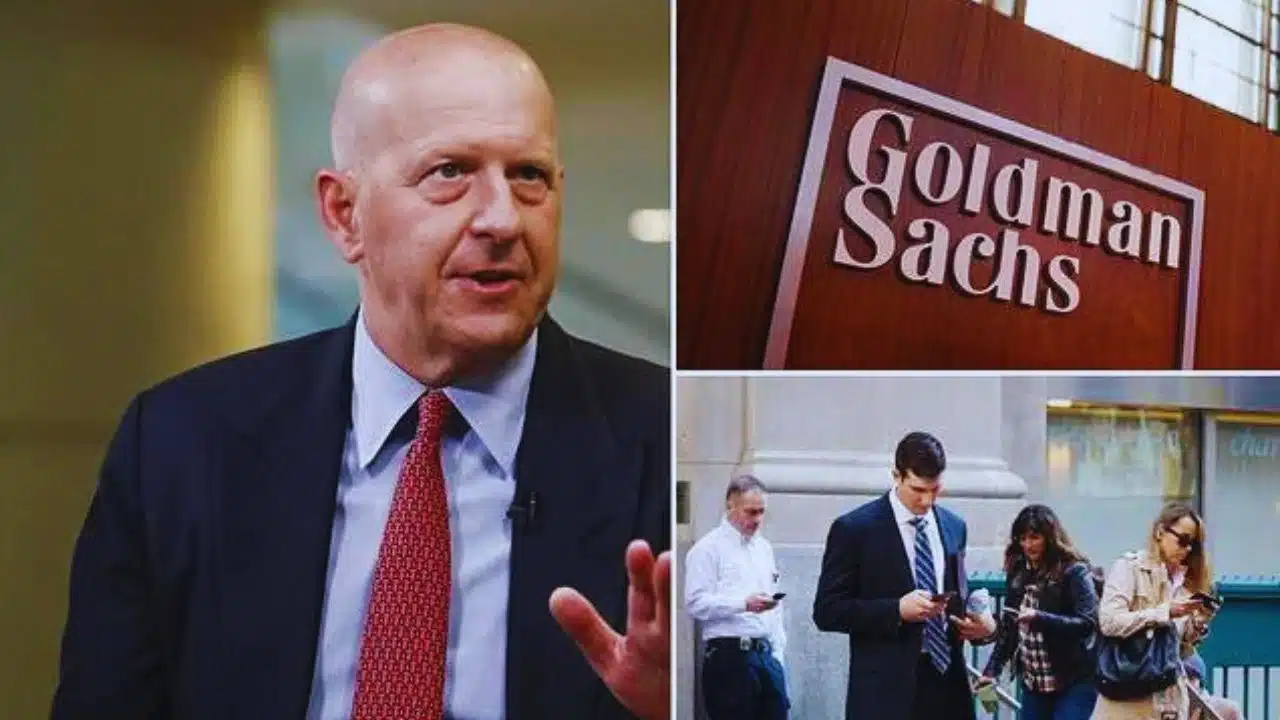
Wall Street’s premier investment bank is on a roll. Goldman Sachs just reported first-quarter results that absolutely crushed analyst expectations, sending its stock soaring.
The New York-based firm posted net earnings of $3.46 billion, or $12.03 per share, for the three months ending March 31st.
That represents a 28% jump in profitability compared to the same period a year ago. And it significantly exceeded the $9.79 per share that Wall Street analysts had been projecting.
So what’s behind Goldman’s outsized performance? Here is what you need to know about Goldman Sachs and its recent success.
Goldman Sachs Surges on Strong Investment Banking Performance
Goldman Sachs reported a 28% increase in first-quarter profit, primarily due to strength in its investment banking division. Goldman’s revenue was reported to be around $14.21 billion, beating estimates of $12.98 billion.
Plus, the company has adjusted the EPS (earnings per share) by reaching $11.58, which was expected to be $8.81 per share.
The bank reported net earnings of $3.46 billion, or $12.03 per share, for the quarter ending March 31, 2024. This handily beat the $9.79 per share that Wall Street analysts had been projecting.
A key factor behind the strong performance was the robust activity in Goldman’s M&A and equity underwriting businesses.
A Bonanza in Mergers and Capital Markets
The main driver of Goldman’s blockbuster quarter was the sheer strength of its investment banking division. Revenues from the bank’s advisory business, which covers things like mergers and acquisitions, spiked 41% to $1.32 billion.
Clearly, corporate dealmaking activity remains robust, even as recession fears loom large. Companies continue to turn to Goldman’s top-notch bankers to guide them through complex M&A transactions and equity offerings.
In fact, equity underwriting revenues jumped 31% to $659 million as firms tapped the capital markets for funding. The volatile market environment hasn’t dampened companies’ appetite for equity raises and IPOs, and Goldman has been a prime beneficiary.
Trading Desks Capitalize on Volatility
But it wasn’t just the investment banking side that powered Goldman’s earnings. The firm’s legendary trading operations also churned out impressive results.
Revenues from fixed income, currencies, and commodities (FICC) trading rose 18% to $2.76 billion. Equities trading was also strong, with revenues increasing 15% to $2.16 billion.
Increased market volatility, which is a result of factors like interest rate increases and recession fears, has historically benefited Goldman’s trading divisions. The bank’s ability to capitalize on market moves and client activity has consistently been a key driver of its profits.
Interestingly, another bright spot for Goldman was its consumer banking unit, which includes the firm’s growing online bank, Marcus. Revenues from this segment jumped 24% year-over-year.
This speaks to Goldman’s ongoing efforts to diversify its business beyond the traditional Wall Street activities of M&A and trading. The bank has been investing heavily in building out its retail banking capabilities, seeking to reduce its reliance on more cyclical investment banking and trading operations.
And the early returns on this strategic shift appear to be quite positive. Marcus continues to gain momentum, attracting consumers looking for a digital-first banking experience. It’s now contributing meaningfully to Goldman’s top and bottom line.
Future Outcomes and Predictions
Goldman’s stellar first-quarter performance is a really positive sign for the firm’s near-term prospects. The fact that they were able to crush earnings estimates by such a wide margin, even amid all the macroeconomic uncertainty, suggests that the bank has some real staying power.
Now, the big question is: can they sustain this momentum going forward? There are certainly some headwinds to consider. The threat of a recession, rising interest rates, and other economic challenges could potentially put a damper on deal-making activity and trading volumes down the line.
However, Goldman seems to be operating from a position of relative strength. Their brand cachet and deep relationships with corporate clients mean they’re likely to continue being a go-to advisor for major transactions.
And their trading desks have repeatedly demonstrated an ability to capitalize on volatility. Looking ahead, we could see a few potential scenarios playing out for Goldman Sachs:
- They maintain their current momentum and continue to post strong earnings, cementing their position as one of the premier investment banks on Wall Street. This could drive further gains in their stock price and cement their reputation as a top-tier financial institution.
- The economic headwinds intensify, leading to a slowdown in their core investment banking and trading activities. However, the growing consumer banking business helps offset some of those declines, allowing Goldman to weather the storm better than some of its peers.
- Goldman doubles down on the consumer banking strategy, making it a much larger part of their overall business mix. This could provide more stable revenues and help insulate the firm from the ups and downs of the market environment.
It will be really interesting to see how things unfold for Goldman in the coming quarters and years. But based on what we know now, the future looks fairly promising for this financial powerhouse.






















