Are you struggling to balance your full-time job with learning new skills? You face a real problem, and you might be wondering how e-learning is changing professional development. Many professionals try to keep their skills sharp while juggling work, family time, and personal commitments. Traditional training methods demand you sit in a classroom for hours, away from your desk and your responsibilities.
You miss work, lose productivity, and still might not learn what you actually need. The old way of professional development just does not fit modern life anymore. Here is the good news. Professional development is shifting fast.
Companies now spend over $370 billion annually on employee training, and online education captures a huge chunk of that investment. In the US, 90% of companies now offer some form of digital training to their teams.
We will show you exactly how e-learning in professional development transforms the way you grow your career. You will discover real benefits like saving money, experiencing flexible learning, and getting training that fits your specific needs.
The Evolution: How E-Learning Is Changing Professional Development
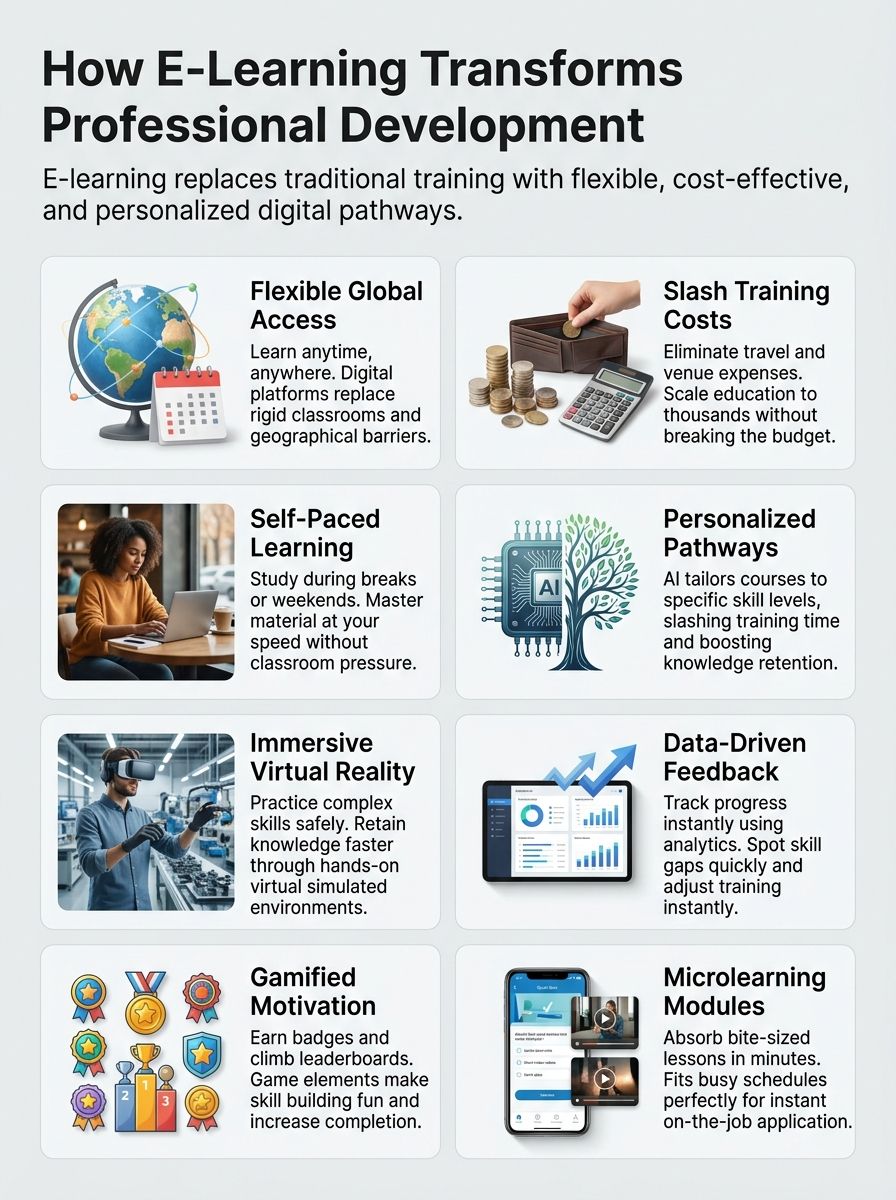
Companies once sent workers to conference rooms for all-day training sessions. Today, professionals learn new skills on their phones during lunch breaks. Traditional professional development has shifted dramatically, moving away from generic classroom sessions. Now, we use personalized, technology-driven solutions.
A 2026 industry report shows that US corporate e-learning programs require 40% to 60% less time than traditional classroom training. This efficiency changes everything for both the employer and the employee.
Traditional methods vs. modern approaches
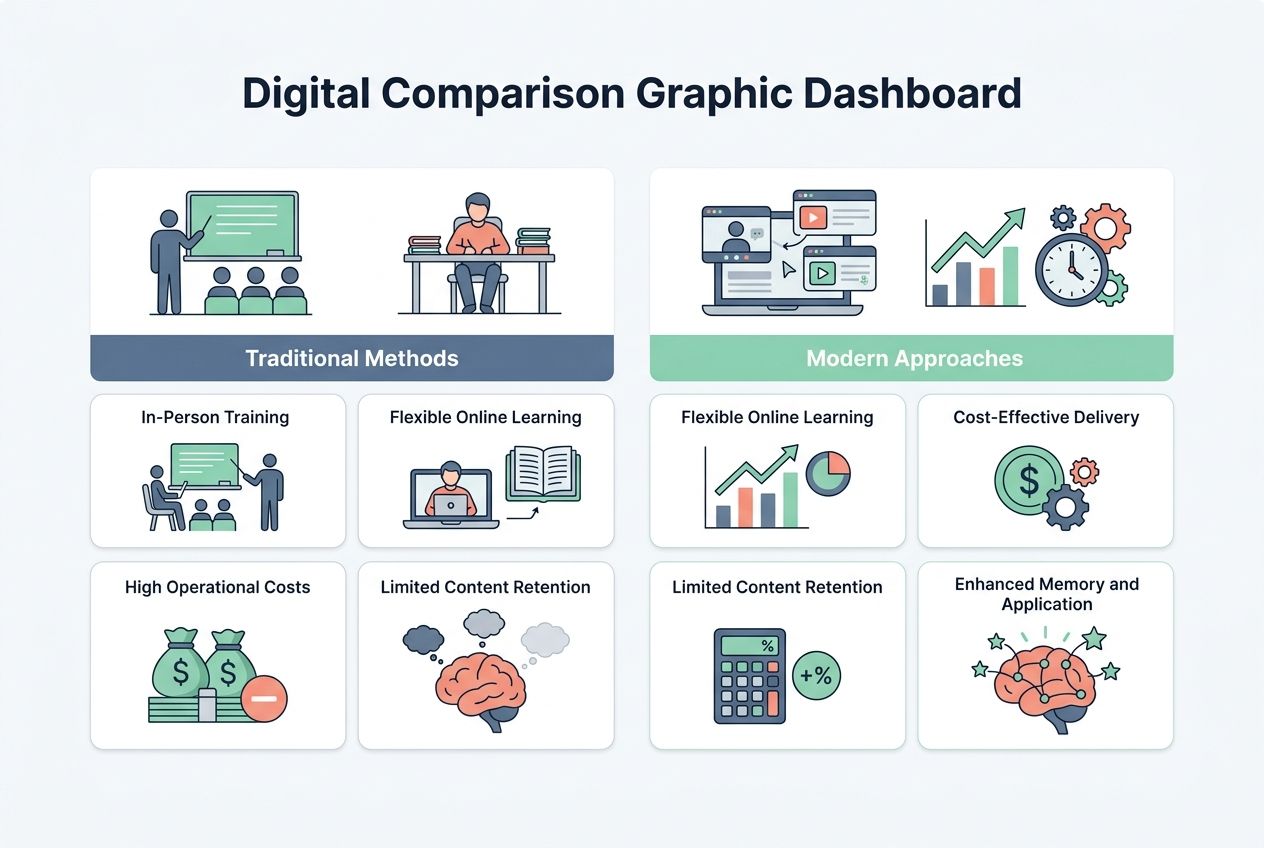
| Traditional Methods | Modern Approaches |
|---|---|
| In-Person Training Employees gathered in physical classrooms, attending workshops and seminars. Learning happened at a set time, in a set place, with a set curriculum. Everyone moved through the material at the same pace, regardless of prior knowledge.
|
Flexible Online Learning Professionals access courses from anywhere, anytime. They progress through material at their own speed, pausing when needed, rewatching content, and jumping ahead when ready. Schedules adapt to their lives.
|
| High Operational Costs Organizations paid for venue rentals, travel expenses, and instructor fees. Scaling training meant multiplying these costs significantly. Budget constraints limited how many employees could participate.
|
Cost-Effective Delivery Digital platforms eliminate travel and venue expenses. One course reaches thousands of employees without proportional cost increases. Organizations save money while expanding access.
|
| Limited Content Retention Studies showed that traditional lectures resulted in approximately 5% content retention after 24 hours. Passive listening rarely translates to real-world application or skill development.
|
Enhanced Memory and Application Interactive modules, videos, and simulations boost retention rates dramatically. Learners engage multiple senses, making information stick. Practical exercises connect learning to job performance.
|
| One-Way Communication Instructors delivered content while employees absorbed passively. Questions went unanswered, confusion persisted, and individual needs were overlooked. Feedback came weeks later, if at all.
|
Real-Time Interaction AI-powered chatbots answer questions instantly. Discussion forums connect learners across departments and geographies. Instructors receive immediate performance data, adjusting support where needed.
|
| Geographic Limitations Remote employees missed training entirely. Branch offices in different regions received inconsistent content. Travel to training sites created logistical nightmares and productivity gaps.
|
Global Accessibility Every employee, regardless of location, accesses identical, high-quality content. Time zones no longer present barriers. Distributed teams stay aligned on skills and knowledge.
|
| Generic Content All learners received the same material, ignoring different skill levels and learning styles. Advanced employees felt bored; struggling learners felt lost. Progress stalled for both groups.
|
Personalized Pathways Adaptive learning systems adjust difficulty and content based on individual performance. Beginners receive foundational material; experts access advanced modules. Everyone progresses optimally.
|
| Delayed Implementation Months passed between identifying skill gaps and delivering training. Market changes outpaced learning initiatives. Organizations struggled to stay competitive.
|
Rapid Deployment New courses launch within days or weeks. Organizations respond quickly to industry shifts and emerging skill demands. Speed translates to competitive advantage.
|
The role of technology in transformation
Technology fundamentally reshapes how professionals acquire skills. It serves as the bridge connecting old training methods to new, smarter approaches. Companies no longer rely solely on in-person workshops and printed manuals.
Digital tools now power professional growth across every US industry. Software platforms, cloud systems, and internet connectivity make learning accessible to anyone, anywhere. Organizations transform their workforce training programs by adopting modern learning management systems. Tools like Cornerstone OnDemand track progress and deliver content instantly.
These systems replace dusty filing cabinets and rigid schedules. Employees access courses on their phones, tablets, or computers whenever they need them. Technology removes the barriers that once held people back from career advancement.
Artificial intelligence personalizes learning paths so each person gets content matched to their needs. Real-time feedback systems show learners exactly where they stand. Virtual classrooms bring teams together across continents.
Data analytics reveal which courses work best. Mobile apps push lessons directly to workers, fitting learning into busy schedules.
Technology is best when it brings people together. – Matt Mullenweg
The Rise of E-Learning: Growth in adoption across industries
E-learning platforms exploded across industries over the last decade. Workers now grab courses on their phones, laptops, and tablets. They learn whenever and wherever they want.
Companies across every sector race to adopt online learning at a rapid pace. Tech firms, healthcare organizations, manufacturing plants, and financial institutions all invest heavily in digital education. By 2025, over 90% of US companies will offer some form of digital learning to their employees.
These industries recognize that workforce training through online platforms cuts costs. Remote training lets companies onboard staff faster and keep current workers sharp. Professional growth happens on the job now, not just in conference rooms.
Organizations of all sizes use specific platforms to meet their unique needs. Here are a few examples driving this growth:
- LinkedIn Learning: Great for broad professional skills and leadership training.
- Coursera for Business: Ideal for academic-level technical and data science training.
- Udemy Business: Offers thousands of targeted courses on highly specific software tools.
Adoption rates tell the real story of this shift. Retail chains use virtual classrooms to train cashiers and managers across multiple locations. Banks implement skill enhancement programs that employees can access from home.
Career advancement opportunities expand when workers can learn at their own pace. This flexibility means companies retain talented people who might otherwise leave. In fact, a 2025 survey from LinkedIn Learning found that a vast majority of employees would stay at a company longer if it actively invested in their learning.
Accessibility and inclusivity in e-learning
As industries adopt online education, a critical advantage emerges. E-learning platforms reach people that traditional workplace training never could. Geographic barriers simply disappear.
Workers in rural areas access the same courses as those in major US cities. People with disabilities find customized learning options that fit their specific needs. E-learning removes the gatekeepers that once controlled who got professional growth opportunities.
Accessibility is not a feature. It is a foundation for digital education that serves everyone.
Inclusive online learning systems offer multiple ways to absorb information. Many users on accessibility forums point out that proper screen-reader integration is the most vital feature for digital courses. Without it, blind employees miss out on essential career development.
Personalized learning paths let each person move at their own speed. Closed captions help deaf and hard-of-hearing employees. Adjustable fonts support those with vision challenges.
Learning management systems now include features that translate courses into different languages. This shift means that career advancement no longer depends on your zip code or your circumstances. Digital transformation in workforce training has opened doors that were previously locked.
Key Benefits of E-Learning in Professional Development
More organizations recognize that digital learning works better than the old classroom model. Workers learn faster, remember more, and actually enjoy the process.
Cost-effectiveness and scalability
Companies save significant money when they shift to online education for workforce training. Traditional classroom training requires physical spaces, travel expenses, and instructor fees. These costs add up fast.
Digital learning platforms eliminate these costs almost entirely. A single course can reach thousands of employees across multiple locations without extra spending. Research shows that online learning reduces energy consumption by nearly 90%, making it an environmentally friendly and cost-effective choice for US businesses.
Shifting to digital platforms can slash corporate training expenses by up to 70%, freeing up the budget for deeper investments in employee well-being.
The cost per learner drops dramatically as more people access the same digital content. Scalability makes online learning perfect for growing businesses. Small teams can start with basic skill enhancement courses, then expand to thousands of workers.
Learning management systems handle this growth smoothly. Companies do not need to hire more trainers or build new training facilities. Remote training reaches employees in different time zones with equal ease. This flexibility creates room for companies to offer more continuing education opportunities.
Flexibility and self-paced learning
E-learning platforms let workers learn at their own speed. This breaks the chains of rigid classroom schedules. Professionals can study during lunch breaks, late nights, or weekends without sacrificing their job duties.
This flexible learning approach helps a parent earn new skills while managing family responsibilities. A shift worker can advance their career without fighting the clock. Self-paced learning removes the pressure of keeping up with classmates.
Personalized learning paths transform how workers develop skills. Employees tackle courses that match their goals. Here is why self-paced learning works so well for busy professionals:
- No scheduling conflicts: You choose the best time to learn.
- Customized speed: You can pause, rewind, or speed up video content.
- Targeted focus: You skip material you already know.
- Immediate application: You can use what you just learned at work the same day.
Digital education systems track progress and adapt content. This approach cuts through the noise and delivers exactly what matters for professional growth. Workplace training feels like a real investment in yourself.
Improved engagement and retention
Self-paced learning removes barriers, but engagement makes learning stick. Interactive technology transforms passive watching into active participation. Learners click, answer, and solve problems in real time.
This hands-on approach keeps minds sharp and focused. A 2025 report revealed that online learning can increase retention rates by 25% to 60% compared to traditional classroom methods. People remember what they do far better than what they simply hear in a lecture.
Gamification and immersive learning environments make skill enhancement enjoyable. Badges, points, and leaderboards motivate workers to complete their goals. Virtual classrooms let employees interact with instructors instantly.
Real-time feedback systems tell learners exactly what they did right. This constant communication builds confidence. Workplace training becomes an exciting opportunity when learners see their progress unfold.
Personalization and adaptive learning experiences
Personalized learning paths shape how professionals grow in their careers. E-learning platforms track what you know and what you still need to learn. Software like Docebo watches your progress, identifies gaps, and adjusts content on the fly.
You get lessons suited to your skill level. Artificial intelligence powers this smart approach by analyzing your performance data. You move faster through topics you grasp quickly.
Here is how adaptive systems customize your training in real time:
- Skill assessments: Evaluates your baseline knowledge instantly.
- Dynamic pacing: Speeds up when you answer correctly.
- Content variety: Swaps text for video if you learn better visually.
This personalized learning approach cuts training time dramatically. Companies save money because employees learn what matters most. Your brain stays engaged because the content speaks directly to your needs.
Adaptive learning experiences transform how people develop new skills. You receive interactive technology that shifts based on your choices. The platform learns your learning style and preferences. This flexibility means career advancement happens faster.
Key Technological Drivers of E-Learning
The interactive technology behind these platforms feels like having a personal coach in your corner.

Artificial intelligence and machine learning
Artificial intelligence and machine learning reshape how companies deliver workplace training. These tools analyze how each worker learns best. They then customize digital education paths to match that exact style.
AI systems track your progress in real time. They spot where you struggle and adjust the content instantly. This personalized learning approach means you move faster through familiar material.
Machine learning algorithms study patterns across thousands of US learners. They get smarter every single day about what works. A 2026 industry survey found that AI-powered recommendations help workers find relevant courses 50% faster than manual searching.
Artificial intelligence does not replace human trainers; it gives them the precise data they need to be better coaches.
Your professional growth accelerates when AI handles the grunt work. These systems flag skill gaps before they become problems. They recommend courses that fit your career goals.
Learning management systems powered by machine learning cut training costs dramatically. They eliminate wasted time on irrelevant content. Companies save money while workers gain skills faster.
Virtual reality (VR) and augmented reality (AR)
Virtual reality and augmented reality technologies reshape how workers learn on the job. VR immerses employees in simulated environments. They practice skills without real-world risks.
A surgeon can perform complex procedures in a virtual operating room. A factory worker can troubleshoot machinery in a safe digital space. In the retail sector, Walmart uses VR headsets to train associates on handling holiday rushes and complex customer service scenarios.
AR overlays digital information onto the physical world. Technicians view repair instructions floating above the equipment they are fixing. Sales teams see customer data pop up during role-playing exercises.
Top VR training scenarios across industries include:
- Hazardous safety drills: Practice emergency responses safely.
- Customer service roleplay: Handle difficult conversations with virtual avatars.
- Equipment maintenance: Learn machine repair without risking expensive damage.
Organizations adopt VR and AR because these tools drive results. Employees retain information faster and apply skills more confidently. Companies reduce training costs by cutting travel expenses and equipment damage. These digital learning solutions create memorable moments that transform how workers develop professionally.
Data analytics and real-time feedback systems
Data analytics transforms how companies track learning progress. Real-time feedback systems show workers exactly what they are doing right and wrong. Managers can spot skill gaps fast.
They see which employees struggle with specific topics. This information helps them offer targeted help right away. Modern learning management systems, like Canvas, collect vast amounts of data every single day to optimize the experience.
Companies use this data to improve their training programs. They learn what works and what falls flat. Workers get better results when they receive instant feedback. Performance metrics become crystal clear for everyone involved.
Here are the most valuable data points companies track today:
- Course completion rates: Shows if the material holds attention.
- Time spent per module: Highlights sections that might be too difficult.
- Assessment scores: Measures direct knowledge transfer.
- Learner drop-off points: Identifies where content needs improvement.
Personalized learning paths emerge from this data collection. The system learns what each worker needs most. Real-time feedback keeps workers motivated. Skill enhancement happens more quickly with this smart approach.
Challenges of E-Learning in Professional Development
There are some significant challenges to e-learning in professional development. Constant tracking can hurt trust between employers and staff. Companies should be transparent about what data they collect and why. Strong data security protects both employee information and company assets.
Addressing the digital divide
Not all workers have equal access to technology or internet connections. Some employees live in rural areas where broadband speeds lag far behind US city standards. Others lack the devices needed to participate in online learning.
A 2025 report on remote work highlighted that millions of rural Americans still lack access to high-speed internet. Companies that ignore this gap leave talented people behind. Organizations must provide laptops, tablets, or other tools to workers who need them.
Closing the digital divide is an essential step for true workplace equality, ensuring every employee has the tools to succeed.
They should also offer offline content options and flexible access schedules. Workplace training programs work best when everyone can actually join in.
Cost barriers create another real problem. Expensive software licenses and high-speed internet subscriptions drain budgets for smaller companies. Low-income workers might struggle to afford personal devices for continuing education.
Smart solutions include subsidizing internet costs for remote training participants. Employers can partner with community centers to offer free access to digital learning resources. Professional growth becomes possible for more people when financial obstacles disappear.
Maintaining engagement and motivation
Once learners gain access to online education platforms, keeping them motivated becomes the real challenge. Engagement drops fast when courses feel boring or disconnected from real work situations.
Workplace training programs that use interactive technology see much higher completion rates. Learners need content that speaks to their career development goals. Generic material often feels like busy work.
E-learning trends show that gamification works wonders for motivation. Adding game elements makes digital learning feel rewarding. Microlearning breaks skill enhancement into bite-sized chunks that fit into busy schedules.
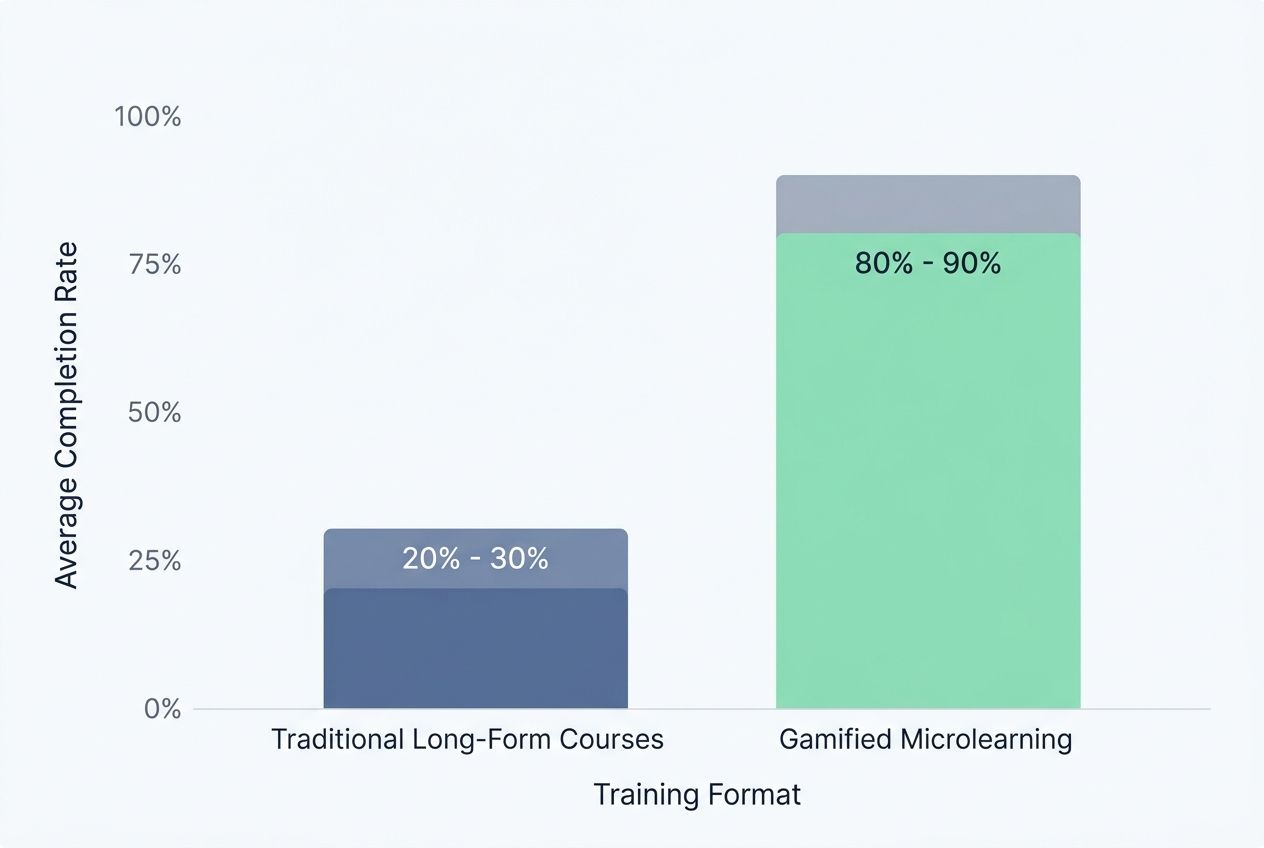
| Training Format | Average Completion Rate |
|---|---|
| Traditional Long-Form Courses | 20% – 30% |
| Gamified Microlearning | 80% – 90% |
Short bursts of learning feel much less overwhelming. Virtual classrooms that include real-time interaction create community. Learners stay committed when they feel connected to others on the same journey. Continuing education becomes something people want to do.
Ensuring data security and privacy
Keeping learners engaged matters, but protecting their information is critical. Online learning platforms collect massive amounts of data about employees. This includes login times, test scores, and personal details.
Companies storing this sensitive information face serious risks if hackers gain access. Data breaches can expose employee records and damage the company’s reputation. They can also violate specific laws like the California Consumer Privacy Act (CCPA) in the US.
Here are key ways organizations protect sensitive training data:
- Use end-to-end encryption: Protects data during transfer.
- Enable two-factor authentication (2FA): Adds an extra layer of login security.
- Conduct regular audits: Spots vulnerabilities before hackers do.
Organizations must install strong encryption, use secure servers, and limit who can see student information. Workplace training systems need regular security checks to catch vulnerabilities. Digital education providers should train staff on data protection practices.
Privacy concerns go beyond hacking threats. Employees worry about surveillance through learning management systems that track their every move. Some platforms monitor how long workers spend on lessons and which videos they watch.
Future Trends in E-Learning: Gamification and Immersive Learning Environments
Gamification transforms workplace training into engaging experiences that stick with employees. Points, badges, and leaderboards tap into our natural competitive spirit. This makes skill enhancement feel like a game worth playing.
Employees tackle challenges, earn rewards, and watch their progress climb in real time. This approach keeps learners motivated, which means they actually complete their courses.
Adding simple game elements like points and badges can boost learner engagement by a massive 90 percent.
Interactive technology makes learning management systems feel alive. It turns boring modules into adventures that people genuinely want to experience. Immersive learning environments use virtual reality to create hands-on practice sessions.
Imagine practicing a difficult sales pitch in a virtual boardroom. You could also troubleshoot equipment in a simulated factory before touching the real thing. A recent corporate study found that gamified learning experiences achieve a 90% engagement rate, crushing the lower rates seen in traditional training.
These interactive technology solutions let professionals learn by doing. Remote training becomes powerful when it feels this real. Employees gain confidence and transfer what they learned directly into their jobs.
Increased focus on microlearning and nano-learning
Professional development is shifting to bite-sized learning modules that fit into busy schedules. These compact formats transform how workers build skills without sacrificing quality or depth.
- Microlearning breaks complex topics into five to fifteen-minute segments. Employees absorb information during coffee breaks, making digital education highly practical.
- Nano-learning takes this concept further by delivering content in two to three-minute bursts. This is perfect for quick refreshers on specific workplace training concepts.
- Mobile-first design powers these short learning modules. Workers access professional growth content directly on smartphones, transforming any location into a virtual classroom.
- Spaced repetition works brilliantly with microlearning formats. Learners encounter the same concepts multiple times, strengthening memory retention through strategic reinforcement.
- Just-in-time learning delivers specific skills exactly when employees need them. This eliminates wasted time on irrelevant material and accelerates career development goals.
- Learning management systems now organize courses into modular chunks. This supports flexible learning that adapts to individual schedules and work demands.
- Personalized learning paths emerge from data analytics tracking employee progress. This shows each worker which microlearning modules matter most for their specific role.
- Engagement rates climb significantly when learners complete short segments. Workers build momentum and see tangible progress in their skill sets.
- Cost-effective training multiplies when organizations package content into microlearning units. This reduces production expenses while reaching more distributed teams.
- Retention improves dramatically through nano-learning approaches. Focused content prevents information overload, helping professionals apply new knowledge immediately.
Enhanced collaboration through virtual platforms
Virtual platforms connect team members across different cities or even continents. Workers share ideas instantly through video calls, chat systems, and shared digital spaces. Tools like Slack and Microsoft Teams integrate seamlessly with modern learning platforms to keep conversations flowing.
Teams work together on projects without the delay of email exchanges. A sales representative in New York can brainstorm with a designer in California right away. Learning management systems provide shared resources, document uploads, and group progress tracking.
Top collaboration tools for remote training include:
- Slack: Perfect for quick, informal chat and file sharing.
- Microsoft Teams: Ideal for integrated video calls and document collaboration.
- Zoom: The standard for reliable virtual classrooms and webinars.
These tools change how colleagues interact, making remote training feel connected and social. Employees build stronger relationships when they interact face-to-face, even through screens. Virtual collaboration platforms also inspire creativity.
People from different backgrounds and skill levels join discussions without hesitation. They approach problems from different perspectives because they work with individuals from various departments. Gamification features in these environments make group projects highly enjoyable.
Leaderboards, badges, and team challenges encourage workers to participate more. Real-time feedback systems allow managers to see contributions, helping them recognize top performers quickly. Workplace training becomes interactive and social rather than a dull lecture.
Final Words
E-learning transforms how workers grow in their careers. It makes professional development accessible, affordable, and adaptable to busy schedules. Technology powers personalized learning experiences. Tools like artificial intelligence, virtual reality, and data analytics keep people engaged and motivated.
Organizations that adopt online education reduce training costs. They easily reach more employees across different locations and time zones. You can start small. Explore learning management systems or microlearning platforms that fit your workplace needs. Take action today.
Pick one e-learning tool for your team, and watch how e-learning is changing professional development in your own workforce.
Frequently Asked Questions (FAQs) on E-learning In Professional Development
1. How is e-learning changing professional development for workers?
E-learning lets you learn new skills at your own pace from anywhere, no more commuting to stuffy classrooms. A 2025 LinkedIn report found that 87% of US professionals say online training helps them stay competitive in their careers.
2. What are some benefits of using digital courses for job training?
Digital courses save you time and money since you skip the commute and printed materials. Companies using e-learning cut training costs by 50-70% while you practice real tasks on your computer and retry until you get it right.
3. Can online learning help employees keep up with fast-changing industries?
Yes, online courses update way faster than traditional training. Platforms like Udemy can refresh content within days when industry tools or regulations change, while in-person workshops might take 6-12 months to update. This means you always get current information right when you need it.
4. Is e-learning as effective as traditional face-to-face workshops?
Many studies say yes because you can replay hard parts and ask questions anytime through forums or chat. Research shows e-learning improves knowledge retention by 25-60% compared to traditional workshops since you control the pace, and managers can track who finishes each lesson.