
Music mogul Sean “Diddy” Combs, 55, recently received a powerful show of respect from fellow inmates after returning to a federal jail in Brooklyn. The gesture came in the form of a standing ovation from incarcerated individuals who were deeply moved by his courtroom victory. Combs had just been acquitted of some of the most serious charges he faced—sex trafficking and racketeering conspiracy—which could have resulted in a life sentence.
The moment wasn’t just celebratory; it symbolized hope and defiance against a justice system that many incarcerated people view as nearly impossible to beat. His defense attorney, Marc Agnifilo, later shared that inmates were inspired by the rare sight of someone defeating the federal government in court, which many saw as a moral boost for incarcerated Black men in particular.
Combs Still Facing Time for Prostitution-Related Charges
Despite the courtroom success, Combs is not a free man. He continues to be held in the federal lockup following his conviction on prostitution-related charges. These charges, though less severe than the original counts, still carry significant prison time. Combs has already spent nearly 10 months in custody since his arrest in March 2024, and this time will be credited toward his final sentence.
Authorities began investigating Combs after executing raids on his properties in both Los Angeles and Miami. From the early stages of the case, his legal team was aware that sex trafficking accusations were likely. Defense counsel encouraged Combs to prepare himself for a legal battle that could define not only his career but also his legacy.
Legal Strategy Focused on Candid Storytelling
During the two-month federal trial in Manhattan, Combs’ legal team, composed of eight experienced attorneys, took an unconventional yet effective approach. They chose not to paint Combs as blameless or perfect. Instead, they addressed his controversial personal behavior—such as jealousy, substance use, and involvement in a sexually open lifestyle involving consensual threesomes with his partners and other men—head-on.
The defense acknowledged that while Combs may have been guilty of personal failings or unhealthy relationships, these did not equate to sex trafficking or criminal conspiracy. This upfront strategy helped prevent the jury from being misled by the government’s attempt to present his private behavior as evidence of organized criminal activity.
Attorney Marc Agnifilo explained that the defense deliberately tackled the most damaging parts of Combs’ personal life, knowing the prosecution would use them to try to create a broader narrative. By doing this, the defense ensured jurors could separate inappropriate personal actions from actual federal crimes.
Mixed Signals From Jury Deliberations
On the day before the final verdict, the jury reported being unable to reach a consensus on the racketeering charge but confirmed they had verdicts on the sex trafficking and prostitution-related counts. The presiding judge instructed them to continue deliberations. At the time, even Combs and his legal team appeared uncertain about the likely outcome.
That night, Agnifilo anticipated a split decision and immediately began preparing a bail request in case the verdict allowed for it. By the next morning, Combs entered the courtroom with renewed energy and optimism. Surrounded by family members, he spent the morning in prayer and appeared visibly more hopeful than the day before.
Shortly thereafter, the jury delivered their decision: Combs was acquitted of both sex trafficking and racketeering. He was only convicted on the lesser prostitution-related charges. As the verdict was read, Combs expressed quiet gratitude toward the jury, while his legal team and family supporters celebrated. Some members of the legal team were seen in tears, and the courtroom briefly erupted in applause, with chants referring to the team as the “Dream Team.”
A Rare Loss for Federal Prosecutors
The verdict delivered a significant blow to the prosecution. Legal experts emphasized how unusual it is for federal prosecutors to lose major cases—especially ones involving high-profile figures and serious allegations such as sex trafficking and racketeering.
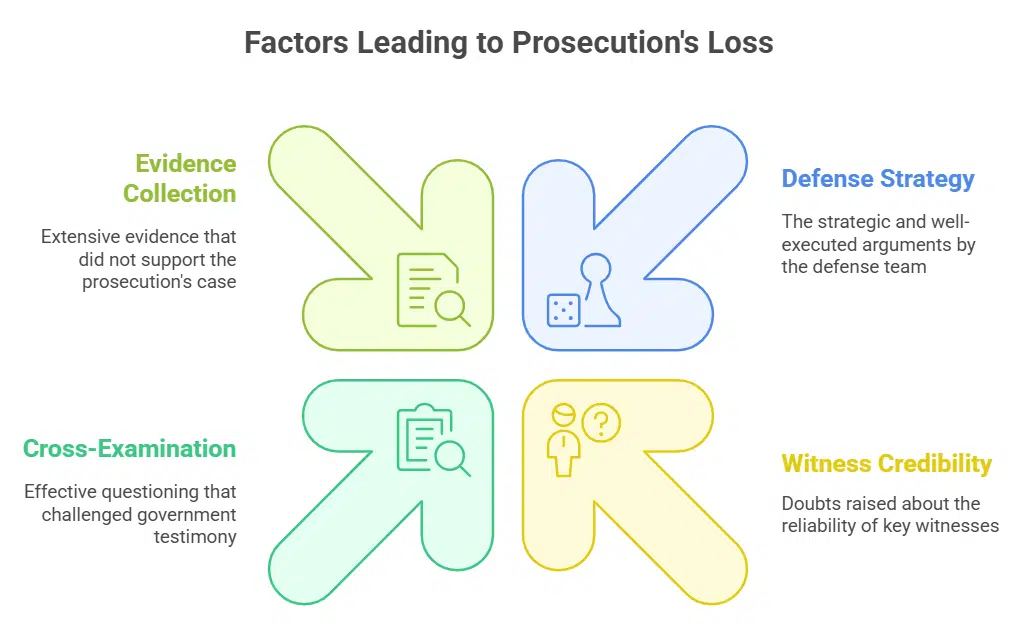
Mitchell Epner, a lawyer who previously worked alongside Agnifilo as a federal prosecutor in New Jersey, noted that the defense team’s strategic and well-executed arguments played a major role in securing this rare courtroom victory. The prosecution’s case faltered despite extensive evidence collection, dozens of witnesses, and months of preparation.
Notably, Combs’ defense lawyers did not call a single witness to the stand. Instead, they relied entirely on effective cross-examinations, carefully dissecting the government’s testimony and challenging the reliability and credibility of its key witnesses, including Combs’ ex-employees and former assistants.
In some cases, these very witnesses, when shown videos of Combs physically assaulting his longtime partner Casandra “Cassie” Ventura, still spoke positively about Combs and his professional relationships, raising doubts about the prosecution’s depiction of Combs as a manipulative criminal leader.
Combs’ Defense Team Turned the Government’s Tools Against Them
An interesting twist in the trial is that the lead defense attorney, Marc Agnifilo, had previously played a significant role in expanding the use of racketeering laws during his time as a federal prosecutor. Two decades ago, he had been part of a task force that used those laws to crack down on organized crime and violent gangs in New Jersey.
This insider knowledge gave Agnifilo a distinct advantage in the courtroom. He was familiar with the structural weaknesses of the Racketeer Influenced and Corrupt Organizations (RICO) statute and knew how to exploit them. He argued that the prosecution failed to establish a clear conspiracy and instead tried to piece together Combs’ chaotic personal life and portray it as an organized crime network.
By highlighting these legal inconsistencies and the lack of cohesive criminal coordination, the defense weakened the prosecution’s overall narrative.
Rebuilding and Rehabilitation: Combs’ Path Forward
While Combs’ legal team successfully avoided the most damaging convictions, the artist and businessman still faces a significant personal and professional challenge. If and when he is released, his priority will likely involve continuing the rehabilitation work he began before his arrest. According to his attorney, Combs had already enrolled in a domestic violence intervention program, which he is expected to resume.
There are signs that Combs is now focused on personal growth and acknowledging the damage caused by past behavior. He reportedly talks frequently about the need for change and self-improvement and has become more aware of the fact that fame and fortune cannot erase deep-rooted behavioral issues.
A Chaotic End to a Historic Court Day
Following the conclusion of the court proceedings, another dramatic event unfolded—this time outside the courtroom. As the legal team was exiting the courthouse, a man near the elevator area suddenly collapsed into seizures.
Drawing from past medical experience, Agnifilo quickly took action. He turned the man onto his side to prevent choking, while his law partner, Jacob Kaplan, placed a backpack under the man’s head. Agnifilo’s daughter assisted by checking the man’s pulse. The emergency situation was eventually brought under control, and the man regained consciousness before being taken away by emergency medical personnel.
The unexpected medical emergency marked a surreal end to an already intense day in court for Combs’ legal team. Agnifilo later reflected on the coincidence and intensity of the events as a powerful reminder of life’s unpredictability.