

The cafe in Milan hums with sound. Espresso cups, chatter, the clink of cutlery. At a small table by the window, a British woman and an Italian man sit across from each other, both trying in their own ways. She speaks in short, clear phrases. She pauses often. She leaves gaps. He fills them. He leans in, hands moving, face alive. His voice rises with every point. She nods. She smiles. She says little. She thinks he is “too much.” He thinks she is distant. This is a clash of cultural communication styles. British silence. Italian expression. The question is not who is right, but who really says more.

What Cultural Communication Styles Really Mean
Cultural communication styles are how people talk, listen, pause, and read each other inside a shared social code. They are not random quirks. They follow patterns shaped by history, class, and how much societies rely on context versus words alone.
High-Context Cultures in Practice
In high-context cultures like Italy, Japan, and many Mediterranean and Asian societies, most of the meaning lives outside the sentences. People read tone, timing, body language, and relationships more than the literal words.
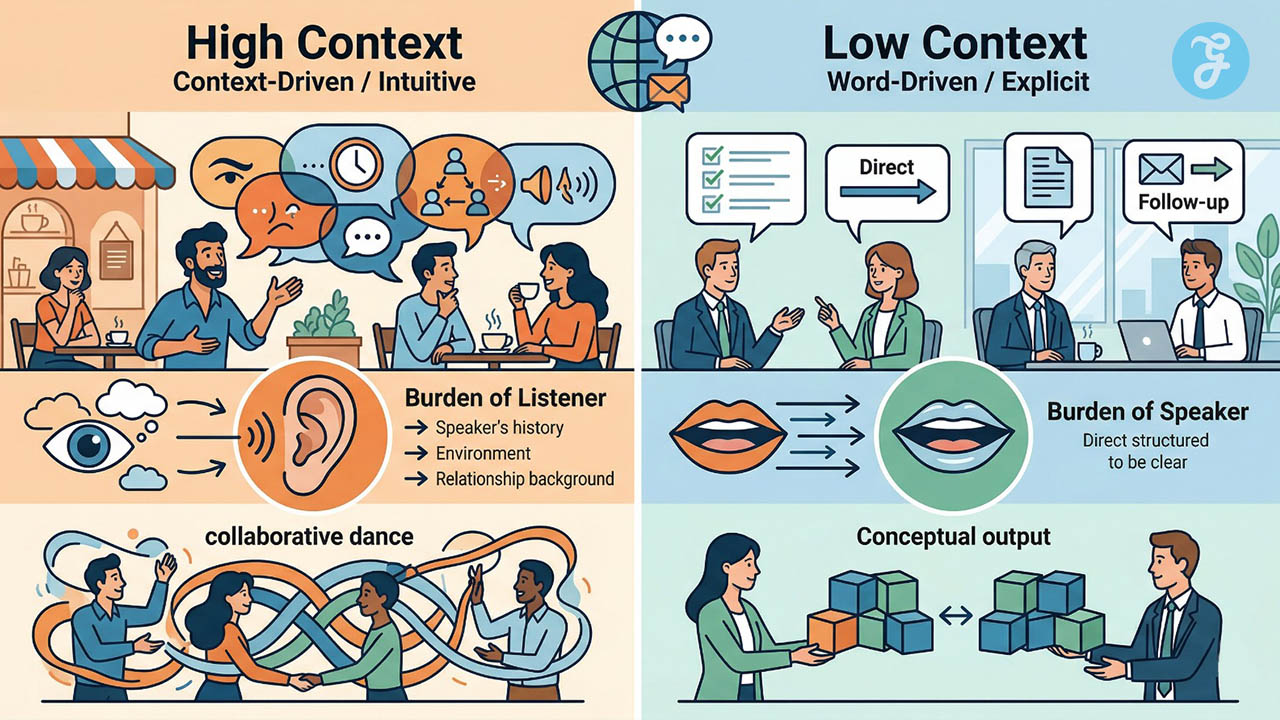
A raised eyebrow or a long pause can carry as much weight as a full sentence. Conversations are layered. What is unsaid is often as important as what is spoken. This is why Italians often talk in fast, overlapping dialogue while relying on shared background and nonverbal cues to stay aligned.
Low Context Cultures in Practice
Low context cultures such as the UK, US, Germany, and Scandinavia put most of the load on the words themselves.
People expect things to be stated clearly. They value explicit instructions, written records, and direct phrasing. Misunderstandings are reduced by clarity rather than interpretation.
The Burden of Responsibility: Speaker vs Listener
A critical but often overlooked layer in cultural communication styles is the “burden of meaning.” In British and other low context cultures, the responsibility for clear communication lies almost entirely with the speaker. If a listener fails to understand, the speaker is often blamed for being vague or organized. This is why British professionals prioritize structured agendas and follow-up emails; they are “protecting” the message from misinterpretation.
In contrast, Italian communication operates on the “burden of the listener.” In this high-context system, it is the listener’s duty to be attuned to the speaker’s history, the current environment, and subtle shifts in tone. If a listener misses a point, it is often seen as their failure to “read the room.”
This creates a fascinating dynamic where Italians may speak in circles or use metaphors, trusting that a “capable” listener will navigate the subtext. This reliance on shared intuition is what makes Italian dialogue feel like a collaborative dance rather than a simple exchange of data.
Where Britain and Italy Sit on the Scale
Studies on cultural communication styles place Italy firmly in the high-context camp. Italians signal a lot through gesture, tone, and implied understanding. The UK sits in the low context group, but with a twist. British communication is more reserved and indirect than American low context styles. This means the UK is still relatively higher context than the United States, even while being classified as low context overall. This gap helps explain why British silence and Italian expression can look so different, yet both are deeply logical inside their own communication systems.
British Silence: Dignity, Distance, or Diplomacy?

British people often communicate by saying less. A peer-reviewed study on silence in English cross-cultural interaction found that British interlocutors use more silence than their American, Irish, or Canadian counterparts. That silence is not emptiness. It is a tool packed with social meaning.
Silence as a Communication Tool
Silence can mark reflection, politeness, or a pause before disagreement. In British cultural communication styles, a gap in talk can soften criticism or give someone space to save face. Silence may also signal that a person is weighing words carefully, not that they are disengaged.
Restraint and Class Codes in Britain
Historically, British public and professional settings favor emotional restraint. Over-expressing emotion can be coded as undignified or vulgar, especially in middle- and upper-class circles. This history shapes modern British communication styles, where understatement and indirectness are often treated as signs of self-control.
How Silence Causes Misunderstandings
Foreigners may read British pauses or minimal feedback as coldness or rudeness. In high-context cultures, the lack of visible cues can make it hard to read the true mood. What feels like a dignified reserve in London can register as distant or untrustworthy in Milan.
Italian Expression: Warmth, Drama, or Chaos?

Italian communication is loud, fast, and full of gesture. Intercultural guides describe Italians as expressive, animated, and highly engaged, often talking over each other as a sign of involvement, not disrespect. Silence is rare and often feels awkward.
The Lively and Fast-Talking Style
Italians tend to speak quickly and fill silences almost immediately. Overlapping speech and interruptions are common. They are treated as proof of interest, not a breach of etiquette. In everyday Italian conversations, stopping for long pauses can look like disengagement.
Nonverbal Cues in Italian Talk
In Italy, tone, facial expressions, and hand gestures carry as much weight as the words. A raised eyebrow, a specific hand movement, or the way someone leans in can shift the meaning of a sentence entirely. These nonverbal cues are tightly woven into Italian communication.
Bella Figura and Indirect Criticism
Italians care deeply about bella figura, the idea of making a good impression. Open criticism, especially in public, is rare. Negative feedback is often softened, delivered indirectly, or saved for private settings to protect social harmony.
Verbal Over Written Communication
Italians prefer the spoken word. Important points are usually negotiated in person or over phone calls. Written lists or blunt emails can be read as cold or overly harsh. In Italian business culture, relationship building and face-to-face interaction carry more weight than formal documentation.
British Restraint vs Italian Expressiveness
British and Italian cultural communication styles feel almost like opposites. One leans on restraint, the other on expression. Yet both are consistent within their own logic. Neither is objectively better. They are shaped by different histories, class patterns, and social expectations.
Context Level
- British Styles (Lower Context): Most meaning lives in the words, with less reliance on shared background.
- Italian Styles (Higher Context): People read tone, relationships, timing, and nonverbal cues alongside the actual sentences.
Use of Silence
- British Speakers: Often use silence as a tool. Pauses can signal reflection, politeness, or a way to avoid confrontation.
- Italian Speakers: Rarely leave long gaps. Silence is often seen as awkward or a sign of disengagement.
Emotional Expression
- British Expression: In public or professional settings, emotional expression is usually restrained.
- Italian Expression: Emotions are expressed more openly. Volume, gestures, and facial reactions are part of everyday communication.
Directness and Indirectness
- British Communication: Relatively direct for a low context culture, but still understated. Negative feedback is often implied rather than stated bluntly.
- Italian Communication: Leans indirect in a different way. Criticism is softened and often moved to private settings to preserve social image.
Preferred Medium in Work Settings
- British Workplaces: Written records, emails, and documentation carry strong importance.
- Italian Workplaces: The spoken word dominates. Discussions, meetings, and calls shape decisions more than written notes.
What Studies and Stories Reveal
Research into cultural communication styles shows that British and Italian patterns are not random habits. They are structured, repeatable, and measurable. In daily work and relationships, these patterns create both friction and connection.
High-Context Italy vs Low-Context UK
Corporate communication research classifies Italy as high-context and the UK as low context. This structural difference explains why Italians often expect more visible cues, while British speakers rely more on clarity and brevity.
Cultural Dimensions Behind the Styles
Cultural frameworks such as Hofstede’s dimensions help explain the deeper logic. Italy tends toward higher uncertainty avoidance and stronger social hierarchy, encouraging indirectness and impression management. The UK is more comfortable with debate and lower hierarchy, supporting clearer and more structured communication. These are not rigid rules for individuals, but they explain national patterns.
The Architecture of Praise and Criticism
The way these cultures handle feedback reveals the deepest friction points in cultural communication styles. In the UK, praise is often delivered through “understated approval.” A phrase like “quite good” is actually high praise in many British circles, whereas “could be worse” might mean “I am very impressed.” This linguistic restraint is designed to maintain humility and avoid the “vulgarity” of over-excitement. For an Italian, however, this lack of enthusiasm can be devastating. They may interpret a British manager’s “not bad” as a sign that their work is mediocre or failing.
Conversely, Italian praise is “additive”, it uses superlatives, hand gestures, and vocal intensity to signal genuine appreciation. When it comes to criticism, Italians often use a “protective” approach to bella figura. They might deliver a sharp critique wrapped in a lengthy, warm conversation to ensure the relationship remains intact. A British colleague, expecting a bulleted list of “areas for improvement,” might walk away from such a meeting feeling liked, but completely unaware that their performance was actually being questioned.
Real World Misunderstandings Between Brits and Italians
Cultural communication styles turn into friction in everyday situations. A simple phrase, a meeting, or an email can land very differently than intended.
“Not Bad” vs Italian Intensity
British colleagues often say phrases like “not bad” or “could be improved.” These are understated signals. To Italians, such comments can sound strongly negative because they expect clearer emotional cues.
Meetings That Feel Like Monologues
Italian conversations are lively and overlapping. Interruptions signal engagement. Non-Italians may feel talked over, while Italians may interpret silence as disinterest.
Emails That Feel Cold or Harsh
In Italian business culture, blunt emails listing problems can feel aggressive. In British settings, the same message may be seen as efficient and professional.
When Silence Speaks Louder and When It Backfires
Both British restraint and Italian expressiveness are powerful tools, yet their effectiveness is entirely dependent on the cultural landscape. What serves as a bridge in one setting may act as a barrier in another.
Silence as a Pillar of Trust
In reserved environments, a deliberate pause is a mark of high social intelligence. These measured responses signal that a speaker is exercising thoughtfulness and emotional control rather than reacting on impulse. In a British professional context, such silence creates an enduring impression of reliability, suggesting that every word has been carefully weighed for its merit.
The Risk of Emotional Distance
In highly expressive cultures, minimal verbal feedback is often misread as a lack of empathy or engagement. When a listener remains silent in an Italian setting, the absence of active cues can feel clinical or cold. Rather than being seen as a sign of respect, this lack of visible reaction is frequently interpreted as a growing emotional distance or a lack of interest in the connection.
Expressiveness as a Bridge to Rapport
Italian style communication excels in building immediate, human warmth. By using animated gestures and vocal variety, speakers can build rapport quickly, making the interaction feel authentic and deeply personal. This style is particularly effective in relationship-driven industries where trust is built through shared energy and visible enthusiasm.
The Friction of High-Energy Dialogue
When high-energy communication enters a strictly structured environment, it can inadvertently signal a lack of discipline. To those accustomed to low-context, understated systems, intense expressiveness may feel chaotic or even intrusive. In these settings, the passion that usually builds warmth is often misread as a distraction from the facts or a breach of professional etiquette.
Modern Global Relationships: Adapting Without Losing Yourself
In global teams and cross-cultural relationships, success lies in flexibility. The goal is not to copy another style perfectly, but to adjust while staying authentic.
Recognize Your Default Style
Understand whether you lean toward restraint or expression. Seeing your habits as patterns helps you adapt without judgment.
Adjust Your Communication Intentionally
- Reserved communicators can add more verbal feedback and clarity.
- Expressive communicators can practice pauses and structured messaging.
Read Context Beyond Words
- In high-context settings, pay attention to tone and relationships.
- In low-context settings, prioritize clarity and explicit agreement.
Who Really Says More?

From one angle, British silence says more. It carries nuance, restraint, and social calibration. From another, Italian expression says more. It communicates emotion, intent, and connection in real time. In modern global communication, the real skill is not choosing one over the other. It is learning both, understanding both, and knowing when to use each. Cultural communication styles shape how we speak and listen. British silence versus Italian expression does not answer who is right. It reveals who understands the other well enough to respond.
Uncommon FAQs: British vs Italian Communication
While the primary differences between these two cultures are well-documented, specific nuances often surface in professional and social settings that can catch even seasoned travellers off guard. Below are uncommon FAQs derived from current cultural research and search trends.
Why do Italians repeat themselves so often in meetings?
In Italian culture, the responsibility for interpreting meaning lies with the listener. If an Italian colleague repeats a point, they are often layering the message with different emotional cues for the listener to pick up. Conversely, a Brit, coming from a culture where the speaker carries the burden of being clear and concise, might find this repetitive or inefficient.
Is “sorry” always an admission of guilt in the UK?
No. In British communication, “sorry” is frequently used as a social lubricant or a placeholder for a pause. It can mean “I’m about to disagree,” “I didn’t quite hear you,” or even “You just stepped on my foot, but I feel awkward about it.” Italians, who use apologies more sparingly and typically only for genuine faults, may find this constant apologizing confusing or insincere.
Why do Italians use “Doctor” (Dottore/Dottoressa) for people who aren’t physicians?
In Italy, the title Dottore or Dottoressa is traditionally used for anyone who has completed a university degree (a Laurea). It is a mark of social hierarchy and respect. British culture, which tends to downplay formal titles in favor of first names or “Mr/Ms” (except for medical doctors or PhD holders), can sometimes perceive this as overly formal or even pretentious.
Does a “stare” from an Italian mean they are angry?
Not at all. Research into non-verbal cues shows that Italians use significantly more sustained eye contact than the British. While a Brit might look away to give someone personal space or avoid being “confrontational,” an Italian uses eye contact to signal engagement and sincerity. To a Brit, this can feel like an “eyeballing,” but to an Italian, looking away can signal shiftiness or a lack of interest.
Why is an Italian business meeting “all over the place” compared to a British one?
British meetings usually follow a linear agenda where punctuality and structure are equated with professionalism. Italian meetings are often multi-active. They prioritize relationship-building and “small talk” (which is actually vital “big talk” for building trust) over the clock. Italians may also engage in “overlapping speech”, talking over one another, not as a sign of rudeness, but as a demonstration of high energy and active participation.
Comparison of Uncommon Cultural Cues
| Feature | British Perspective | Italian Perspective |
| Punctuality | Monochronic: A sign of respect; time is a linear resource. Being late is a minor “moral” failing. | Polychronic: Fluid; a few minutes late is seen as a sign of a relaxed, human-centric approach that prioritizes the current person over a rigid clock. |
| Personal Space | High value on the “bubble”; physical touch is rare between colleagues. | Reduced personal space; touch (back pats, handshakes) signals warmth. |
| Conflict | Handled with understatement or “diplomatic silence.” | Handled with animated debate; volume is seen as passion, not aggression. |
| Titles | Prefer “down-to-earth” address to minimize hierarchy. | Respect for academic and professional titles (Avvocato, Ingegnere). |