

The digital education landscape has transformed rapidly, but unfortunately, so have the predators. If you are reading this, you are likely suspicious of a “life-changing” opportunity that just popped up in your feed. You are right to be cautious. Course scams have evolved from simple PDF e-books into sophisticated, AI-driven operations designed to drain your wallet and waste your time.
In 2026, the line between a legitimate expert and a high-tech con artist is blurrier than ever, and spotting the difference requires a forensic eye. The era of the “Lamborghini-renting” guru is largely over, replaced by something far more insidious: the “AI-powered” expert. These modern scammers don’t just sell you a dream; they use deepfake technology, algorithmic manipulation, and psychological warfare to convince you that you are one credit card swipe away from financial freedom.
This article is your defense manual. We will dismantle their tactics, expose their new technologies, and provide you with a foolproof verification framework to ensure you never fall victim to the modern digital grift.
Key Takeaways
- Course Scams in 2026: It relies on “AI FOMO” (Fear Of Missing Out) and complex jargon to confuse buyers.
- Verify the Instructor: If they don’t have a LinkedIn with a real work history, they aren’t an expert.
- Ignore the Flash: Real wealth is quiet. If they are screaming about their Lamborghini, they need your money to pay the lease.
- Check the Refund Policy: Avoid “Action-Based” guarantees. Look for “Unconditional” refunds.
- Master Resell Rights (MRR): It is a red flag. If the main value of the course is selling the course, it’s a pyramid scheme.
- Trust Your Gut: If it sounds too good to be true, like making $10k/month with zero work, it is 100% a scam.
The Evolution of the Grift: From Dropshipping to AI Hallucinations

To understand how to spot a scam today, we have to look at how they have changed. In the early 2020s, course scams were mostly about dropshipping cheap products or “Amazon FBA.” In 2026, the narrative has shifted to exploit the average person’s fear of being left behind by Artificial Intelligence.
The modern scammer knows you are worried about job security. They exploit the “AI Anxiety” by selling courses that promise to teach you how to “Master AI” or start an “AI Automation Agency” (AAA) with zero coding skills.
The Three Pillars of 2026 Scams
- The “Algorithm Hack”: Gurus claiming they have cracked the code to TikTok, YouTube Shorts, or Google SGE (Search Generative Experience). They sell the idea that there is a “secret button” for virality.
- The “Faceless” Empire: Courses selling the dream of running YouTube channels or Instagram pages using entirely AI-generated content, promising passive income without ever showing your face or doing real work.
- The “Master Resell Rights” (MRR) 2.0: A pyramid-like structure where the course content is irrelevant. You buy the course solely for the license to resell it to the next person.
Table: The Old Scam vs. The 2026 Scam
| Feature | The “Old School” Guru (2020-2024) | The “High-Tech” Grifter (2026) |
| The Hook | “Buy a Lamborghini like me.” | “Don’t let AI steal your job.” |
| The Evidence | Photos of cash and cars. | Doctored Stripe dashboards & deepfake client calls. |
| The Product | A PDF or basic video series. | A “Community” or “Mastermind” with AI bots. |
| The Pressure | “Price goes up at midnight.” | “The algorithm changes next week, buy now!” |
| The Refund | Hard to get, but possible. | “Action-Based” (Impossible to qualify for). |
The “AI Avatar” Trap: Who Is Teaching You?
One of the most disturbing trends in 2026 is the use of non-existent instructors. With the advancement of video generation tools like Sora and advanced avatars from platforms like HeyGen or Synthesia, scammers can now create an “industry expert” out of thin air.
These avatars have perfect diction, trustworthy faces, and “studied” mannerisms. They never stumble over their words, they never look tired, and they don’t exist.
How to Spot an AI Instructor
- The Uncanny Valley: Look closely at the mouth movements. Does the audio sync perfectly with the lips, or is there a slight, robotic delay?
- Lack of Digital Footprint: A real expert has a history. If “John Smith, the AI Marketing Genius” has no LinkedIn profile, no podcast interviews, and no guest posts prior to 3 months ago, he is likely a fabrication.
- Generic Backgrounds: Is the instructor always sitting in the exact same pristine, blurry modern office? Is the lighting suspiciously static? Legitimate creators usually have variations in their environment.
Warning: If a course creator refuses to do live sessions or only communicates via text/pre-recorded video, treat it as a major red flag. Legitimate educators engage with their students in real-time.
The “Master Resell Rights” (MRR) Pyramid
You may have seen this on social media: “I made $10k this month selling a digital marketing course!” But when you ask what the course teaches, the answer is vague.
This is the MRR Trap. It is a loophole model that skirts the legal definition of a pyramid scheme but operates almost identically. Here, the “product” is the course itself. The curriculum teaches you digital marketing, but the primary application of that knowledge is to resell the exact same course to other people.
Why MRR is a Dead End
The market for these courses saturates instantly. If 1,000 people buy the course, there are suddenly 1,000 new competitors trying to sell the same product to the same audience. The only people who make money are the creators at the top of the chain and the early adopters. By the time you see the ad, the market is already flooded.
Real Skills vs. MRR Schemes:
- Real Skill: You learn Python to build apps for any client.
- MRR Scheme: You learn to set up a sales funnel to sell this specific course.
The Anatomy of a Fake Guru: Red Flags to Watch
Recognizing a scammer is a skill you can learn. While the technology changes, the psychological triggers remain the same. They prey on Desperation, Greed, and Ego.
1. The “Action-Based” Refund Policy
This is the nastiest trick in the 2026 playbook. The sales page says “100% Money Back Guarantee,” but the fine print says: “Refunbd available only if you prove you have watched 100% of the videos, completed every worksheet, posted in the group daily for 30 days, and launched 5 ad campaigns.”
They make the refund requirements so time-consuming and expensive (spending money on ads) that you eventually give up.
2. The “Lifestyle” Ratio
Analyze their social media content.
- The Educator: 80% Educational content (How-to, tips, industry news), 20% Personal/Promotional.
- The Scammer: 80% Lifestyle content (Travel, cars, watches, “freedom”), 20% Vague motivational quotes.
If they are selling the result (wealth) rather than the process (work), run away.
3. The “Exclusive” Discord/Skool Community
Scammers love moving you off open platforms like Twitter or LinkedIn into private “Masterminds” on Discord or Skool. Why?
- Control: They can ban anyone who asks difficult questions.
- Echo Chamber: They fill the group with “hype bots” or paid shills who post fake wins (“Just made my first $5k!”) to gaslight new victims into thinking the problem is them, not the course.
The “Setter” and “Closer” Trap: The Dangerous DM
In 2026, if you comment “INFO” on a guru’s post, you trigger a sophisticated human assembly line designed to extract thousands of dollars from you. You are not talking to the guru; you are talking to a commission-only sales team.
Phase 1: The Appointment Setter (The DM)
The person chatting with you in Instagram DMs is a “Setter.” Their only job is to get you on a Zoom call. They use a script to find your “pain points” (e.g., you hate your job, you have debt) and then position the call not as a sales pitch, but as an “Interview” or “Strategy Session” to see if you are a “good fit.”
Phase 2: The Closer (The Call)
Once on the call, you meet the “Closer.” They will not show you the course curriculum. Instead, they will use a psychological script known as “Pain-Agitate-Solution.”
- The Audit: They ask intrusive financial questions (“What is your credit limit?”, “Do you have savings?”) to see how much they can charge you.
- The Gap: They make you admit your life is currently failing and that you need a change.
- The silence: After revealing the price (usually $5,000+), they go silent. The first person to speak loses.
The Red Flag: If they ask you to open a new credit card or suggest borrowing money from family to pay for the course (“Using OPM – Other People’s Money”), hang up immediately. This is predatory financial advice.
The Verification Funnel: How to Audit a Course in 5 Minutes
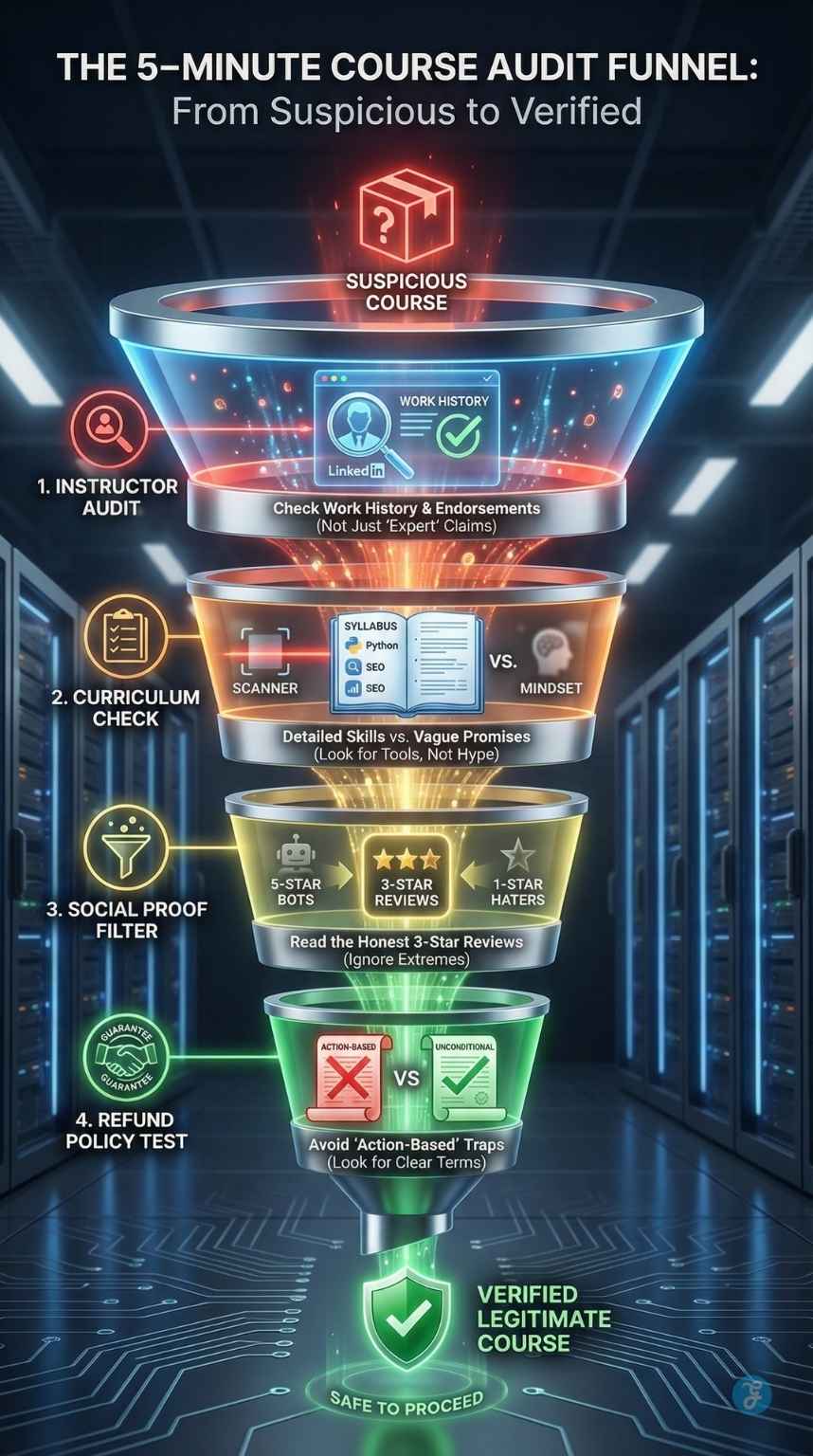
Before you invest $500, $1,000, or $5,000 into a course, you need to perform a due diligence audit. Think of this as a background check for your education.
Step 1: The LinkedIn “Reverse” Search
Don’t just look for their profile; audit it.
- Check the Tenure: Did they become an “Expert” in 2025? Or do they have 5-10 years of experience in the field?
- Check the Companies: Are the companies they worked for real? Scammers often list “Self-Employed” or “CEO at [Generic Name] Media” for their entire history.
- Check the Endorsements: Are they endorsed by other real people in the industry, or just random bot accounts?
Step 2: The “3-Star Review” Strategy
Ignore 5-star reviews; they are often bought or incentivized (e.g., “Leave a 5-star review to unlock the bonus module!”). Ignore 1-star reviews; they can be from angry competitors or people who simply didn’t do the work. Read the 2, 3, and 4-star reviews.
These are usually from real humans who found some value but were honest about the flaws. Look for comments like:
- “Content was okay, but mostly available for free on YouTube.”
- “Audio quality was poor.”
- “The instructor was never present in the community.”
Step 3: Image & Income Forensics
Scammers use “Inspect Element” to edit the HTML of their banking dashboards to show fake numbers.
- Video Verify: Do they refresh the page on video? Even this can be faked, but it’s harder.
- Reverse Image Search: Take screenshots of their “Student Success” testimonials. Run them through Google Lens. You will often find these faces are stock photos or stolen from other websites.
The “Review Laundering” Network: Why You Can’t Find Bad Reviews
Ever searched “Is [Guru Name] a Scam?” and found 10 articles from legitimate-looking news sites saying they are a genius? This is called Reputation Laundering.
Scammers pay PR agencies to publish “Press Releases” on sites like Yahoo Finance, Business Insider (sponsored posts), or seemingly independent blogs. These are paid advertisements disguised as news.
How to Spot a Fake Review Article
- The “Sponsored” Tag: Look for tiny text at the top or bottom saying “Sponsored Content” or “Brand Partner.”
- The Affiliate Link: If the article concludes with a big button saying “Join The Course Here,” it is an affiliate marketing piece, not an objective review. The writer gets paid if you buy.
- Disabled Comments: Real news articles usually allow comments. Fake PR pieces often disable them to prevent victims from warning others.
- Parasitic SEO: Scammers often create their own review sites (e.g., “https://www.google.com/search?q=BestCourseReviews2026.com”) and rank them #1 on Google to praise their own products.
Table: The Due Diligence Checklist
| Checkpoint | Pass Criteria | Fail Criteria |
| Instructor | Verifiable history on LinkedIn/Industry sites. | “Hidden” identity or brand new profile. |
| Curriculum | Detailed syllabus with specific tools/skills. | Vague modules like “Mindset Mastery” or “The Secret”. |
| Price | Transparent, aligns with market rates. | “Valued at $10,000, yours for $97!” (False Anchoring). |
| Testimonials | specific outcomes, verifiable people. | “This changed my life!” (Generic), blurrier names. |
| Support | Clear contact email/support desk. | Only a DM or a “Contact Us” form with no address. |
Semantic Saturation: Why “Fake Gurus” Use Confusing Language
In 2026, scammers have adopted “Pseudo-Intellectual” language to mask the shallowness of their content. They use complex acronyms and NLP (Neuro-Linguistic Programming) words to sound authoritative.
Watch out for these meaningless buzzwords:
- “Quantum Scaling”: Meaningless jargon for “growing a business.”
- “Neuro-Marketing Secrets”: Usually just basic sales psychology 101.
- “Algorithmic Alignment”: A made-up term to imply they control social media platforms.
- “Passive Income Ecosystem”: Often code for “Pyramid Scheme.”
If an instructor cannot explain what they teach in simple, plain English, they likely do not understand it well enough to teach it, or they are hiding the fact that there is nothing to teach.
Case Studies: The “Success” That Wasn’t
To illustrate these concepts, let’s look at hypothetical examples based on real 2026 trends.
Case A: The “AI Architect” [The Tech Scam]
The Pitch: “Learn to build AI infrastructures for Fortune 500 companies and charge $50k per project. No coding needed.”
The Reality: The course taught basic ChatGPT prompting (available for free) and how to use Zapier.
The Red Flag: The instructor claimed to have worked with “Top Tech Giants” but refused to name them due to “NDAs” (Non-Disclosure Agreements). In reality, real consultants have portfolios they can share.
Case B: The “Faceless Wealth” [The Media Scam]
The Pitch: “Automate 100 YouTube channels and make $30k/month passive income.”
The Reality: YouTube’s 2026 algorithm aggressively penalizes mass-produced AI content. Students spent months generating spam videos that got zero views or were banned for “Repetitive Content.”
The Red Flag: The instructor showed revenue screenshots but never showed the actual channels they owned. Why? Because the channels were likely banned or didn’t exist.
What To Do If You Have Been Scammed
If you realize you have purchased a useless course or fallen for a scam, do not feel ashamed. These operations are designed by teams of marketers and psychologists to trick you. Here is your recovery plan.
1. Document Everything Immediately
- Download the invoice.
- Screenshot the “Money Back Guarantee” on the sales page (use the Wayback Machine if they changed it).
- Screenshot your emails asking for a refund and their refusal.
- Download the course syllabus to prove that the content did not match the promise.
2. The Chargeback Process
Contact your credit card issuer or PayPal. File a dispute for “Item Not as Described” or “Service Not Received.”
- Do not say “Fraud” (which implies your card was stolen).
- Do say “Misrepresentation of Product.” Provide your dossier of evidence.
- Note: If you used crypto, the money is likely gone. This is why scammers love crypto payments.
3. Report Them
- USA: Federal Trade Commission (FTC) at ReportFraud.ftc.gov.
- UK: Action Fraud.
- Global: Trustpilot and Reddit (r/scams or r/marketing).
- Warning Others: Write a factual, emotion-free review. Stick to the facts: “I requested a refund on Date X per the policy, and was denied because of Reason Y.” This protects you from libel accusations while warning future victims.
The Legal Loophole: The “Consulting Agreement” Trick
Why do banks often deny chargebacks for these scams? Because the scammer made you sign a digital contract that redefines what you bought.
When you buy a high-ticket course, they often send a DocuSign agreement.
- The Trick: The contract states you are purchasing “Consulting Services” or “Digital Access,” not a guarantee of income.
- The Waiver: It usually includes a clause where you “Waive your right to a chargeback” and acknowledge that “No results are guaranteed.”
The Defense: If a “guru” asks you to sign a contract after you have paid but before you get access, read it carefully. If the contract contradicts the sales pitch (e.g., the pitch said “Guaranteed Success” but the contract says “For Educational Purposes Only”), do not sign it. Demand a refund immediately. Once you sign, you have legally agreed that their marketing lies were just “puffery” and not binding promises.
Legit Alternatives: Where to actually Learn
The tragic irony of course scams is that high-quality education has never been cheaper or more accessible. You do not need to pay a “Guru” $2,000.
Top-Tier Accredited Platforms
- Coursera & edX: Learn directly from universities (Harvard, MIT) or tech giants (Google, IBM, Meta). These certificates carry actual weight on a resume.
- Udemy: While quality varies, the platform has a strict 30-day refund policy that they actually honor.
- HubSpot Academy: Excellent, free certification for digital marketing and sales.
- Specific Skill Platforms:
- Coding: FreeCodeCamp, Odin Project.
- Design: Dribbble, Behance tutorials.
- Data: DataCamp.
Table: The Cost of Knowledge
| Topic | The Guru Price | The Legit Price | Value Difference |
| Digital Marketing | $997 – $2,500 | Free (HubSpot/Google) | Legit certs are recognized by employers; Guru certs are not. |
| Data Science | $3,000 Bootcamp | $49/mo (Coursera) | Coursera offers degrees; Bootcamps often offer empty promises. |
| Dropshipping | $1,500 “Masterclass.” | Free (YouTube/Shopify) | Information is identical; the Guru just organizes it. |
Final Thought: The Shortcut is the Longest Road
The allure of the “Course Scam” is the promise of a shortcut. We all want to believe there is a secret elevator to the top of the mountain. But in 2026, just like in 1926, the only way to the top is the climb.
Legitimate success comes from acquiring valuable skills, applying them consistently, and enduring failure. A $997 course will not save you from the work; it will only deplete the resources you need to do it. Save your money, trust legitimate institutions, and invest in your own ability to learn and adapt—that is the only asset that no guru can sell you, and no scammer can take away.
Found a suspicious course? Don’t buy it yet. Run it through the Verification Funnel above, or stick to accredited education paths.