
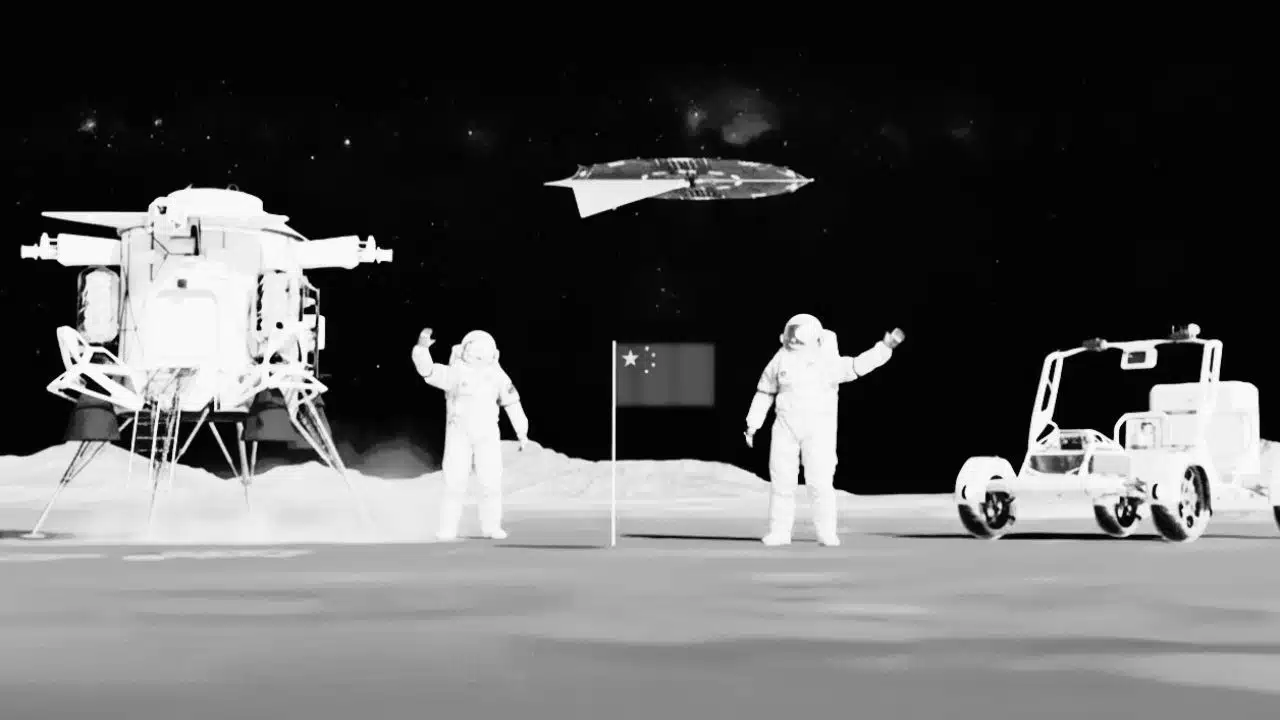
China has reaffirmed its commitment to landing astronauts on the moon by 2030, with officials declaring that all development programs are progressing smoothly and that the nation’s fixed goal remains firm and unwavering.
The announcement came as the country prepared to launch its next crew rotation to the Tiangong space station, demonstrating China’s dual focus on maintaining near-Earth orbital operations while simultaneously advancing its ambitious deep-space exploration objectives.
Strategic Mission Goals and Objectives
China’s manned lunar landing mission represents a pivotal milestone in the nation’s broader space exploration strategy, focusing on mastering critical technologies including manned Earth-Moon round trips, short-term stays on the lunar surface, and human-robot collaborative exploration. The mission will encompass a comprehensive range of tasks, including landing on the moon’s surface, roving across the terrain, sampling geological materials, conducting scientific research, and safely returning astronauts to Earth.
According to detailed animations released by the China Manned Space Agency at the Human Space Symposium, astronauts will drive lunar rovers on the moon’s surface with planned three-day driving routes centered on the landing area. The program aims to conduct large-scale space science experiments targeting three key areas: lunar science, lunar-based science, and resource exploration and utilization.
Core Hardware and Vehicle Systems
The crewed lunar program relies on an integrated suite of specially developed spacecraft, rockets, and equipment, with primary preliminary prototyping of all key flight hardware now completed. The Long March-10 carrier rocket serves as the primary launch vehicle and has successfully completed second-stage propulsion system tests and captive firing tests.
The Mengzhou manned spacecraft, primarily designed for lunar missions while also supporting space station operations in low-Earth orbit, has undergone zero-altitude escape tests and is scheduled for additional thermal and maximum dynamic pressure escape testing. The Lanyue lunar lander has successfully completed comprehensive landing and takeoff verification tests and awaits integrated testing prior to operational missions.
The specialized Wangyu lunar extravehicular suit, unveiled in September 2024, features a distinctive red-and-white design engineered to withstand the moon’s extreme temperatures, radiation, and abrasive dust while providing astronauts with the necessary flexibility to execute critical surface tasks. Integrated within the suit are both long and short-range cameras, an operations console, and an advanced visor designed to minimize glare for optimal visibility. Finally, the Tansuo crewed lunar rover has been developed to support exploration and sample collection activities on the lunar surface.
Recent Testing Achievements and Milestones
The lunar program has demonstrated substantial progress through a series of successful tests conducted throughout 2025. These accomplishments include the second-stage propulsion system test for the Long March-10 rocket, validating the vehicle’s ability to generate sufficient thrust for lunar missions; the captive firing test for the Long March-10, confirming engine stability and performance; the zero-altitude escape test for the Mengzhou spacecraft, verifying astronaut emergency egress systems; and the comprehensive landing and takeoff verification test for the Lanyue lander, confirming the vehicle’s capability to safely descend to and ascend from the lunar surface.
Additionally, payload designs for scientific research and applications have been finalized, providing the mission with necessary instrumentation and experimental apparatus.
Intensive Testing Schedule Ahead
China has outlined a packed and rigorous testing schedule to advance the program toward its 2030 target. Upcoming critical tests include integrated testing for the Lanyue lunar lander to validate all systems operating in concert; thermal tests for the Mengzhou manned spacecraft to ensure systems function reliably in extreme temperature conditions; maximum dynamic pressure escape tests for the Mengzhou spacecraft to confirm astronaut safety during critical launch phases; and low-altitude and technology verification flights for the Long March-10 carrier rocket to demonstrate flight readiness.
CMSA spokesperson Zhang Jingbo emphasized that numerous new technologies still require validation, and the upcoming workload is heavy given the high-quality standards and tight timeline for flight tests. The project team has pledged to overcome these challenges and lay a solid foundation for achieving the nation’s lunar exploration goal on schedule.
Ground Infrastructure Development
Beyond spacecraft and vehicle development, China is accelerating the development of essential ground-based infrastructure required for the lunar program’s success. This infrastructure encompasses the launch site facility from which lunar missions will depart, the comprehensive tracking network required to monitor spacecraft throughout their journey to and from the moon, and designated landing sites on Earth where astronauts and mission components will return.
These facilities represent critical components of the overall mission architecture and are being developed in parallel with spacecraft testing activities.
Mengzhou-1 Public Logo Solicitation
In a notable step highlighting public engagement, CMSA spokesperson Zhang Jingbo announced that the Mengzhou-1 spacecraft mission will be included in a public logo solicitation campaign alongside missions to China’s space station.
This spacecraft is primarily designed for lunar missions while also supporting space station missions in low-Earth orbit, representing a versatile platform that can serve multiple operational objectives. The public logo campaign reflects efforts to build national pride and public awareness surrounding the ambitious lunar program.
Concurrent Tiangong Space Station Operations
Complementing its lunar ambitions, China is executing its scheduled crew rotation for the Tiangong space station, demonstrating the continuity and sophistication of its human spaceflight program. The latest crew comprising Cai Xuzhe (mission commander), Song Lingdong, and Wang Haoze will launch from the Jiuquan Satellite Launch Center on October 30, 2025, at 11:44 p.m. Beijing time. Cai Xuzhe previously served as commander of the Shenzhou-15 mission, while Song Lingdong and Wang Haoze are making their first journeys to space.
The crew will spend six months aboard the station conducting research and maintaining facility operations. Notably, the mission will transport four mice—two male and two female—to study the effects of weightlessness and confinement on living organisms, contributing to scientific understanding essential for long-duration human space missions.
Strategic Context and International Competition
China’s sustained commitment to its 2030 lunar landing goal reflects the nation’s broader determination to establish itself as a leader in space exploration. The development of an independent space station program, following China’s exclusion from the International Space Station due to U.S. national security concerns, demonstrates the country’s strategic focus on achieving autonomous spacefaring capabilities.
The parallel advancement of both near-Earth orbital infrastructure and deep-space lunar exploration objectives underscores China’s comprehensive approach to establishing long-term human presence and scientific research capabilities in space.