Do you ever look at your daily routine and wonder if your green habits are actually making a dent? You recycle your cardboard, you try to use less water, and maybe you even feel a tiny pang of guilt every time you fill up your gas tank. I totally understand that feeling. We all want to do our part to protect the environment. You have probably heard people talk about programs that help the planet, and you might be asking yourself, “Carbon Offsetting: Does It Actually Work?”
Many airlines and major retail companies now offer these programs directly at checkout. They let you pay a small fee to cancel out your carbon footprint by supporting clean energy or planting trees somewhere else in the world. But are these initiatives truly effective, or just a feel-good distraction?
Grab a cup of coffee, and let’s go through it together. I will break down exactly how these programs operate, share a few simple tricks to spot the real ones, and show you exactly what to look for, and I think you will be surprised at how easy it can be to make a real difference.
What Is Carbon Offsetting?
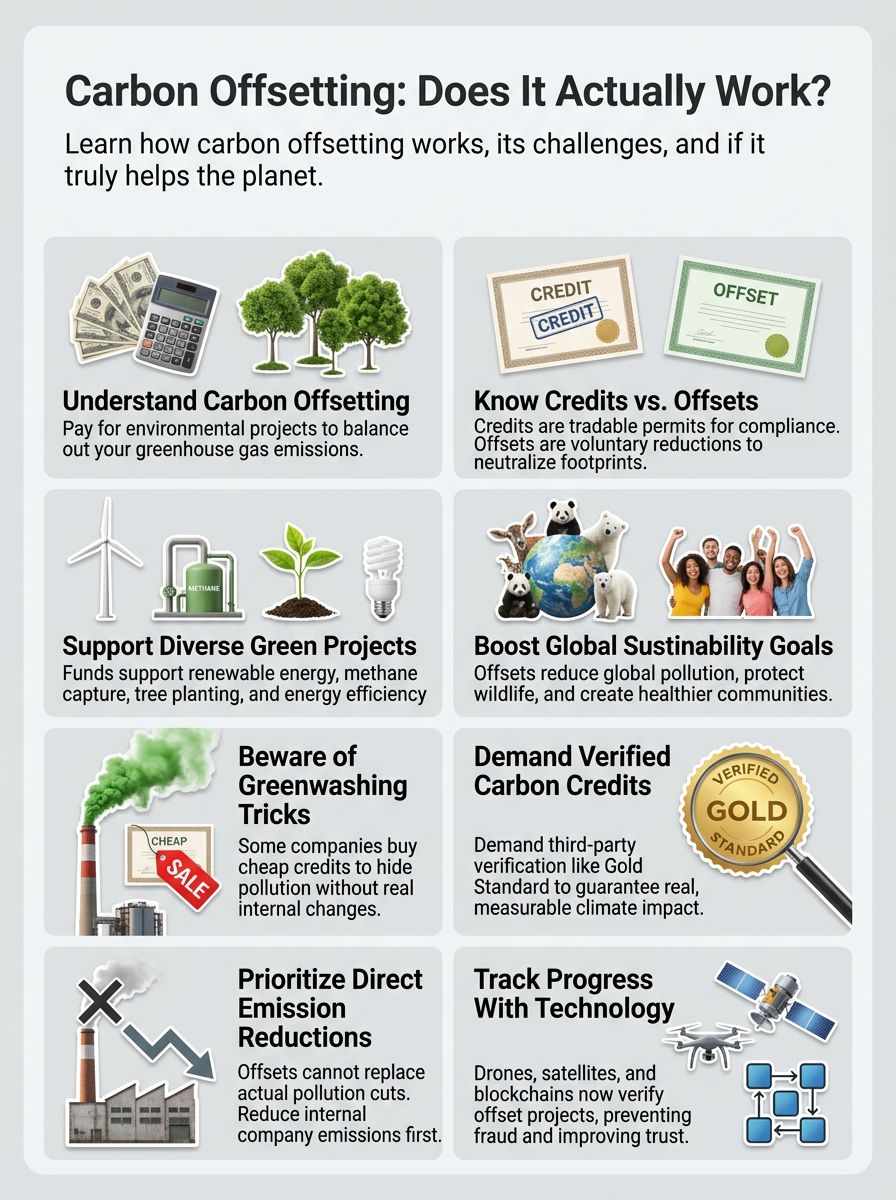
Carbon offsetting is a specific method used to balance out the greenhouse gases we put into the air. It tries to make up for pollution by funding external projects that help our planet heal.
Definition of carbon offsetting
People use carbon offsetting to balance out their greenhouse gas emissions. Say you take a long flight, drive your car every day, or run a manufacturing facility. That activity adds pollution directly to the air.
Carbon offsetting means you pay for projects that pull the exact same amount of pollution back out, or stop it from being released in another place entirely.
According to the US Environmental Protection Agency, the average American produces about 14 tons of carbon dioxide each year. That means balancing your personal ledger takes a significant amount of effort.
As Jane Goodall wisely said, you cannot get through a single day without having an impact on the world around you.
A great example is planting trees. Trees soak up carbon dioxide as they grow, acting like nature’s vacuum cleaner for the sky. By paying for these projects, people and companies try to shrink their impact on climate change and make progress in sustainability.
How carbon offsetting works
Companies or individuals start by measuring exactly how much greenhouse gas they produce. Next, they pay for certified projects that cut the same amount of emissions somewhere else.
For example, if a US business makes 100 tons of carbon dioxide each year, it might support planting enough native trees to absorb those 100 tons over time. Some offset projects build wind farms or solar panels to replace coal power and reduce future pollution.
The money from these payments goes straight to the project developers. To guarantee the process is accurate, every ton of avoided pollution is tracked using a specific framework.
Here is the standard step-by-step process used by top sustainability programs:
- Calculate: A business uses an auditor to calculate its total annual carbon footprint.
- Purchase: The business buys certified carbon credits equal to its emissions.
- Fund: That money funds a specific project, like a new clean energy facility.
- Retire: The purchased credits are “retired” on a public registry so they cannot be sold again.
The hope is to completely balance out a personal or company footprint while helping global conservation efforts at the same time.
Understanding Carbon Credits
Carbon credits act like special vouchers for cutting down greenhouse gases. Some people mix them up with carbon offsets, but there is a big difference that you should know about.
What are carbon credits?
A carbon credit is essentially a digital coupon that represents a measurable environmental benefit. Companies earn or buy one credit for cutting down greenhouse gases by one metric ton.
These credits help people and companies direct money to support actions that fight climate change, such as capturing methane gas or building solar grids. Governments often set strict limits on pollution, then hand out these credits so businesses do not go overboard with emissions.
The global carbon offset market is massive and growing fast. Market analysts at Coherent Market Insights project that the global carbon offset market will be valued at over $666 billion by 2025.
Here is a quick look at who drives this massive market:
- Regulated Industries: Power plants and factories that must obey government emission caps.
- Tech Giants: Companies like Microsoft that make public pledges to become carbon negative.
- Airlines: Carriers buying credits to meet international aviation emission standards.
- Everyday Consumers: Shoppers voluntarily pay a few extra dollars to offset their shipping emissions.
North America is a major player in this space. Experts expect the region to hold roughly 43.5% of the total market share in 2025 due to strict new climate policies.
Difference between carbon credits and carbon offsets
Grasping the exact difference between carbon credits and carbon offsets can really help you navigate climate action conversations. The terms get tossed around a lot, but they have distinct meanings in the industry.
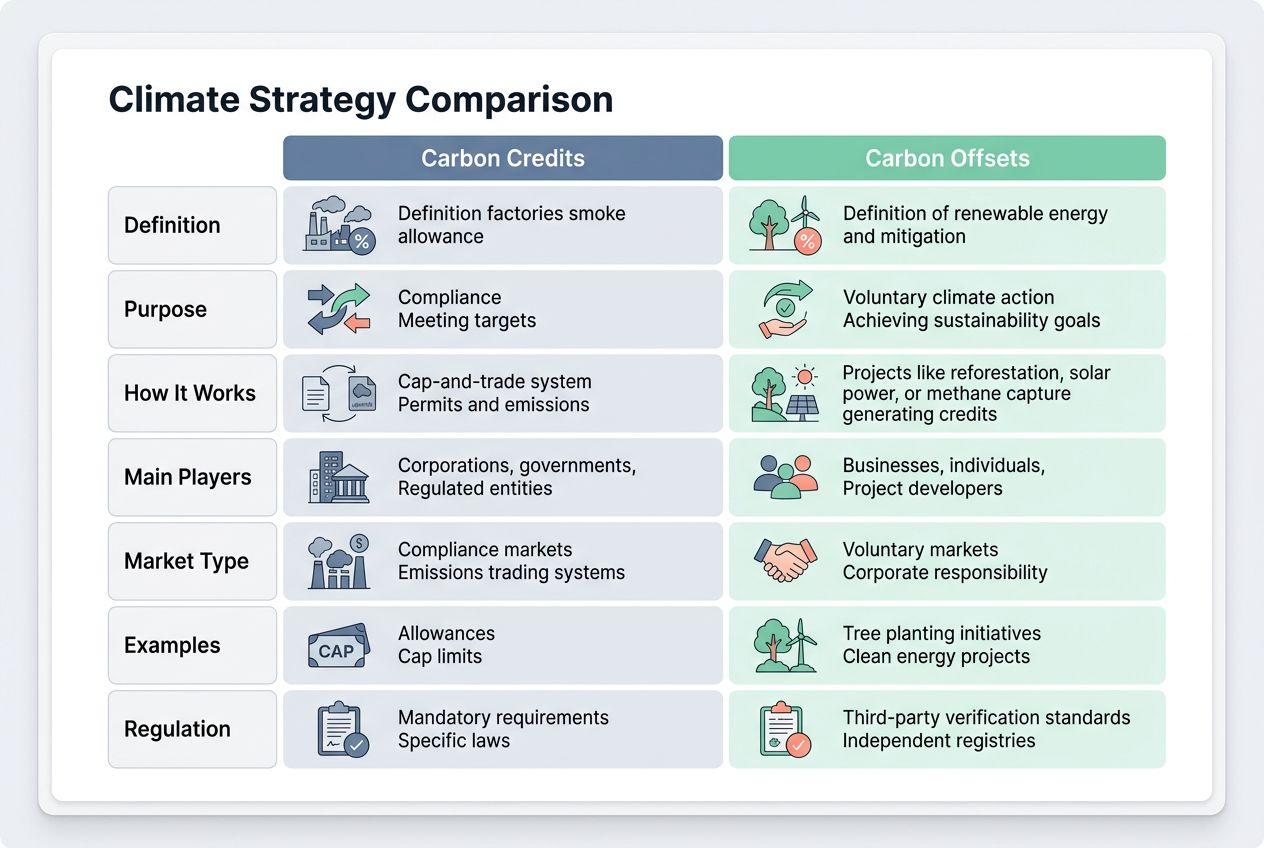
Think of a carbon credit as a permission slip required by law, while a carbon offset is a voluntary apology for your emissions. Check out this breakdown:
| Aspect | Carbon Credits | Carbon Offsets |
|---|---|---|
| Definition |
A tradable permit represents one metric ton of CO2 avoided or removed.
|
Measurable reduction in greenhouse gases is used to counterbalance emissions.
|
| Purpose |
Used in regulatory compliance markets, like the EU ETS.
|
Used by individuals, companies, or events to neutralize their own emissions.
|
| How It Works |
Governments or authorities set a cap. Companies get credits, can trade or sell if under the cap.
|
The project reduces or removes emissions. Others buy these reductions to balance out their carbon footprint.
|
| Main Players |
Governments, large industries, and regulated sectors.
|
Voluntary buyers, companies, individuals, and events.
|
| Market Type |
The compliance market started in 2005 with the Kyoto Protocol.
|
The voluntary market is often smaller and more varied.
|
| Examples |
EU Emission Allowances, California Cap-and-Trade Program credits.
|
Tree planting projects, renewable energy certificates, and cookstove initiatives.
|
| Regulation |
Heavily regulated, tied to government rules and caps.
|
Less regulated, but often verified by standards like the Gold Standard or VCS.
|
Types of Carbon Offset Projects
Some projects focus entirely on trapping dangerous gases, while others aim to grow more trees or save electricity. Each project takes a unique path, but they all share the common goal of lowering harmful emissions.
Renewable energy projects
Wind farms and solar panels help lower greenhouse gases by generating clean, green power. These smart projects replace aging coal or oil plants, which constantly send carbon into the air.
Every single megawatt-hour of renewable electricity can prevent almost one full ton of CO2 emissions from reaching the atmosphere. The US is seeing massive growth in this sector, with states like Texas leading the nation in wind energy production.
Investing in renewable energy offsets directly funds the transition away from fossil fuels, creating a cleaner power grid for future generations.
Buyers use these energy credits to cancel out their own emissions on paper. This helps companies shrink their carbon footprint while also boosting sustainable practices worldwide.
Methane collection and combustion
Cows, local landfills, and even rice fields release a massive amount of methane directly into the air. This specific gas is incredibly dangerous because it traps much more heat than carbon dioxide does over a short period.
The US EPA notes that municipal solid waste landfills are the third-largest source of human-related methane emissions in the United States. Quality offset projects trap this methane from garbage dumps and old coal mines right before it escapes into the sky.
The trapped gas can then be burned to make useful electricity or used as fuel for delivery trucks. Burning methane lowers its immediate danger for climate change since the fire turns it mostly into carbon dioxide and water vapor.
Reforestation and afforestation
Reforestation means planting new trees in areas where historic forests have been cut down. Afforestation is the practice of planting trees in completely new places that never had forests before.
Trees act like giant natural sponges. They actively clean greenhouse gases from the sky and store the carbon safely in their trunks, leaves, and the surrounding soil.
A vital insider tip to watch out for is the species of trees being planted. High-quality projects always use a diverse mix of native tree species rather than planting a single type of pine tree. Monoculture forests are bad for local wildlife and are much more likely to catch fire or succumb to disease.
Energy efficiency projects
Energy efficiency projects cut expensive energy waste in our homes, local offices, and massive factories. These projects focus on upgrading old technology to modern standards.
Smart thermostats and better building insulation help keep warm air inside during the cold winter months. This means you burn less heating fuel and pump far fewer greenhouse gases into the sky.
Here are a few common energy efficiency upgrades that generate reliable carbon offsets:
- Swapping out old, heat-producing incandescent lights for cool LED bulbs.
- Upgrading massive industrial heating systems to high-efficiency electric heat pumps.
- Installing ENERGY STAR-certified smart windows in large commercial buildings.
- Distributing clean-burning cookstoves to rural communities to reduce open-fire wood burning.
Such changes lower utility bills incredibly fast while shrinking your daily carbon footprint.
Industrial pollutant destruction
Next to basic energy efficiency, some advanced projects attack greenhouse gases straight from the factory floor. They use special technology to break down highly harmful gases like nitrous oxide or hydrofluorocarbons before these toxic fumes escape into the air.
These specific chemicals are incredibly potent. For instance, the EPA states that one ton of nitrous oxide traps heat just as much as 298 tons of standard carbon dioxide.
Factories install dedicated units that destroy these exact pollutants with extremely high temperatures or safe chemicals. Some specialized companies set up credits for each ton destroyed, so other businesses can buy them through offset programs, too.
Benefits of Carbon Offsetting
Carbon offsetting can absolutely spark big, positive changes for everyday people and the planet. It is much like planting seeds that eventually grow into healthier local communities and much cleaner skies.

Reducing greenhouse gas emissions
Planting trees clearly helps trap carbon dioxide, which is one of the main greenhouse gases harming our atmosphere. Building more community wind and solar farms stops some pollution right before it ever enters the air.
Farms that actively collect methane from farm animals or local landfills turn a terribly strong gas into usable energy instead of letting it leak out. Energy-saving projects in residential homes and commercial factories cut heavy waste right at the source.
Ecosystem Marketplace data shows that in 2023, people utilized almost two billion metric tons’ worth of carbon offsets worldwide.
These specialized offset projects work perfectly beside your direct efforts, like using less fuel or turning off the electricity day by day.
Supporting environmental projects
Carbon offset projects breathe fresh life directly into local ecosystems. Some targeted efforts restore ancient forests, which profoundly help clean our air and hold back dangerous deforestation.
Other popular projects invest in critical renewable energy, like offshore wind or massive solar power arrays. In the US, organizations like the National Forest Foundation use these funds to plant millions of trees across our national public lands.
Local farmers can update their aging equipment to save diesel energy and lower greenhouse gases right on the farm. These projects naturally boost good jobs for local people, protect endangered animals, and give children much healthier places to play.
Contribution to the UN Sustainable Development Goals
Offset projects play a wonderfully big part in helping nations reach the UN Sustainable Development Goals, which officially started in 2015. These specific projects do far more than just cut greenhouse gases.
For example, planting trees can effectively lift people out of poverty, beautifully restore wildlife habitats, and drastically clean the local air. Renewable energy efforts bring bright light to places without reliable power and help rural schools or clinics run much better.
High-quality carbon projects usually support these specific UN goals:
- Goal 13 (Climate Action): Directly reducing the amount of CO2 in the atmosphere.
- Goal 15 (Life on Land): Restoring degraded forests and protecting vulnerable biodiversity.
- Goal 8 (Decent Work and Economic Growth): Creating new, green jobs for local communities.
- Goal 7 (Affordable and Clean Energy): Funding the construction of new solar and wind farms.
Every small step cuts emissions while making daily life much fairer for everyone involved. It is a fantastic win-win scenario that is good for both the planet and its people.
Challenges and Criticisms of Carbon Offsetting
Some vocal critics say carbon offsetting is a lot like putting a tiny bandage on a badly broken bone. They rightly wonder if it truly solves the bigger climate problems or just covers them up temporarily.
Concerns about greenwashing
Many large companies proudly claim to lower their corporate carbon footprint by buying cheap carbon credits. Sometimes, these bold claims give consumers a completely false sense of actual progress.
For example, big businesses may keep polluting heavily while using distant offset projects as a convenient cover to avoid making any real changes. This deceptive practice is known as greenwashing.
Greenwashing directly tricks well-meaning customers and makes it look like real action is happening when it absolutely is not. A pro-tip I always share is to watch out for brands that use vague terms like “eco-friendly” without linking to a transparent, public registry to prove their offset purchases.
Oversight and quality assurance issues
Some heavily marketed carbon offset projects make massive promises, but completely fail to deliver on them. Poor initial checks on projects such as massive tree planting or methane capture can mean absolutely no real benefit for the climate.
Without enforcing strong rules or honest third-party audits, some of these credits look fantastic on paper but actually do nothing at all for greenhouse gases.
A massive 2023 investigation by the UC Berkeley Carbon Trading Project revealed a startling truth. They found that up to 94% of the rainforest offset credits certified by Verra were actually ‘phantom credits’ that offered zero benefit to the climate.
Companies sometimes buy these incredibly cheap and easy credits just to appear green to their customers. Tight rules, regular unannounced checks, and completely open records are urgently needed so buyers know their money is making a true difference.
Limitations of forestry-based projects
Forestry-based offset projects often face uniquely big hurdles. Physical forests can easily burn down, be chopped down illegally, or simply die from a new disease.
Severe wildfires in California have frequently shown exactly how easily this tragic loss happens in protected offset areas. Projects may confidently claim they store carbon, but they instantly lose it all if the trees are destroyed or cut down too soon.
Because of intense public scrutiny regarding these exact failures, Verra announced they are officially phasing out its deeply flawed rainforest offset program by mid-2025. It simply takes many years for tiny new forests to absorb enough greenhouse gases to offset the daily pollution from our cars or planes right now.
Lack of impact on internal corporate emissions
Many major businesses buy carbon credits while their own local factories or home offices keep polluting the exact same amount. Companies pay millions for offset projects located far away, but their local community emissions stay mostly unchanged.
For example, a large US tech company might eagerly support tree planting overseas, yet its local data servers still use an incredible amount of electricity from fossil fuels right at home. Offsets may help somewhere else on a spreadsheet, but they do not push these companies to cut actual greenhouse gases in their daily operational work.
Here are the real changes companies must make instead of just buying offsets:
- Installing solar panels directly on the roofs of their own factories.
- Transitioning their entire corporate delivery fleet to electric vehicles.
- Upgrading all office HVAC systems to high-efficiency models.
- Investing heavily in Sustainable Aviation Fuel for their necessary business travel.
A great example of this shift is Delta Air Lines. In 2022, Delta officially ended its pure carbon offset program to focus heavily on real emission cuts, like targeting a 10% usage rate of Sustainable Aviation Fuel at LAX by 2025.
Key Mechanisms and Frameworks for Carbon Offsetting
Many complex rules and systems carefully guide how carbon offsetting works around the world. These specific frameworks shape the exact way companies and nations take coordinated action on cutting emissions.
Kyoto Protocol
The historic Kyoto Protocol set a firm target for richer countries to drastically lower their greenhouse gas emissions. Signed back in 1997 and officially put into action in 2005, it created strict rules for each participating country.
Some large economies, like the United States, did not accept it at the time. The main trick up its sleeve was the creation of a global carbon credit system.
It established the Clean Development Mechanism, allowing wealthy countries to earn carbon credits by funding emission-reducing projects in developing nations. Each certified credit stood for one metric ton of carbon dioxide successfully kept out of the air.
Paris Agreement Article 6 mechanisms
Article 6 of the famous Paris Agreement sets the modern rules for countries to actively work together and cut greenhouse gas emissions. These updated rules make it much easier and safer for nations to buy and sell verified carbon credits.
For example, one country can cleanly fund a massive renewable energy project in another place and use the resulting savings as part of its own good deeds against climate change.
Article 6 introduced Internationally Transferred Mitigation Outcomes (ITMOs), a strict system designed to keep accounting honest and ensure emission cuts are never accidentally counted twice by two different countries.
Countries must openly share incredibly clear records and meticulously track all moving carbon credits. This strict way guarantees that every single step gets thoroughly checked by experts.
REDD+ initiatives
REDD+ stands for Reducing Emissions from Deforestation and Forest Degradation. It officially started in 2008, directly under the United Nations climate framework.
This powerful program pays developing countries vital funds to keep their mature forests standing. In 2022 alone, the REDD+ program successfully issued over 136 million verified carbon credits worldwide.
Forests play a huge part in capturing floating greenhouse gases. REDD+ strongly encourages much better forest management by giving massive financial rewards if old trees are left untouched instead of being cut down for quick timber.
CORSIA framework for aviation
CORSIA works specifically to dramatically cut emissions from commercial flights traveling between different countries. The program officially stands for the Carbon Offsetting and Reduction Scheme for International Aviation.
Airlines that fly across international borders must strictly keep their total carbon footprint at their established 2020 baseline levels. If they go over that baseline, they must buy high-quality carbon credits to perfectly balance out the extra greenhouse gases.
Here are a few key facts about how CORSIA impacts modern aviation:
- The system officially began its pilot phase in 2021 under the UN’s International Civil Aviation Organization.
- US airlines alone were responsible for over 55 million tons of emissions subject to CORSIA rules in 2024.
- Airlines are now pushing to buy Sustainable Aviation Fuel (SAF) to reduce their direct need for these offset credits.
- The framework aims to completely halt the growth of global airline pollution even as passenger numbers skyrocket.
Ensuring the Quality of Carbon Offsets
Finding high-quality carbon offsets is a lot like searching for a golden ticket. They are sometimes hard to spot, but they truly make all the difference in the world for our climate.
Criteria for assessing offset quality
Good, verified carbon offsets can make a genuine difference. Weak, unverified ones do absolutely very little for the actual planet or climate change.
To find the best projects, I highly recommend looking for programs that follow the strict Oxford Principles for Net Zero Aligned Carbon Offsetting.
- Every offset should be additional, which means the project would not happen without your payment.
- Projects must avoid double-counting, so only one person or group claims the benefit.
- Carbon reductions have to be measurable. You need hard numbers, not just hopeful guesses.
- The impact must last for an incredibly long time, sometimes 100 years or more. Quick fixes will not help reduce long-term emissions.
- Each project should be verified by third-party groups like Verra or Gold Standard to cut down on greenwashing and false claims.
- Careful monitoring across all years helps track real success against claimed reductions.
- Transparency is key; every day, people need access to clear data on exactly where the money goes.
- The project should not hurt local communities, local wildlife, or sensitive ecosystems.
- Offset projects like natural forests need guaranteed protection from risks such as summer fires or tree loss due to pests.
- Certified projects often report their final results in accessible public registries so anyone can verify the progress.
Importance of certification and verification
Independent certification and strict verification act as a critical safety net for all carbon credits. These mandatory steps help officially prove each offset is completely real, and not just fancy marketing words on paper.
Respected groups like the Gold Standard and the Climate Action Reserve set incredibly tough rules for projects to pass before they ever give out certificates. Without independent checks like this, major companies might just pay for cheap offsets that do absolutely nothing for the actual air or forests.
A strong, public stamp of approval from a rigorous outside group gives everyone much more faith in these climate action efforts.
With highly trusted systems securely in place, buyers sleep better knowing their hard-earned cash supports true environmental impact and real sustainability goals.
Does Carbon Offsetting Actually Work?
Can simply planting trees or buying digital credits really cut down on global pollution, or is it just clever corporate smoke and mirrors? Let’s look closely at the actual results.
Evaluating effectiveness in reducing emissions
Carbon offsetting can absolutely help lower total greenhouse gas emissions, but the final results depend entirely on how well each specific project works. Some targeted solar and wind projects cut down dirty emissions right away.
Tree planting projects naturally take much longer since young trees need decades to fully soak up significant carbon dioxide. Quality matters incredibly too; only certified credits from verified projects actually reduce emissions and completely avoid double-counting.
Organizations like the Science-Based Targets initiative provide incredibly strict guidance here. They actively require that a company must aggressively cut at least 90% of its own internal emissions before using carbon offsets to cover the final 10%.
Balancing offsetting with direct emission reductions
Looking at exactly how much these offsets reduce emissions, it is incredibly clear that credits alone cannot permanently fix climate change. Many climate experts constantly warn major companies against using carbon credits as a cheap, free pass to just keep polluting.
Real progress only happens when massive companies dramatically lower their greenhouse gases right from the very start. They must switch directly to clean energy or stop massive leaks and daily waste in their own manufacturing process.
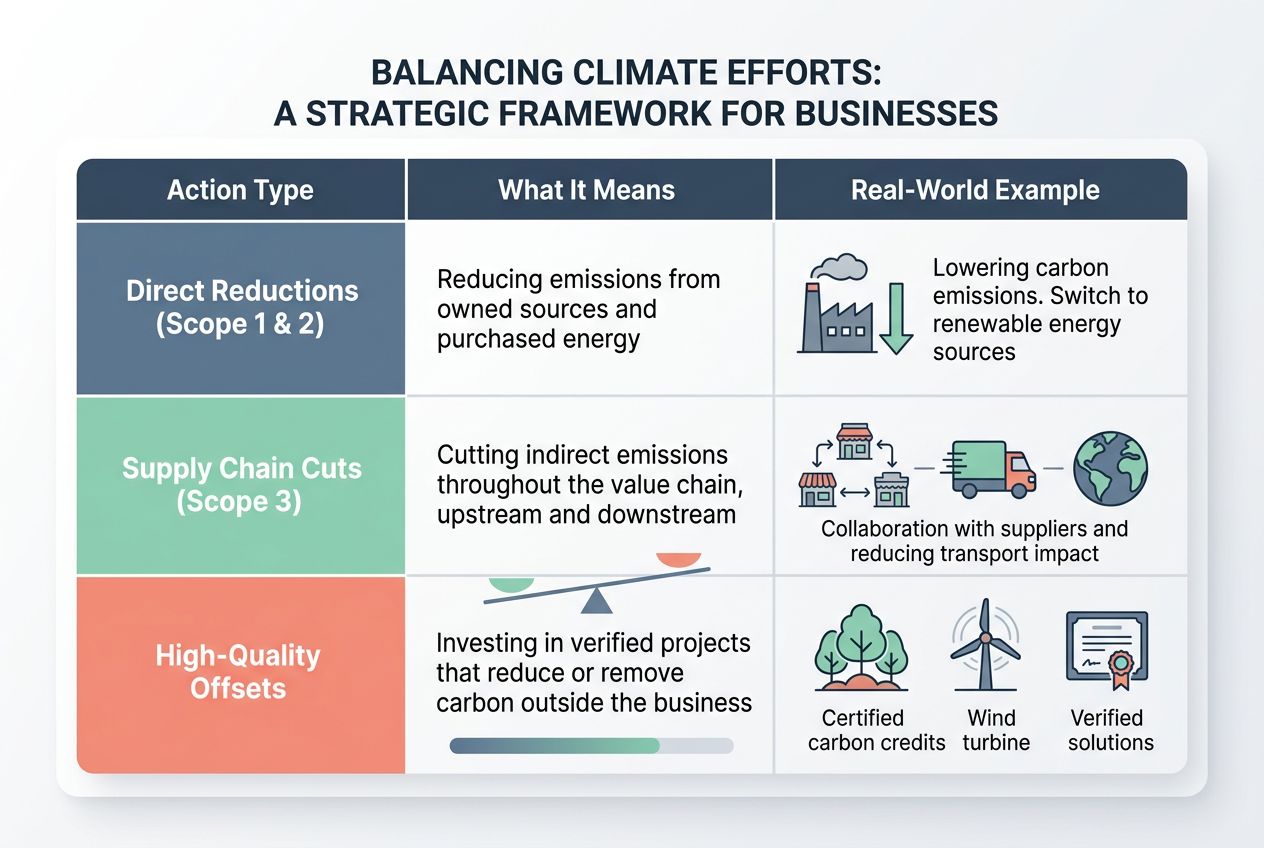
Here is a simple way to look at how businesses should balance their efforts:
| Action Type | What It Means | Real-World Example |
|---|---|---|
| Direct Reductions (Scope 1 & 2) | Cutting emissions created directly by the company. | Installing solar panels on the factory roof. |
| Supply Chain Cuts (Scope 3) | Reducing emissions from suppliers and customer use. | Requiring parts suppliers to use electric delivery trucks. |
| High-Quality Offsets | Balancing out the tiny fraction of emissions that cannot be cut yet. | Buying certified Direct Air Capture credits for the final 5%. |
Offsetting should always act as the final icing on the cake, never the main course on the hard path to corporate sustainability.
The Role of Carbon Offsetting in Global Climate Policies
Carbon offsetting currently plays a massive part in complex climate rules everywhere. These credits fit directly into the bigger, long-term plan for saving our planet.
The Paris Agreement and Article 6 mechanisms
The famous Paris Agreement officially set a completely worldwide goal to aggressively keep global warming well below 2 degrees Celsius. During COP26 in Glasgow, global leaders finalized the critical rules for Article 6.
These specific units let one wealthy country effectively pay for vital climate projects in another place and legally count those results toward its own domestic goals. Article 6 creates two main functional tools: one helps governments trade directly, and the other supports private companies.
Many environmental groups sincerely hope these coordinated actions will help drastically reduce greenhouse gases much faster worldwide. It makes it significantly easier to securely buy verified offsets and actively support sustainable practices around the globe.
Role in achieving net-zero goals
Carbon offsetting absolutely helps major companies and developed countries formally meet their ambitious net-zero goals. These popular goals aim for zero net emissions by 2050.
They achieve this by aggressively cutting what can be reduced internally, then safely removing or balancing out any stubborn leftover greenhouse gases. Big tech groups use these strategies aggressively; for example, Microsoft pledged to be completely carbon negative by 2030.
Here are the primary ways net-zero goals rely on the offset market:
- Funding expensive, experimental carbon removal technologies.
- Providing massive cash injections to struggling conservation programs.
- Creating a direct financial penalty for companies that fail to lower internal emissions.
Making true, lasting progress means perfectly mixing smart internal steps and high-quality external offset projects outside the main company walls.
The Future of Carbon Offsetting
Brilliant new ideas and much smarter digital tools are rapidly reshaping exactly how carbon offsetting works today. The next few years will bring massive improvements in both technology and strict market rules.
Emerging technologies and methodologies
Direct air capture technology works by literally sucking carbon dioxide straight from the ambient sky. Giant, specialized fans pull in the regular air, and then advanced chemical machines safely lock away the greenhouse gases.
This space-age technology is expanding rapidly right here in the US. For instance, Climeworks and Heirloom are actively developing massive Direct Air Capture hubs in Shreveport, Louisiana, which are expected to begin operations by 2026.
Another major US example is Project Stratos in Texas, a facility aiming to capture an incredible 500,000 tons of carbon dioxide annually starting in 2025. Satellites and advanced drones also now track massive natural offset projects with incredibly sharp eyes to quickly spot devastating fires or illegal tree loss.
Strengthening voluntary carbon markets
Voluntary carbon markets have grown incredibly fast over the last decade. As intense public scrutiny increases, there is a massive push to clean up the system and guarantee high-integrity credits.
The Integrity Council for the Voluntary Carbon Market is leading this specific charge by releasing its strict Core Carbon Principles. Stronger certification makes completely sure carbon credits come from highly trusted offset projects that truly fight greenhouse gases.
Tougher global rules and advanced satellite tracking will eventually weed out the fake projects, leaving only high-quality offsets that genuinely protect our shared atmosphere.
This rapid shift can dramatically boost public confidence for both transparent businesses and everyday people who truly want to genuinely lower their environmental impact.
Closing Thoughts
Carbon offsetting truly offers a helpful hand in the massive, ongoing fight against severe climate change. Each verified offset project aggressively steps up to directly shrink greenhouse gases or safely protect incredibly fragile local ecosystems. However, it is abundantly clear that not every single project perfectly hits the intended bullseye.
The global voluntary carbon markets continue to grow at a staggering pace, but fierce critics rightfully raise their eyebrows at corporate greenwashing. We desperately need completely honest reporting and much closer eyes on the actual data. So, regarding the big question, “Carbon Offsetting: Does It Actually Work?” The answer is yes, but only if you pair high-quality, verified credits with serious, direct changes to your daily habits.
The future definitely calls for significantly better global rules if we sincerely hope these noble efforts push us much closer to our shared sustainability goals.