

Accessing a bulk-billing doctor in Australia has undergone a massive shift in 2026. While the “gap fee” was once a near-certainty for most Australians, the full implementation of the Bulk Billing Practice Incentive Program (BBPIP) and the expansion of the Triple Incentive means more clinics are returning to a 100% bulk-billing model. Whether you are a student, a concession holder, or a full-fee-paying professional, these nine expert tips will help you navigate the 2026 Medicare landscape without reaching for your wallet.
How We Selected Our 9 Expert Bulk-Billing Tips for 2026
To curate this list, we analyzed the April 2026 Medicare Benefits Schedule (MBS) updates and the latest operational guidelines for the Strengthening Medicare reforms. Our selection focuses on the practical tools that yield immediate results, such as the new BBPIP signage and the mandatory MyMedicare registration requirements. We prioritized tips that account for the 2026 Medicare Safety Net thresholds and the expanded network of Urgent Care Clinics (UCCs), ensuring that you can find care for both routine check-ups and non-life-threatening emergencies across every state and territory.
9 Expert Tips for Accessing Bulk-Billed GP Services
The 2026 system is designed to reward patient-doctor continuity. By understanding how the new incentives work behind the scenes, you can position yourself at the front of the queue for no-cost appointments.
1. Look for the “Medicare Bulk Billing Practice” Official Signage
A major change in 2026 is the introduction of official Medicare Bulk Billing Practice signage. Clinics displaying this specific logo have joined the Bulk Billing Practice Incentive Program (BBPIP). In exchange for a 12.5% loading payment from the government, these practices have committed to bulk billing every eligible service for every Medicare-enrolled patient.
Best for: General patients who do not hold a concession card but still want 100% bulk-billed routine appointments.
Why We Chose It: It is the most direct indicator of a clinic’s billing policy under the new 2026 federal incentives.
Things to consider: Practices must be registered with MyMedicare to participate in this program, so you may be asked to link your file during your first visit.
2. Register with MyMedicare for Priority No-Cost Access
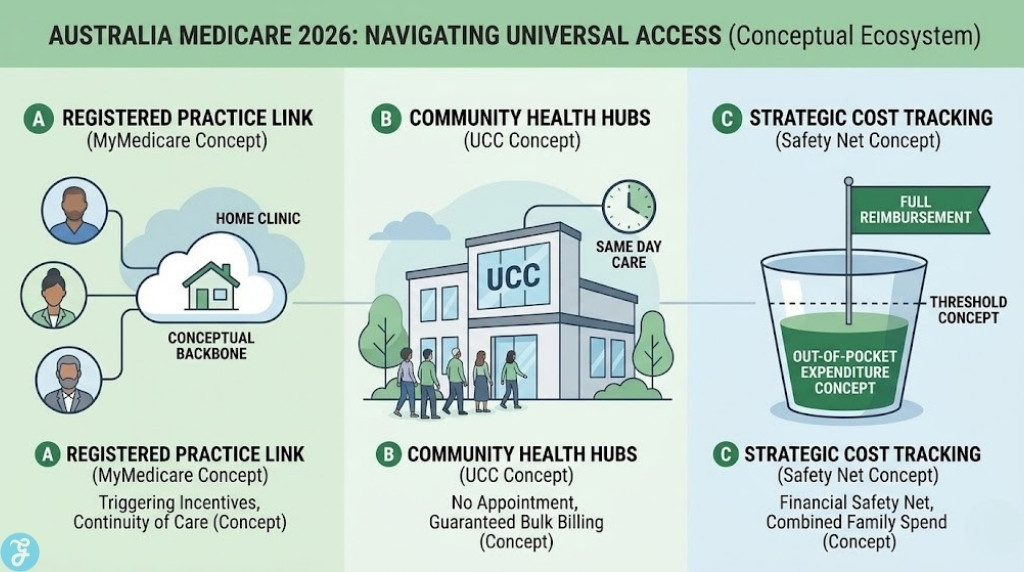
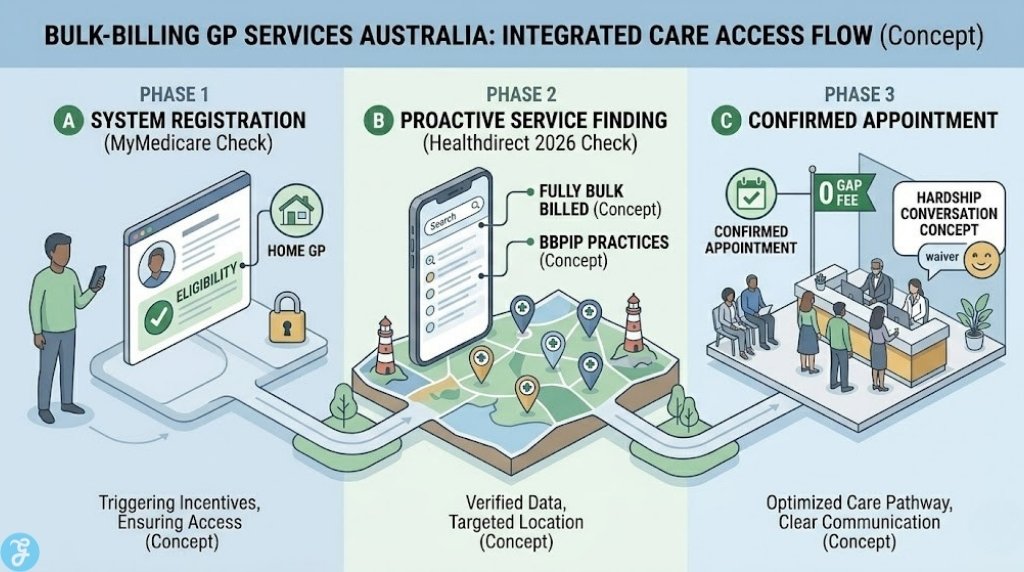
MyMedicare is no longer just a voluntary registration; in 2026, it is the primary way the government tracks “linked” patients for incentive payments. Many practices now reserve their bulk-billing slots exclusively for patients who have formally registered with them via myGov. This “patient-doctor link” triggers higher payments for the GP, making it financially viable for them to drop the gap fee for you.
Best for: Individuals with chronic conditions or those who visit the same GP at least twice a year.
Why We Chose It: It is the “golden ticket” that unlocks bulk billing for long consults and telehealth that might otherwise attract a fee.
Things to consider: You can only be registered with one practice at a time, so choose the clinic that is most convenient for your long-term care.
3. Utilize the Upgraded Healthdirect Service Finder
The Healthdirect National Health Services Directory received a significant data overhaul in early 2026. You can now use a specific filter for “BBPIP Participating Practices.” This is far more accurate than searching for “Bulk Billing” in Google Maps, as it pulls real-time data from the Medicare Organisation Register to show which clinics are currently committed to zero gap fees.
Best for: People moving to a new area or those whose regular doctor has recently transitioned to mixed billing.
Why We Chose It: It is the only official government database that distinguishes between “mixed billing” and “full bulk billing.”
Things to consider: Always call ahead to confirm, as some clinics may have reached their daily “no-cost” appointment quota.
4. Visit a Medicare Urgent Care Clinic (UCC) for Same-Day Needs
By mid-2026, the network of Medicare Urgent Care Clinics has expanded to 137 locations nationwide. These clinics are 100% bulk billed for all Australians, regardless of whether you have a concession card. They are designed for “non-life-threatening” issues like minor fractures, infections, or burns that require immediate attention but don’t warrant an Emergency Department visit.
Best for: After-hours care or weekend injuries when your regular bulk-billing GP is closed.
Why We Chose It: They offer guaranteed no-cost care with no appointment necessary, seven days a week.
Things to consider: UCCs do not handle routine care like prescriptions, referrals, or chronic disease management plans.
5. Leverage the Expanded 2026 “Triple Incentive”
The “Triple Incentive” payment was once limited to children and concession card holders. However, the 2025-26 Budget expansion means that if you belong to any “vulnerable” category—including those in regional or rural areas (MMM 2-7 zones)—your GP receives a much higher incentive to bulk bill you. If you live outside a major city, you should rarely, if ever, pay a gap fee in 2026.
Best for: Regional and rural residents, students under 16, and Commonwealth Concession Card holders.
Why We Chose It: It provides the highest financial return for GPs, making bulk billing the “default” for nearly 11 million Australians.
Things to consider: Ensure your current address is updated in Medicare via myGov to reflect your eligibility for regional incentive zones.
6. Track Your 2026 Medicare Safety Net Thresholds
If you cannot find a bulk-billing doctor and must pay a gap fee, ensure you are tracking your spend towards the Medicare Safety Net. For 2026, the Original Medicare Safety Net (OMSN) threshold is $594.00. Once your gap expenses reach this amount, Medicare will reimburse you 100% of the schedule fee for the rest of the year, effectively making your appointments “government-covered” at a higher rate.
Best for: Families and individuals with high ongoing medical costs who have reached their spending limit.
Why We Chose It: It acts as a financial “fail-safe,” ensuring that even if you pay a gap early in the year, your costs drop to near-zero as the year progresses.
Things to consider: Families must register as a “Safety Net Family” on the Medicare website to combine their spending totals.
7. Link Your Concession Card to Your Medicare Profile
Many patients miss out on bulk billing because their Health Care Card or Pensioner Concession Card has expired or isn’t linked to their Medicare record. In 2026, GPs use automated software to check your concession status. If the link is broken, the system defaults to “Private Billing,” and you may be charged a fee on the spot.
Best for: Low-income earners, pensioners, and job seekers.
Why We Chose It: It prevents administrative errors that lead to unexpected out-of-pocket costs at the reception desk.
Things to consider: If you get a new card, double-check that it appears in your Express Plus Medicare app immediately.
8. Request a “Hardship” Bulk-Billing Waiver
Even “Mixed Billing” practices usually have a policy for patients in financial distress. Most 2026 practice management guidelines allow GPs to switch a private consult to a bulk-billed one at their discretion for “Financial Hardship.” Don’t be afraid to ask, “Do you have a hardship policy for bulk billing?” before your appointment begins.
Best for: People experiencing temporary financial strain who need urgent medical advice but cannot afford the gap.
Why We Chose It: It empowers the patient to advocate for themselves within a private business framework.
Things to consider: This is most effective for long-term patients who have a pre-existing relationship with the doctor.
9. Optimize Telehealth Under the “12-Month Rule”
Telehealth remains a vital bulk-billing tool in 2026, but the “12-month rule” still applies: you must have seen your doctor (or another doctor in the same practice) in person at least once in the last year to be eligible for a bulk-billed video or phone consult. If you meet this requirement, many clinics offer bulk-billed “Quick Scripts” or “Result Reviews” via telehealth.
Best for: Simple follow-ups, repeat prescriptions, and pathology results that don’t require a physical exam.
Why We Chose It: It saves time and travel costs while utilizing the GP’s capacity for shorter, remote consultations.
Things to consider: If you haven’t seen your GP in person for over a year, you will likely be charged a private fee for a telehealth call.
Comparing Medicare Access Options in 2026
The following table outlines the different ways you can access Medicare-covered care depending on your location and medical needs. Understanding these tiers helps you choose the most cost-effective path for your situation.
| Service Type | Typical Cost (2026) | Best Use Case | Appointment Needed? |
| BBPIP Practice | $0 (Fully Bulk Billed) | General health and routine checks | Yes |
| Urgent Care Clinic | $0 (Fully Bulk Billed) | Minor injuries (burns, sprains) | No (Walk-in) |
| Mixed Billing GP | $30 – $60 (Gap Fee) | Specialized or niche GP care | Yes |
| Telehealth | $0 (If eligible) | Prescriptions and simple results | Yes |
| Hospital ED | $0 | Life-threatening emergencies | No |
Our Top 3 Picks and Why?
Of the nine tips, Registering for MyMedicare, Visiting Urgent Care Clinics, and Finding BBPIP Signage are the most effective strategies for 2026. MyMedicare is the structural foundation that makes bulk billing sustainable for your doctor. Urgent Care Clinics provide a 100% guaranteed safety net for after-hours care without the long wait of a hospital. Finally, the new BBPIP signage is the most reliable visual shortcut to finding a practice that has moved back to a 100% no-cost model for all patients.
Maximizing your Medicare benefits in 2026 is about being proactive rather than reactive. By setting up your digital profile now, you ensure that you are always eligible for the lowest possible cost.
The Selection Framework:
-
Digital Setup: Log into your myGov account and link Medicare and Centrelink today. Ensure your bank details are correct for “Easy Claiming.”
-
The “First Visit” Rule: Even if a practice is “Mixed Billing,” aim for one in-person visit per year. This “unlocks” your ability to receive bulk-billed telehealth for the following 12 months.
-
Practice Search: Use the Healthdirect app once a month to check if your local clinics have joined the BBPIP.
Decision Matrix (Table):
| If you are… | Your 2026 bulk-billing strategy should be… |
| A healthy adult without a concession card. | Find a BBPIP-signed practice and register with MyMedicare. |
| A parent with a child under 16. | Visit any GP; the Triple Incentive ensures 90%+ bulk-billing rates. |
| Living in a rural area (MMM 3+). | Check for Regional Incentive bulk-billing clinics in your town. |
The Future of Australia’s Medicare Universal Access
The “no-cost” GP visit is making a comeback across Australia in 2026. While the previous decade saw a sharp decline in bulk-billing rates, the introduction of the Bulk Billing Practice Incentive Program has fundamentally changed the business model for local clinics. By rewarding GPs who commit to universal access and encouraging patients to “link” to their practices through MyMedicare, the system is becoming more sustainable and predictable. As more Urgent Care Clinics open and the safety net thresholds adjust, the goal of a truly universal healthcare system is closer to reality than it has been in years.
Frequently Asked Questions (FAQ)
Is bulk billing disappearing in Australia in 2026?
No, it is actually increasing. While “Mixed Billing” (paying a gap) was common in 2023 and 2024, the new 2026 BBPIP incentives have encouraged thousands of practices to return to a 100% bulk-billing model to remain competitive.
Can I be bulk billed for a telehealth appointment?
Yes, but only if you have seen that specific GP (or another GP in that practice) in person within the last 12 months. This is a federal requirement to ensure continuity of care.
What is the Medicare Safety Net threshold for 2026?
For the calendar year 2026, the Original Medicare Safety Net threshold is $594.00. Once you reach this out-of-pocket spend on gap fees, Medicare will pay 100% of the MBS fee for all subsequent out-of-hospital services for the remainder of the year.
Do I have to pay for a visit to a Medicare Urgent Care Clinic?
No. Every Medicare Urgent Care Clinic (UCC) in Australia is required to provide 100% bulk-billed services. You do not need a concession card or an appointment to receive care at these locations.
How do I register for MyMedicare in 2026?
You can register via the Express Plus Medicare app or through your myGov account. Simply select “MyMedicare” and search for your preferred general practice to initiate the link