
Have you ever spent way too long scrolling through streaming apps, searching for something that actually feels thrilling and different? If gritty, futuristic stories filled with advanced technology, danger, and thought-provoking ideas sound appealing, the cyberpunk genre might be exactly what’s been missing.
Cyberpunk is a branch of science fiction set in dystopian futures where powerful technology exists alongside decaying societies. As author William Gibson famously described it, the genre blends “low life and high tech.” That tension between innovation and social collapse is what makes cyberpunk so compelling.
There is a wide range of must-see titles in the genre, from legendary films to groundbreaking anime. The following guide highlights some of the best cyberpunk movies and anime picks from both worlds so viewers can skip the endless scrolling and jump straight into the most exciting cyberpunk stories.
Ready? Let’s dive in.
What Is the Cyberpunk Genre?
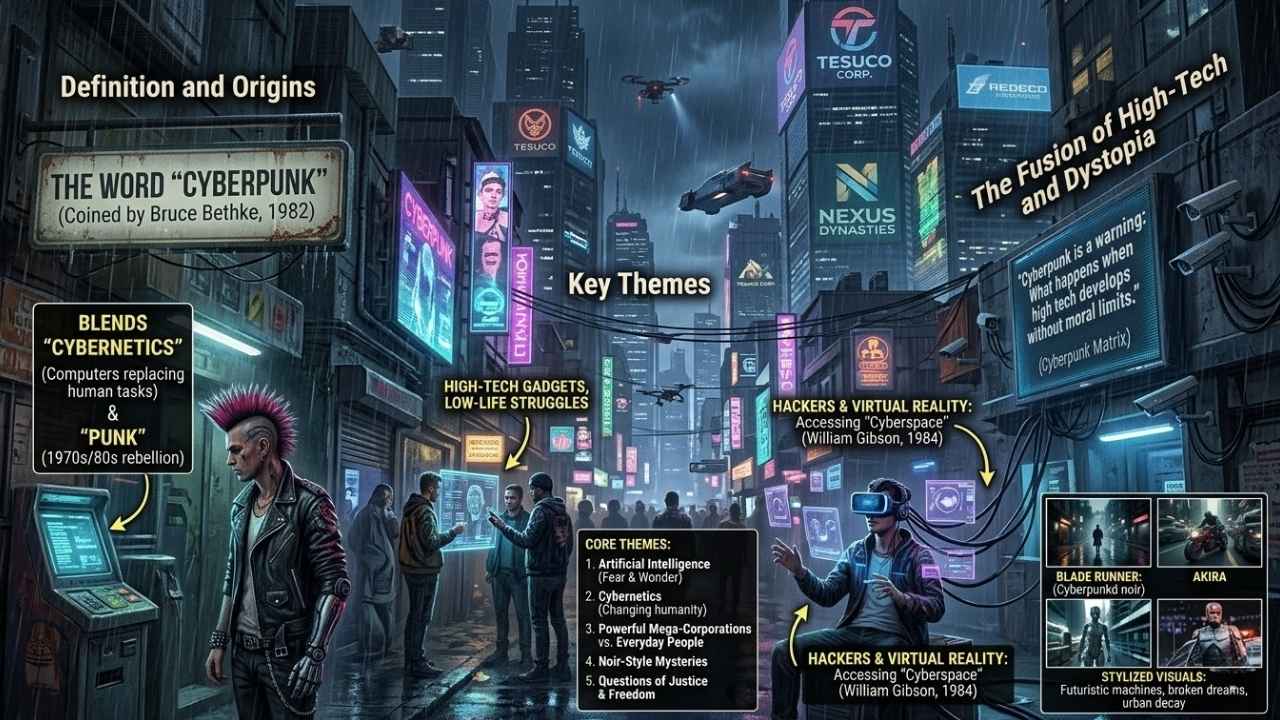
Cyberpunk throws you into a futuristic city, soaked in neon and shadows. It’s all about hackers, artificial intelligence, and a society tangled up in technology.
Definition and Key Themes
A cyberpunk story takes place in a dystopian future where advanced technology stands right next to ruined cities and broken societies. Neon signs flicker over crowded streets, hackers crack codes, and mega corporations often control daily life.
The word “cyberpunk” itself was coined by writer Bruce Bethke in a 1982 short story. It blends “cybernetics” (the science of replacing human tasks with computers) with the “punk” attitude of rebellion that grew popular in the 1970s and ’80s. That mix of rebellion and technology is still the heart of every great cyberpunk story.
These stories mix high-tech gadgets with low-life struggles. Think virtual reality headsets, cybernetic limbs, surveillance cameras everywhere, and antiheroes just trying to survive.
The themes run deep:
- Artificial intelligence that causes fear and wonder in equal measure
- Cybernetics that change what it means to be human
- Powerful mega corporations fighting against everyday people left behind by progress
- Noir-style mysteries hidden under neon lights
- Questions about justice and freedom in a world where both feel out of reach
Anime like Akira (1988) and movies like Blade Runner (1982) show how technology shapes dreams and nightmares at once. These aren’t just action stories. They’re warnings.
The Fusion of High-Tech and Dystopia
Cities shine with neon lights, yet shadows fill every corner. Massive mega corporations control technology and people’s lives, shaping grim futures where justice feels distant.
Citizens often struggle in these dense cities, living among advanced cybernetic technology but also facing chaos and decay. Hacking is common. Hackers slip into virtual reality networks or break through surveillance systems for survival or profit.
Cyberpunk found its roots in the 1960s and 1970s New Wave science fiction movement, with writers like Philip K. Dick exploring darker, technology-driven futures. Then, in 1984, William Gibson’s novel “Neuromancer” helped solidify cyberpunk as a true genre, introducing ideas like cyberspace and a future where data thieves and mega corporations reign supreme.
“Cyberpunk is more than a genre. It’s a warning. It asks what happens when high tech develops without moral or social limits.” (Cyberpunk Matrix)
Anime like Akira (1988) and Ghost in the Shell (1995) show futuristic machines standing beside broken dreams and urban decay. Movies like Blade Runner (1982) paint rain-soaked city streets full of secrets under glowing billboards. Robocop (1987) raises questions about humanity as a cyborg police officer fights crime amid rising corruption. Tech upgrades are easy to find, but they never come free from consequence.
Iconic Cyberpunk Movies

These cyberpunk movies paint a gritty picture of technology, dystopia, and artificial intelligence. Each film shows futuristic cities where hackers, antiheroes, and mega corporations rule the streets.
Blade Runner (1982): The Definitive Cyberpunk Film
Blade Runner hit theaters in 1982 and changed science fiction forever. Director Ridley Scott set the film in a dystopian, neon-lit Los Angeles filled with advanced technology, flying cars, and towering advertisements on skyscrapers.
Harrison Ford stars as Rick Deckard, a weary detective called a “blade runner.” His job is to hunt down rogue androids called replicants, built by the powerful Tyrell Corporation to be “more human than human,” that have escaped and returned to Earth.
Cybernetic lifeforms struggle for freedom while humans fall deeper into social decay. Rain pours constantly over gritty city streets packed with hackers and people living on the edge. The film’s haunting score, composed by Vangelis, was nominated for both a BAFTA and a Golden Globe.
Interestingly, the film initially underperformed at the box office, partly because it opened the same summer as E.T. the Extra-Terrestrial. Critics were divided. But time proved it right. Today, Blade Runner holds an 89% critics’ score on Rotten Tomatoes, and it’s recognized as one of the most influential science fiction films ever made. A 2017 sequel, Blade Runner 2049, directed by Denis Villeneuve, earned an 88% score on Rotten Tomatoes.
Blade Runner’s neo-noir style mixes futurism, dark themes, and questions about what it means to be human. Those are the key pillars of cyberpunk culture, and this film built them.
The Matrix (1999): A Revolution in Sci-Fi
Neo wakes up in a dystopian future run by machines and learns the truth about virtual reality. Released in 1999 by directors the Wachowskis, The Matrix helped shape the cyberpunk genre for modern times. It draws heavy inspiration from Japanese cyberpunk, particularly Ghost in the Shell.
Cities feel cold and abandoned. Everyone is watched through endless surveillance. People use cybernetic implants to download skills straight into their minds.
The film blends futuristic technology, artificial intelligence, hackers, and thrilling action into philosophical questions about reality and freedom. Mega corporations pull strings while rebels risk everything. Dark cityscapes mix with glowing screens and green code, a true symbol of cyberpunk style that still stands strong today.
Ghost in the Shell (1995): Philosophy Meets Futurism
Ghost in the Shell (1995) drops you into a gritty, futuristic city where advanced technology shapes daily life. Major Motoko Kusanagi is a cyborg cop who hunts hackers and battles cybernetic criminals. The film is set in 2029, in a world where cyborgs blend seamlessly with humans and the internet can be accessed directly through neural links.
The movie digs deep into artificial intelligence, identity, and what it really means to be human in a world full of virtual reality, augmentation, and powerful mega-corporations. It was adapted from the acclaimed manga series by Masamune Shirow, and it profoundly influenced Hollywood filmmakers including the Wachowskis and James Cameron.
Rich visuals fill every scene with glowing city lights and urban decay. This is pure cyberpunk style mixed with sharp science fiction storytelling.
Complex questions twist around every corner: Can memories be trusted? Where do our souls end if bodies are just shells? Ghost in the Shell stands tall as an anime classic that pulls no punches.
Akira (1988): The Anime That Changed Everything
Akira hit theaters in 1988 and changed anime forever. Director Katsuhiro Otomo dropped audiences into a futuristic, post apocalyptic Tokyo full of neon lights, cybernetic bikes, and crumbling buildings. Tetsuo’s journey from troubled teen to power-mad force mixed technology with raw human emotion.
The film’s production budget was around 1.1 billion yen (roughly $9 million at the time), making it one of the most expensive anime productions ever made. To put that in context, it used over 160,000 hand-drawn animation cels, and the dialogue was recorded before animation began, a first for an anime production. The result still holds up visually today.
Akira didn’t just use dystopia as a backdrop. It made broken cities and wild technology pulse with life on screen. The film earned over $80 million worldwide in home video sales and is credited with paving the way for global anime franchises like Pokémon, Dragon Ball, and Naruto. Later films, including The Matrix and Stranger Things, borrowed directly from Akira’s cyberpunk style. Director Rian Johnson even cited it as an inspiration for his film Looper (2012).
Many see Akira as the reason cyberpunk anime went mainstream after 1988. It wasn’t just a movie. It was a turning point.
Robocop (1987): Tech, Justice, and Humanity
Robocop hit theaters in 1987 and changed how people saw science fiction. Detroit has fallen into chaos. Crime spreads everywhere while the city crumbles, a classic cyberpunk dystopia.
Mega-corporations push advanced technology that blurs the line between human and machine. Alex Murphy, a police officer killed on duty, comes back to life as Robocop, a mostly-machine cop with some memories of his old life still haunting him.
This film explores what happens when artificial intelligence meets justice and corporate greed twists morals. Can you stay human after becoming part robot? Does tech really solve crime or just make things worse? Guns blaze, neon signs flicker, and cold steel mixes with broken dreams under constant surveillance. This is gritty cybernetic noir at its finest.
Dredd (2012): A Gritty Cyberpunk World
Mega City One spreads out like a never-ending machine, filled with high-tech gadgets and endless grime. Dredd (2012) throws viewers into this post-apocalyptic city, where Judge Dredd acts as judge, jury, and executioner all at once. The character originated in the comic “2000 AD,” first published back in 1977, which means the Judge Dredd universe is one of the oldest continuously running cyberpunk stories in pop culture.
Karl Urban’s Judge Dredd faces off against the Ma-Ma gang in a tower block war zone. Harsh surveillance tracks everyone’s moves while technology gives both sides an edge. The story shows how cybernetics mix with daily life but bring no comfort to the city’s poor or vulnerable.
This gritty film packs advanced technology, dystopia, justice without mercy, and mega-corporations all under one steel roof. Classic cyberpunk themes, stamped on concrete and neon lights.
Must-Watch Cyberpunk Anime
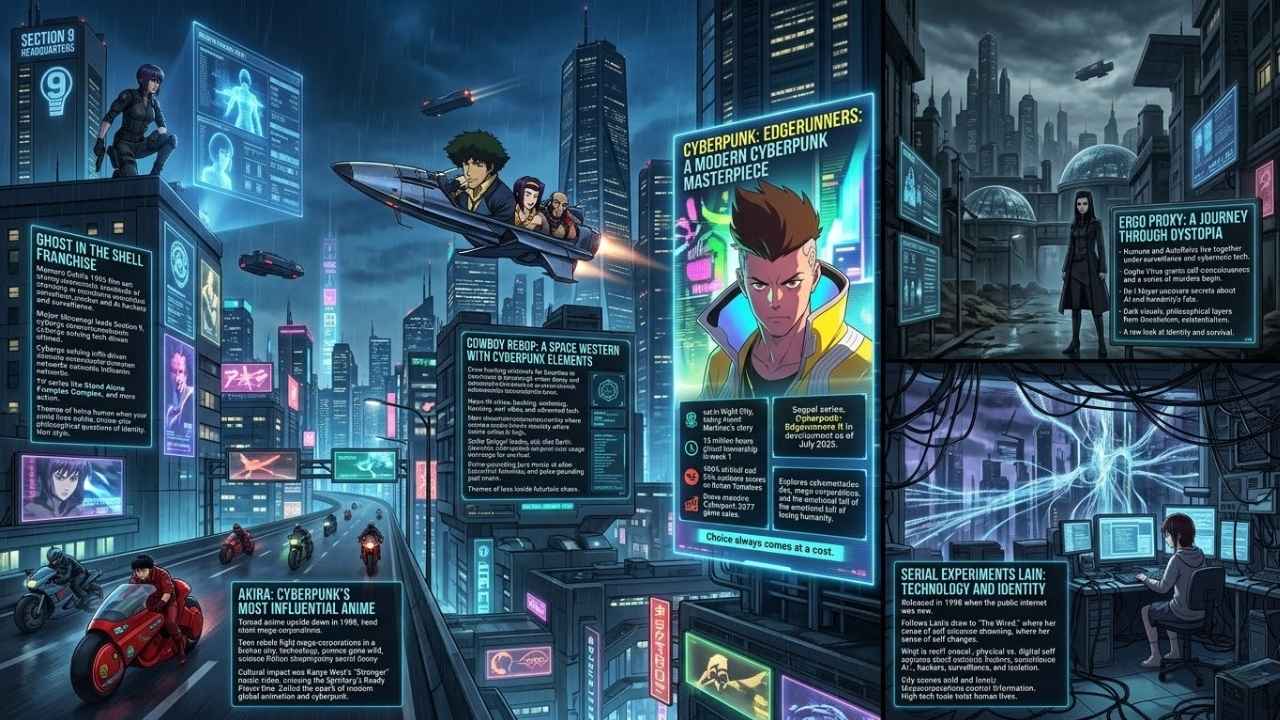
Anime in the cyberpunk genre blends futuristic ideas with gritty, dystopian stories. These shows pack a punch with bold heroes, wild technology, and questions about what it means to be human.
Ghost in the Shell Franchise
Major cities glow with neon light, but shadows hide secrets. The Ghost in the Shell franchise started with Mamoru Oshii’s 1995 film, blending dystopia and cybernetic technology. It set new standards for science fiction anime with its focus on artificial intelligence, virtual reality, hackers, and surveillance.
Motoko Kusanagi leads Section 9 as a cyborg tasked with solving crimes only possible in a world packed with futuristic tech. The film’s hacker villain, known as the Puppet Master, infiltrates networks to steal data and commit cybercrimes, a plot that feels more relevant today than when it was made.
The franchise spans TV series like Ghost in the Shell: Stand Alone Complex, which many fans feel contains more action and nuanced character development than the original film, plus several additional movies. This series explores what it means to be human when your mind can live online.
Many call Ghost in the Shell one of the best cyberpunk stories ever told. It mixes noir style, philosophical questions about identity, and cutting-edge visuals that keep viewers engaged from start to finish.
Akira: Cyberpunk’s Most Influential Anime
Akira turned anime upside down in 1988. Neon-drenched Tokyo, speeding bikes, and cybernetic power set the stage for this classic. Director Katsuhiro Otomo told a story of teen rebels fighting giant mega-corporations in a broken city. Futurism met raw chaos as technology ran wild through crowded streets.
This film showed how science fiction could shape feelings about society, depicting social decay through animation and sound in ways live-action films of the era couldn’t match. Kanye West’s music video for “Stronger” paid tribute to the film, and Steven Spielberg referenced Kaneda’s bike in Ready Player One, two examples of how deeply Akira’s imagery has seeped into popular culture decades later.
Many call Akira the spark that set off not just cyberpunk anime, but modern global animation trends. Its bold style remains the heartbeat of futuristic dystopia and technology gone wrong.
Cowboy Bebop: A Space Western with Cyberpunk Elements
Cowboy Bebop dropped in 1998, mixing space Western action with classic cyberpunk style. The crew of the spaceship Bebop hunts criminals for bounties, drifting through a future filled with urban decay and advanced technology.
You see neon-lit cities, hacking scenes, and noir vibes everywhere. Society feels broken. Crime is high, justice is messy, and people must adapt to survive in a harsh world run by powerful mega corporations.
Spike Spiegel leads the group with cool moves and sharp wit. Each character faces their own struggles: robots replace jobs, old Earth lies forgotten, and many use tech just to get by or escape reality. Themes of loss echo under pulse-pounding jazz music while bounty hunters dodge dangers at every turn. This show combines science fiction with real emotion as it explores identity inside futuristic chaos.
Cyberpunk: Edgerunners: A Modern Cyberpunk Masterpiece
Cyberpunk: Edge runners burst onto Netflix in September 2022. Set in Night City, a sprawling dystopian metropolis from the world of CD Project Red’s Cyberpunk 2077 video game, the 10-episode anime tells the story of David Martinez, a teenager who becomes an “edge runner,” a mercenary outlaw trying to survive against impossible odds.
The numbers behind its reception are hard to ignore. The show racked up nearly 15 million hours of global viewership in its first week alone. It earned a rare 100% critical rating and a 96% audience score on Rotten Tomatoes, making it one of the highest-rated Netflix originals of all time. Its success even drove a massive resurgence in Cyberpunk 2077 game sales, with the game regularly hitting over one million daily players after the anime launched.
It also sparked the announcement of a sequel series, Cyberpunk: Edge runners II, confirmed to be in development as of July 2025.
The anime explores cybernetic body upgrades, towering mega corporations, and the emotional toll of losing your humanity for power or survival. Each episode pulls viewers into a future that feels both exciting and terrifying. Choice always comes at a cost.
Ergo Proxy: A Journey Through Dystopia
Ergo Proxy, released in 2006, paints a bleak future where humans and androids called Auto Reivs live together. The city of Romdo keeps order with strict surveillance and advanced cybernetic technology. When a virus called the Cogito Virus infects the Auto Reivs and grants them self-consciousness, a series of murders begins to shake the city’s foundations.
Re-l Mayer, the main character, works as an inspector who uncovers secrets about artificial intelligence and humanity’s fate. Dark visuals create a strong dystopia vibe while exploring deep questions with each twist. Face masks hide emotions. Robots may think for themselves.
Think science fiction mixed with noir, with layers of philosophical depth drawn from themes like Gnosticism and existentialism. This series stands out for its raw look at identity and survival in a world ruled by technology and fear.
Serial Experiments Lain: Technology and Identity
Serial Experiments Lain, released in 1998, takes viewers deep into a world where technology shapes daily life and identity. The anime follows Lain Iwakura, a quiet teenage girl who becomes drawn to the “Wired,” a vast virtual network similar to the internet.
Keep in mind that in 1998, the public internet was only about seven years old and still largely unfamiliar to most people. The show’s exploration of online identity and virtual reality felt genuinely unsettling then, and it feels startlingly relevant today.
As Lain spends more time online, her sense of self changes. She questions what is real and whether her physical or digital self matters more. The story explores classic cyberpunk themes like artificial intelligence, hackers, surveillance, and isolation. City scenes feel cold and lonely. Wires snake everywhere like roots in an old forest.
Megacorporations control much of society’s information. People can barely separate reality from their digital identities inside this dystopian future. Serial Experiments Lain stands out for showing how high-tech tools twist human lives and challenge our ideas about who we are.
The Impact of Cyberpunk on Pop Culture
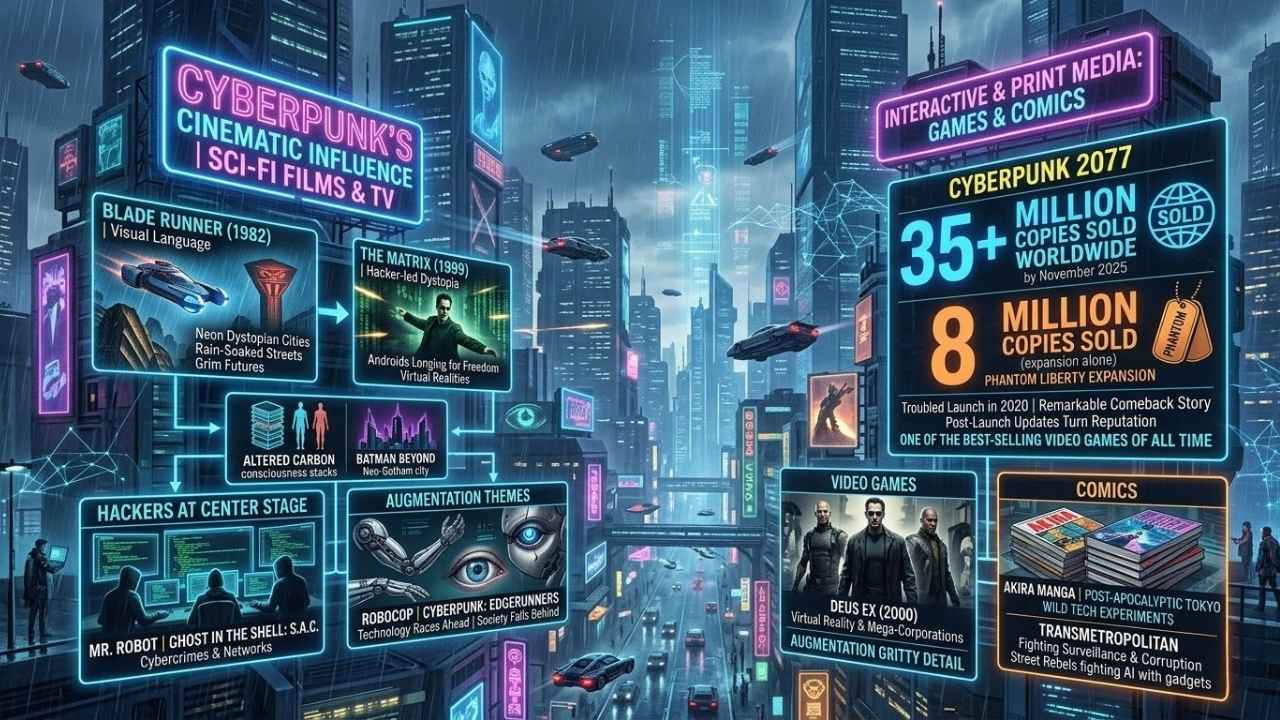
Cyberpunk shapes modern pop culture by inspiring new films, games, and stories. Its futuristic reach keeps growing, and here’s why that matters.
Influence on Modern Sci-Fi Films and Shows
Blade Runner (1982) set the visual language for dystopian cityscapes, those neon lights, rain-soaked streets, and grim futures. Its influence appears directly in The Matrix (1999), Altered Carbon on Netflix, and even animated shows such as Batman Beyond.
Modern science fiction puts hackers at center stage, like in Mr. Robot or Ghost in the Shell: Stand Alone Complex. Themes of cybernetic augmentation show up from RoboCop to Cyberpunk: Edge runners. Big questions about humanity and technology keep resurfacing, think androids longing for freedom or people losing themselves inside futuristic machines.
Today’s science fiction owes much to those early tales that asked how far people will go when technology races ahead but society falls behind.
Cyberpunk in Video Games and Comics
Cyberpunk video games throw you into dystopia, letting you play as hackers, antiheroes, or rebels. Cyberpunk 2077 by CD Project Red is the biggest recent example. Despite a troubled launch in 2020, the game sold over 35 million copies worldwide by November 2025, making it one of the best-selling video games of all time. Its comeback story is remarkable: post-launch updates and the Phantom Liberty expansion (which alone sold 8 million copies) completely turned the game’s reputation around.
Even before that, classics like Deus Ex (2000) explored virtual reality, mega corporations, and augmentation in gritty detail. These futuristic worlds show cities packed with advanced technology but shadowed by decay.
Comics also give this genre a bright spotlight. The Akira manga set the bar high in the ’80s with tales of post apocalyptic Tokyo and wild tech experiments gone wrong. Western comics like Trans metropolitan follow sharp-tongued reporters fighting against surveillance and corruption in overrun cities. Fans see stories where artificial intelligence controls lives while street rebels fight for freedom using only grit and gadgets.
Final Thoughts
Cyberpunk stories show us futures shaped by technology, dystopia, and tough choices. These movies and anime mix high-tech gadgets with gritty city streets, making every story feel close to home.
Getting started is easy. Just pick one title from this list and see how themes like artificial intelligence, hackers, or virtual reality shape the plot. The effects of cybernetics and surveillance in these stories spark real thoughts about where we’re all headed. Give these films and anime a try. You might find yourself asking new questions about our own future long after the screen goes dark.