

The Atlantic Immigration Program (AIP) has solidified its position in 2026 as Canada’s most strategic regional immigration pathway. While federal programs like Express Entry are grappling with record-high CRS cut-offs and category-based draws, the AIP remains a stable, employer-driven bridge to permanent residency in Nova Scotia, New Brunswick, Prince Edward Island, and Newfoundland and Labrador. With the 2026-2028 Immigration Levels Plan allocating a steady 4,000 admissions annually to this stream, it offers a predictable route for those willing to build their lives in the Atlantic provinces.
How We Selected Our 10 Best Atlantic Immigration Program 2026 Facts
To assemble this guide, we evaluated the latest 2026 IRCC operational updates and the newly implemented provincial “Candidate Pool” systems. Our selection was filtered based on the factors that provide the highest “approval certainty”—specifically focusing on the removal of the LMIA requirement, the lower language barriers, and the unique 2026 sectoral priorities. These ten facts represent the structural advantages that make the AIP the premier choice for skilled workers and international graduates who prefer local economic integration over a high-stakes points race.
The 10 Most Essential Atlantic Immigration Program 2026 Facts
Understanding the mechanics of the AIP is crucial because it operates on a fundamentally different logic than the rest of Canada’s economic streams. Instead of competing against thousands of strangers in a pool, you are competing for a specific job offer from a pre-vetted local employer.
1. The Employer-Driven (No CRS) Selection Model
The most defining characteristic of the AIP is that it completely bypasses the Comprehensive Ranking System (CRS). You do not need to worry about your age, your master’s degree, or having “Superior” language scores to get an invitation. In 2026, the “invitation” is the job offer itself from a designated employer, which effectively guarantees your path to permanent residency as long as you meet the basic eligibility.
Best for: Applicants over 30 or those without master’s degrees who find it impossible to compete in the Express Entry pool.
Why We Chose It:
-
It removes the “points-test” anxiety that dominates Canadian immigration.
-
It focuses on local labor demand rather than a generalized federal score.
-
It ensures that every immigrant has a guaranteed income upon arrival.
Things to consider: The challenge is shifted from “scoring points” to “securing a job,” which requires a targeted Canadian-style resume and networking within the Atlantic provinces.
2. The 2026 LMIA-Exemption Advantage
Under standard work permit rules, a Canadian employer must pay for and wait for a Labour Market Impact Assessment (LMIA) to prove no Canadian could do the job. In 2026, AIP designated employers are exempt from this process. This makes you a “low-friction” hire, as the employer can bring you on board without the bureaucratic delays and costs associated with traditional foreign worker streams.
Best for: International candidates who need a competitive edge when applying for Canadian jobs.
Why We Chose It:
-
It makes hiring you significantly more attractive to a local business owner.
-
It reduces the processing timeline for your initial entry into Canada.
-
It eliminates the $1,000 LMIA processing fee for the employer.
Things to consider: The employer must still be “designated” by their province, so you should prioritize applying to companies already on the official 2026 designation lists.
3. TEER Category Versatility (TEER 0 to 4)
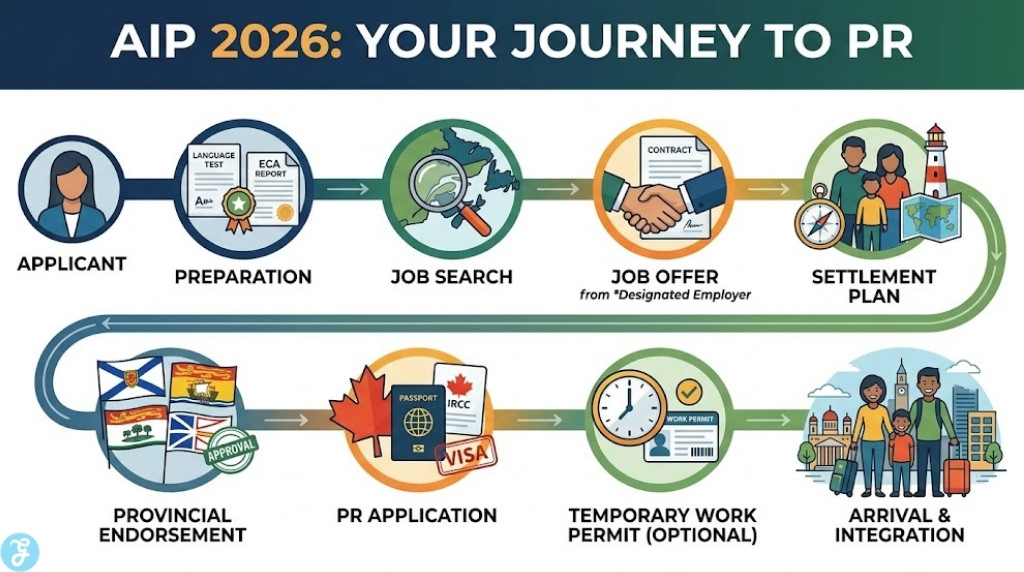
While many PR programs only accept “High Skilled” workers, the AIP in 2026 remains inclusive of TEER 4 occupations. This includes intermediate roles such as industrial butchers, long-haul truck drivers, and food and beverage servers. This makes it one of the few permanent residency pathways in Canada that values “essential” labor as much as “professional” labor.
Best for: Workers in technical trades and service industries who are often excluded from federal skilled worker programs.
Why We Chose It:
-
It acknowledges the broad range of skills needed to sustain the Atlantic economy.
-
It provides a PR lifeline for workers in critical supply chain roles.
-
It allows for a more diverse demographic of newcomers to settle in the region.
Things to consider: Your past work experience must align with the TEER level of your Atlantic job offer to qualify for the endorsement.
4. Lower Language Proficiency Thresholds
The AIP offers some of the lowest language requirements of any Canadian economic program. For TEER 4 roles, you only need a CLB 4, and for TEER 0, 1, 2, and 3, the requirement is only CLB 5. In a 2026 environment where many streams are demanding CLB 7 or higher, this makes the AIP exceptionally accessible for those who are functionally proficient but not academically fluent.
Best for: Skilled tradespeople and international workers for whom English or French is a second or third language.
Why We Chose It:
-
It focuses on the ability to perform the job rather than the ability to pass a complex test.
-
It opens the door for a wider range of global talent to enter the Atlantic workforce.
-
It reduces the “test prep” burden on applicants who are already working full-time.
Things to consider: While the minimum is low, some employers may still require higher proficiency depending on the specific safety or communication needs of the role.
5. The Mandatory Settlement Plan Requirement
A unique feature of the AIP is the Settlement Plan, which must be completed before you apply for PR. This is a personalized roadmap created by a designated service provider (at no cost to you) that identifies the schools, healthcare, and community supports your family will need. This ensures that you aren’t just “moving for a job,” but actually “settling for a life.”
Best for: Families with children who want to ensure a smooth transition into the Canadian social and educational system.
Why We Chose It:
-
It provides a built-in support network before you even land in Canada.
-
It has historically led to much higher retention rates in the Atlantic provinces.
-
It helps spouses find employment and children find appropriate schooling.
Things to consider: You cannot receive your provincial endorsement without this plan, so you should initiate it as soon as you accept your job offer.
6. International Graduate Stream (Zero Experience Needed)
If you graduated from a recognized post-secondary institution in one of the four Atlantic provinces, you do not need any work experience to apply for the AIP. This is a massive advantage in 2026, as it allows students to transition from their study permit directly to permanent residency without the stress of finding “relevant” 1-year experience first.
Best for: International students currently studying in Nova Scotia, New Brunswick, PEI, or Newfoundland and Labrador.
Why We Chose It:
-
It rewards students for their local investment in the Atlantic education system.
-
It streamlines the path to PR for young talent already integrated into the community.
-
It effectively “anchors” educated youth in the region to combat aging demographics.
Things to consider: You must have lived in an Atlantic province for at least 16 months in the two years before you graduated to be eligible.
7. New Brunswick’s 2026 Candidate Pool System
As of February 3, 2026, New Brunswick has transitioned to a “Candidate Pool” system for AIP endorsements. Instead of a first-come, first-served model, applications are now selected monthly based on provincial priorities (such as healthcare and construction). This change is designed to ensure that the most critical labor gaps are filled first, even if those applicants applied later.
Best for: Healthcare professionals and skilled tradespeople who can benefit from “priority selection” in New Brunswick.
Why We Chose It:
-
It creates a more “strategic” and less “random” selection process.
-
It helps the province manage high application volumes more effectively.
-
It provides a clear signal of which industries are most valued in the 2026 economy.
Things to consider: If your occupation is in a non-priority sector, you may face longer wait times in the New Brunswick pool compared to the other three provinces.
8. Updated 2026 Settlement Fund Requirements
The proof of funds required for the AIP remains significantly lower than Express Entry. For 2026, a single applicant only needs to show approximately $3,815 CAD. Furthermore, if you are already living and working in Canada under a valid work permit, you are generally exempt from this requirement entirely, making the transition to PR much easier for onshore workers.
Best for: Applicants who have high skills but may not have the large “savings” required by the federal government’s $14,000+ threshold.
Why We Chose It:
-
It reflects the lower cost of living in the Atlantic provinces.
-
It prioritizes your current job offer and future earnings over your current bank balance.
-
It removes a significant financial barrier for young families and low-wage workers.
Things to consider: You must provide official bank letters that meet IRCC’s specific criteria for “liquid” and “unencumbered” funds.
9. Provincial Endorsement vs. Federal PR
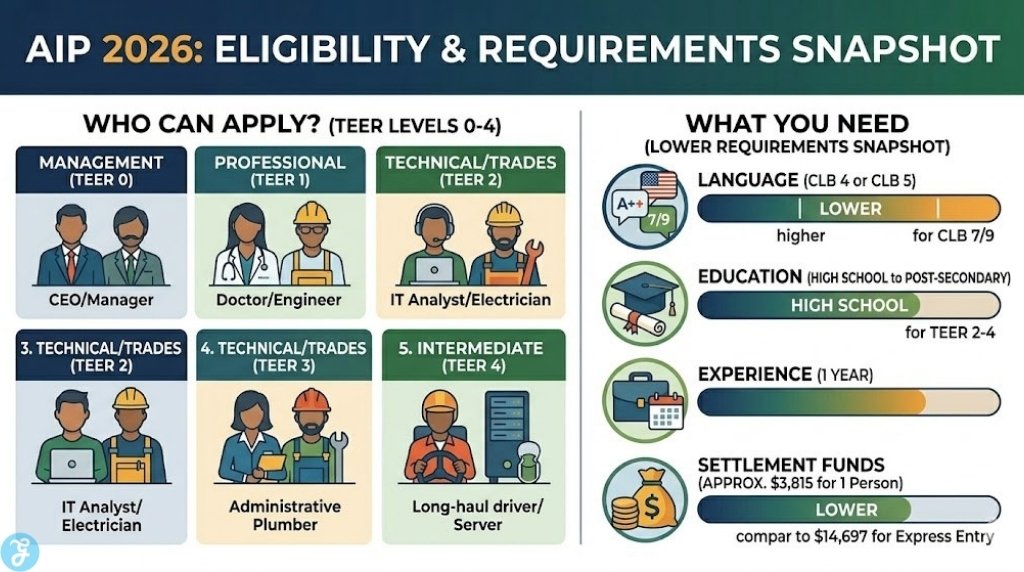
The AIP is a two-stage process. First, you must receive an endorsement from the province where you will work. Once you have this certificate, you then apply to the federal government (IRCC) for your PR visa. In 2026, getting the provincial endorsement is often the “hardest” part; once you have it, the federal stage is largely a background and medical check.
Best for: Applicants who want to know early in the process if their application is “supported” by the government.
Why We Chose It:
-
It gives the provinces direct control over who enters their labor market.
-
It serves as a “stamp of approval” that makes the federal PR stage more predictable.
-
It allows provinces to “vouch” for workers in critical roles like nursing and education.
Things to consider: You cannot apply for PR until your employer successfully secures this endorsement for you from their provincial government.
10. The “Work While You Wait” Permit Option
Because PR processing can take 11+ months, the AIP allows you to apply for a temporary work permit once you have your provincial endorsement. This allows you and your family to move to Canada and start your life immediately while the federal government processes your permanent residency in the background.
Best for: Offshore applicants who are ready to start their new jobs and don’t want to wait a year in their home country.
Why We Chose It:
-
It provides immediate economic stability for the newcomer.
-
It allows children to start school and spouses to start working earlier.
-
It helps employers fill their vacancies without waiting for the final PR grant.
Things to consider: This work permit is “employer-specific,” meaning you are tied to the designated employer who sponsored you until your PR is granted.
Comparing the AIP to Federal Skilled Worker Options
When planning your Canadian journey in 2026, it is vital to see how the Atlantic Immigration Program 2026 stands up against the standard Express Entry Federal Skilled Worker (FSW) path.
The table below outlines the core differences in eligibility and requirements for the current year.
| Feature | Atlantic Immigration Program (AIP) | Federal Skilled Worker (FSW) |
| Job Offer | Mandatory (Designated Employer) | Not Mandatory |
| Language (Min) | CLB 4 or 5 | CLB 7 |
| Education (Min) | High School (TEER 2-4) | Post-Secondary |
| CRS Score | Not Required | High Score Mandatory |
| Settlement Funds | Low (~$3,800 for 1 person) | High (~$14,600 for 1 person) |
| Experience | 1 Year (Waived for graduates) | 1 Year (Mandatory) |
Our Top 3 Picks and Why?
Of the points discussed, the Employer-Driven Model, the LMIA Exemption, and the Lower Language Thresholds are the most critical. These three pillars make the AIP the most “accessible” program in the Canadian immigration portfolio. By removing the high-stakes points competition and the bureaucratic hurdles of the LMIA, the AIP allows workers to be judged on their professional utility rather than their academic perfection. In 2026, the real “key” to Canada isn’t a high test score—it’s a job offer from an Atlantic designated employer.
Strategic Roadmap: Securing Your Atlantic Permanent Residency
Success in the Atlantic Immigration Program 2026 requires a high degree of coordination between you, your prospective employer, and the provincial government. Follow this roadmap to avoid common filing errors.
The Selection Framework:
-
Designation Check: Always verify that an employer is “designated” before accepting a job offer. If they aren’t, the job offer is useless for the AIP.
-
Early Preparation: Get your Educational Credential Assessment (ECA) and language tests done before you start the job hunt. Employers prefer “ready-to-go” candidates.
-
Sector Targeting: If you are in healthcare, skilled trades, or construction, prioritize your search in New Brunswick and Nova Scotia, as these are the current priority selection areas.
Decision Matrix (Table):
| If your situation is… | Then your AIP strategy should be… |
| You are a graduate of an Atlantic university. | Use the International Graduate stream to skip work experience. |
| You are a TEER 4 worker (Trucking/Retail). | Focus on Newfoundland and PEI for high intermediate demand. |
| You have a family and limited savings. | Prioritize the AIP over Express Entry due to the lower fund requirement. |
Final Audit: 5-point Checklist Before Applying
-
Have you confirmed your employer’s designation status for the 2026 program year?
-
Is your Educational Credential Assessment (ECA) less than 5 years old?
-
Did you and your family complete the Settlement Plan with a designated service provider?
-
Is your job offer on the official IMM 5650 form?
-
Have you verified your family’s specific Settlement Fund requirement for 2026?
Launching Your New Life in Atlantic Canada
The Atlantic Immigration Program 2026 is designed to turn the stress of immigration into the stability of employment. By focusing on regional needs and removing the “points-race” barriers, Canada has created a pathway that truly welcomes workers of all skill levels into the Atlantic community. Whether you are drawn to the tech growth in New Brunswick or the maritime heritage of Nova Scotia, the AIP provides the structural support and legal certainty needed to build a permanent, prosperous future on Canada’s east coast.
Frequently Asked Questions (FAQ)
Is there an age limit for the Atlantic Immigration Program 2026?
Unlike many Provincial Nominee Programs (PNPs) that reduce points as you get older, the AIP does not have a strict age limit. As long as you have a valid job offer from a designated employer and meet the basic education and experience requirements, you can apply.
Can I move to Toronto or Vancouver after getting PR through the AIP?
When you apply for the AIP, you sign a declaration of your “intent to reside” in the Atlantic province that endorsed you. While Canadian Permanent Residents have mobility rights under the Charter, moving immediately after arrival could lead to questions about the genuineness of your intent during the application process. It is generally advised to remain in the region for at least the first two years
How do I find a list of designated employers for 2026?
Each of the four Atlantic provinces maintains its own list of designated employers. You can find these on the official government websites for Nova Scotia, New Brunswick, Prince Edward Island, and Newfoundland and Labrador. These lists are updated frequently as new companies join or old ones leave the program.
Do I need a college degree for the AIP?
No. For TEER 2, 3, or 4 occupations, the minimum education requirement is only a Canadian high school diploma or its equivalent. A post-secondary credential is only required for TEER 0 or 1 positions.