

Have you ever stared at your foreign university transcript and wondered if those hard-earned credits will count in the United States? You finished classes abroad, but now you feel stuck between two totally different education systems. I know exactly how frustrating that uncertainty can be. The good news is that most American universities do accept international credits. They just need official proof that your past coursework matches their current standards.
A recent report by the Institute of International Education showed that the US hosts over one million international students. Many of them successfully transfer their past credits every single year.
So grab a cup of coffee, and let’s go through the international credit transfer process together. I will show you exactly how to make your credits count and save yourself a ton of time and money.
Understanding International Credit Transfers
Moving credits from a foreign university to your new school might feel like solving a puzzle, but it is totally doable. You will want to grasp how this process works before you take your next steps.
What is Credit Transfer?
Credit transfer is the system that moves your academic credits from a foreign university to your new school in the United States. Your past coursework counts toward your new degree, which means you avoid repeating classes you already completed.
Schools evaluate your transcripts to decide which credits they will accept. An admissions counselor reviews your official transcripts alongside detailed course descriptions to compare your foreign coursework to their classes.
This course equivalency process determines what officially transfers over. If you studied under the European Credit Transfer System (ECTS), universities typically divide your credits in half. For instance, a 60 ECTS year equals roughly 30 US credits.
Your study abroad experience becomes a valuable part of your academic journey at home. It prevents you from forcing a complete restart of your education.
Importance of Transferring Credits
Transferring your credits from a foreign university saves you serious time and money. Starting fresh at a new school without credit recognition wastes your previous academic efforts.
Your transcript assessment determines which courses actually count toward your new degree. Every approved credit brings you one step closer to graduation.
Here are a few big reasons why this matters:
- Lower Tuition Costs: Every transferred credit is a class you do not have to pay for again.
- Faster Graduation: You skip introductory classes and move straight into advanced coursework.
- Protecting Your Investment: Your past hard work gets the official recognition it deserves.
- Better Schedule Flexibility: With fewer required classes, you can take electives you actually enjoy.
Many transfer students discover that their international education holds real value when schools approve their credits. An admissions counselor helps you understand exactly what your new school will accept.
Researching Transfer Policies
Every school plays by different rules regarding accepting credits from abroad. You need to research your target university’s specific transfer policies before you submit a single piece of paper.
University Accreditation Requirements
Your new school needs proper accreditation to accept credits from your foreign university. Accreditation means an official organization has checked the school and confirmed it meets high-quality standards.
Schools in the United States get accreditation from regional bodies like the Higher Learning Commission. Your foreign university also needs proper recognition from its home country, usually from the Ministry of Education.
Both schools must hold a valid accreditation status for credit transfer to work smoothly. If your foreign school lacks official recognition, your credits might not transfer at all.
Accreditation is the mandatory bridge that connects your past education to your future success in the United States.
Most universities require that your international institution hold recognized accreditation before they evaluate your academic records. You can usually check your target school’s specific requirements on their main admissions website. Getting this information early saves you time and prevents rejection letters later.
Credit Conversion Systems
Different countries use different credit systems. Converting your credits means translating them into a format your new school completely understands.
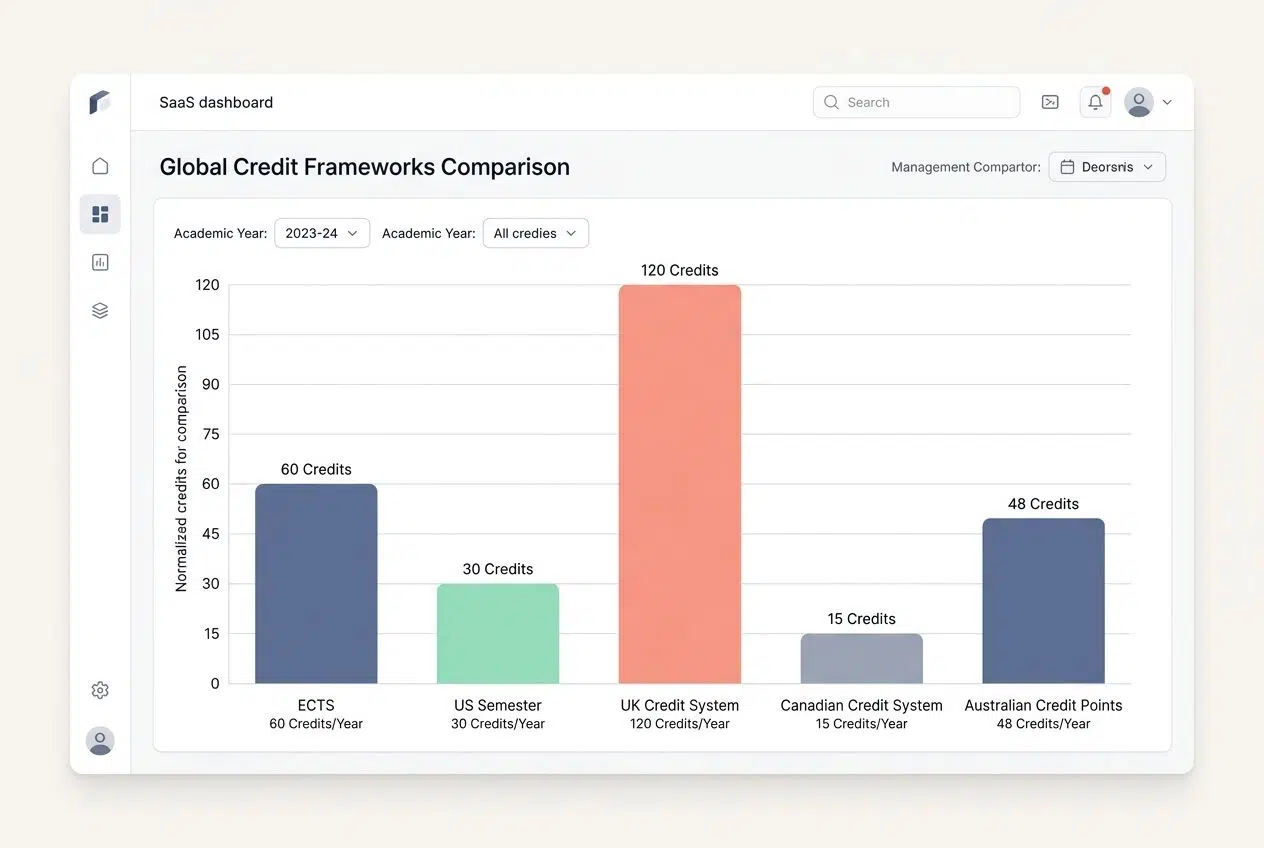
| Credit System | How It Works | Key Details |
|---|---|---|
| ECTS (European Credit Transfer System) | Used across Europe. One ECTS credit equals about 25 to 30 hours of student work. | Most European universities accept ECTS credits directly. Conversion to US credits typically divides ECTS by 2. |
| US Semester Credits | Standard in American universities. One credit equals roughly 15 weeks of instruction with one hour of class per week. | Most US institutions require 120 semester credits for a bachelor’s degree. Schools often accept transfer credits at face value. |
| UK Credit System | British universities use a different scale. One standard year usually totals 120 credits. | Converting UK credits to US credits often involves dividing by 3 or 4. A 15-credit UK course becomes roughly 4 US credits. |
| Canadian Credit System | Very similar to the US system. One credit equals one hour of instruction per week for one term. | Canadian credits transfer almost directly to US institutions. Minimal conversion is needed in most cases. |
| Australian Credit Points | Uses a points system rather than traditional credits. One standard year is often 48 to 96 points, depending on the university. | Converting Australian points to US credits varies heavily by institution. Always check your specific school’s conversion chart. |
Most receiving institutions have conversion charts readily available on their websites. Contact your target school’s registrar’s office to get their exact mathematical formula.
Transfers between similar systems face fewer hurdles, but large gaps require careful evaluation. Some schools cap the total number of transfer credits you can apply toward your bachelor’s degree, often stopping at 60 credits.
Planning ahead prevents major disappointments and wasted coursework. Get everything in writing from the admissions office before you commit to transferring.
Preparing Essential Documentation
You will need to gather paperwork that proves what you learned abroad. Your new school wants to see exactly what courses you took and how well you did in them.
Official Transcripts
Official transcripts form the absolute backbone of your credit transfer application. Your home university must issue these documents to show every single course you took and your grades. Most schools require official transcripts to come directly from your foreign university in sealed envelopes. If your school uses digital portals like Parchment, that is even better and much faster.
Contact your registrar’s office to request multiple copies early on. Having extras prevents painful delays if one gets lost in the mail.
Your transcripts need a certified translation if they are in another language. You should use a translator approved by the American Translators Association (ATA) to ensure the university accepts it.
The admissions counselor can tell you exactly which format they require. Sending these early saves you from frustrating delays during the evaluation phase.
Detailed Course Descriptions and Syllabi
Your transcripts tell the basic story, but course descriptions and syllabi provide the full picture. Universities need to see the depth of what you actually learned in each class.
Syllabi show the specific topics you covered and the grading scale used. These documents help admissions counselors match your international coursework to equivalent classes at your new university.
Without detailed syllabi, evaluators simply cannot understand if your credits fit their program. Make sure your documents include these crucial details:
- Reading Lists: The specific textbooks and articles required for the class.
- Weekly Schedules: A precise breakdown of what topics you studied each week.
- Grading Methods: How your professor weighted exams, essays, and class participation.
- Credit Hours: The total number of hours you spent sitting in the classroom.
Grab copies of every syllabus from your foreign university right now. If your university no longer has them, email your former professors directly to ask for copies.
Your credential evaluation service will use these exact materials to assess course equivalency. Think of them as the vital bridge between your past education and your future degree.
Credential Evaluation
A professional evaluation service takes your foreign coursework and translates it into American academic terms. This vital step separates students who move forward smoothly from those who hit constant roadblocks.
Utilizing Professional Evaluation Services
Professional companies handle the heavy lifting when you transfer credits from a foreign university. They specialize in credential evaluation and compare your international coursework to strict US standards.
They examine your official transcripts and syllabi to determine accurate course equivalency. Most universities require you to use an evaluator approved by the National Association of Credential Evaluation Services (NACES).
Companies like World Education Services (WES) or Educational Credential Evaluators (ECE) lead the industry. Your admissions counselor can usually recommend their preferred evaluation service for your specific situation.
These evaluators produce detailed reports showing exactly which credits transfer over. You receive a document that clearly lists your course matches, which becomes your absolute proof during the admissions process.
Understanding Evaluation Fees
Credential evaluation services charge fees that vary based on the level of detail you need. For a university transfer, you almost always need a “Course-by-Course” evaluation because it calculates a US GPA on a 4.0 scale.
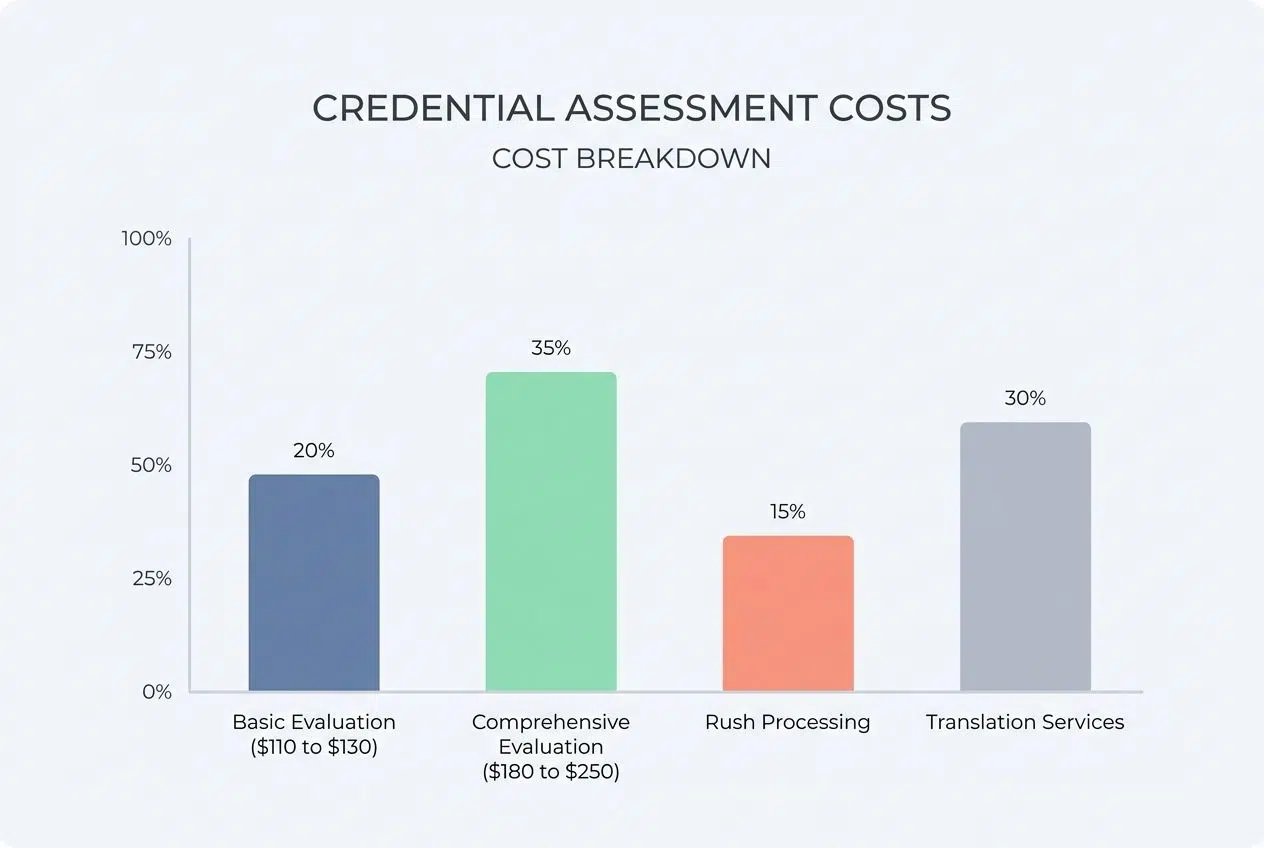
| Fee Type | Estimated 2026 Cost | What It Covers |
|---|---|---|
| Basic Evaluation | $110 to $130 | Standard document-by-document assessment, confirming your degree is equivalent to a US bachelor’s degree. |
| Comprehensive Evaluation | $180 to $250 | In-depth course-by-course analysis that converts your grades into a standard US GPA on a 4.0 scale. |
| Rush Processing | $50 to $150 additional | Expedited evaluation completed within a few days instead of the standard weeks. |
| Translation Services | $50 to $70 per page | Professional translation of your documents if they are not written in English. |
Costs differ based on the specific NACES member you choose. Timing matters immensely when budgeting for these required evaluation fees.
A standard WES evaluation takes about four to seven weeks from the moment they receive your documents. Requesting rush processing adds money to your bill, yet saves you weeks of stressful waiting.
Getting quotes from a few NACES providers helps you find reasonable rates without sacrificing quality. Always double-check which providers your target university officially accepts before paying anything.
Working With Academic Advisors
Your academic advisor acts as your personal guide through the credit transfer maze. They help you map out which courses count toward your degree and spot any gaps you must fill.
Pre-approval of Courses
Talk to an admissions counselor at your new university before you take any more classes abroad. Most schools let you submit course descriptions from your foreign university for an early review.
The counselor will tell you which credits count toward your degree and which ones fall short. Getting this approval in writing protects you completely from future surprises.
Ask for a formal letter or email that clearly lists all approved credits. Many international students on Reddit emphasize that universities sometimes accept you before they evaluate your credits.
You must ask for a preliminary credit evaluation early so you know your exact academic standing. Talk openly with your counselor about any concerns you have right now.
Planning Additional Coursework
Your academic advisor becomes your best friend at this crucial stage. They help you figure out exactly which courses you still need to finish your degree.
Your advisor will look at your transcript assessment and identify any specific gaps. Here is how a great advisor helps you plan:
- Mapping Prerequisites: They show you which foundational classes you must take before advanced ones.
- Spotting Missing Requirements: They check if you lack specific state-mandated courses like US History.
- Balancing Course Loads: They ensure you do not take too many difficult lab classes in one semester.
- Maximizing Electives: They figure out how to apply your leftover international credits as general electives.
Data from the National Student Clearinghouse shows that clear academic planning directly improves graduation rates. Planning your schedule carefully means thinking ahead about course sequencing.
You should consider your work schedule and personal commitments when deciding how many classes to tackle. Spreading out your coursework prevents burnout and keeps your GPA exceptionally high.
Walking Through the Credit Transfer Process
You will submit your application materials to your new university’s admissions office. Staff members will review everything carefully, and then you will track your status through their online portal.
Submitting Applications and Documents
Submitting your application and official transcripts marks a critical moment in your transfer journey. Getting these materials in front of the right people opens doors to your academic future.
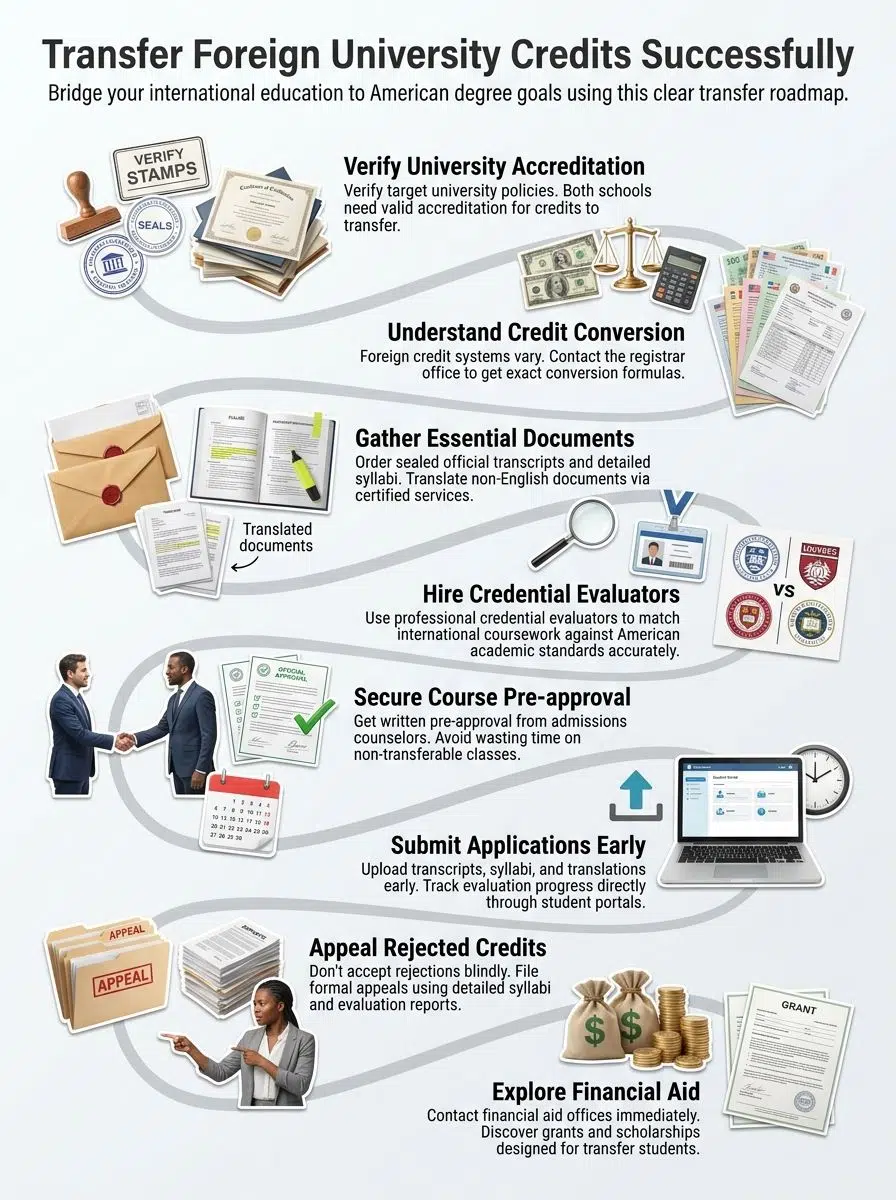
- Gather all required official transcripts from your foreign university. Your institution’s registrar’s office must provide sealed copies that admissions offices trust.
- Submit your application through standard platforms like the Common App for Transfer, which handles international students efficiently.
- Prepare detailed course descriptions for every single class you want to transfer. These syllabi show what content you covered and what skills you developed.
- Translate all documents into English using a certified translator if your foreign university issued them in another language.
- Check your target university’s admissions portal for their specific deadlines. Different schools have totally different systems and document preferences.
- Submit proof of your English language proficiency. Tests like the TOEFL or IELTS demonstrate your ability to succeed in an English-speaking classroom.
- Contact your admissions counselor after submitting everything to confirm receipt. This simple step prevents the frustration of discovering missing documents weeks later.
Checking the Status of Credit Evaluations
Most universities give you a secure tracking system to monitor your credit evaluation progress. Log in to your student portal, find the admissions tab, and look for your official evaluation report status.
You will see updates as your academic records move through each stage of review. Call your admissions counselor if the status does not change after three full weeks.
They can tell you exactly where your coursework stands in the timeline. Your final evaluation report tells you which credits the university officially approves.
Read through it carefully to spot any rejected courses or missing information. If your course equivalency does not match what you expected, that is your clear signal to ask questions immediately.
Common Challenges and Solutions
Transferring credits from a foreign university throws curveballs at most students. You might face missing paperwork or rejected coursework that leaves you scratching your head. The good news is that practical solutions exist for nearly every roadblock.
Managing Missing or Rejected Credits
Sometimes your credits do not transfer on the first try, and that happens very often. Missing or rejected credits feel frustrating, but you have real options to move forward.
- Contact your admissions counselor: Do this right away after receiving rejection news to learn exactly why your coursework fell short.
- Compare your syllabi: Look at your original course syllabi against the receiving institution’s course descriptions to spot specific differences.
- Ask about electives: Look into whether your rejected credits might count toward general education requirements instead of strict major courses.
- Take a challenge exam: Many universities offer Departmental Challenge Exams, such as CLEP (College Level Examination Program) tests, to let you prove you know the material and earn the credit.
- Gather extra proof: Provide additional documentation from your foreign university, including textbooks used and professor credentials.
Accept that some minor credits simply may not transfer over. Plan your future course schedule accordingly, focusing heavily on completing your required degree classes.
Appealing Transfer Decisions
Your university may reject some credits initially, but that decision is rarely final. You have the total right to appeal transfer decisions and fight for your academic records.
- Gather all supporting materials before you submit a formal appeal. Include your official transcripts, long-form syllabi, and detailed reading lists.
- Request a written explanation from the admissions office detailing why your credits faced rejection. This helps you build a much stronger counter-argument.
- Prepare a formal appeal letter that explains your coursework in great detail. Demonstrate clear course equivalency between your foreign classes and their standards.
- Schedule a direct meeting with the department chair of your specific major. Department chairs often have the final authority to override admissions and approve your credits.
- Provide clear evidence that your past coursework aligns with current US industry standards or professional certifications.
- Follow up on your appeal status regularly through the main admissions office to track your progress closely.
Final Steps to Continue Your Education
You will want to get comfortable with your new school’s specific style and expectations pretty fast. Money matters too, so dig into grants and scholarships that fit your exact situation.
Adjusting to the New Academic System
Your new American university operates differently from your foreign institution. Teaching styles shift, grading scales change, and classroom expectations transform overnight.
In the US, you will likely encounter continuous assessment models. This means your grade depends heavily on weekly quizzes, group projects, and daily class participation, rather than just one massive final exam.
Talk to your admissions counselor about what to truly expect in the classroom. They can explain how your university structures courses and evaluates student performance.
Reach out to academic support services on campus right away. They offer writing centers and study groups designed specifically for transfer students.
Connect with other international students who came from abroad too. They understand your unique situation and can share great tips about new coursework expectations.
Exploring Financial Aid Options
Many schools offer specific financial aid packages to transfer students from foreign universities. You will want to contact the financial aid office at your new institution immediately.
Because international students typically do not qualify for standard US federal student aid (FAFSA), finding funding requires a bit more digging. You need to explore other specific avenues.
Here are the best places to look for funding:
- Institutional Scholarships: Merit-based money given directly by your new university based on your high GPA.
- Private International Grants: Funds from specific databases like the IEFA (International Education Financial Aid) portal.
- Departmental Awards: Specific scholarships reserved just for students in your chosen major.
- On-Campus Employment: Part-time jobs up to 20 hours a week that help cover your living expenses.
Some aid programs require you to transfer a minimum number of credits to qualify as a full-time student. Talk to your financial aid advisor about which specific options fit your personal situation best.
Getting your financial house in complete order now saves you massive stress later on. It allows you to focus entirely on your new classes.
Wrapping Up
Your credit transfer journey has finally reached its last stretch. You are now positioned perfectly to move forward with your American education. You gathered your official transcripts, completed the necessary credential evaluation through NACES-approved services, and secured pre-approval for your coursework.
Your academic records are completely in order, and the university has processed your application. This is your moment to take confident action and enroll in your upcoming classes. Start exploring private scholarships and institutional grants right away to help cover your tuition costs. Connect closely with your new institution’s financial aid office to learn exactly what support you qualify for today.
Your transition into this new academic environment opens incredible doors to fresh opportunities. The admissions process takes patience, but you successfully completed it and earned your spot.
Get adjusted to your new university’s systems, meet your new classmates, and begin your studies. Your hard work in transferring your international education credits paid off, and you are ready to finish your degree.
Frequently Asked Questions (FAQs) on International Credit Transfer
1. How do I start transferring my credits from a foreign university?
Start by contacting your new school’s registrar or admissions office to ask about their international credit transfer policy. Most US colleges will require you to use a credential evaluation service like WES (World Education Services) or ECE to translate and assess your foreign transcripts.
2. Will all my classes from abroad count toward my degree here?
It depends on your new school’s policies and how closely your courses match their curriculum. According to recent data from the American Council on Education, US colleges typically accept about 60-70% of credits from accredited foreign institutions, though this varies widely by school. Think of it like matching recipes; some ingredients translate perfectly, while others just don’t fit the program requirements.
3. What documents do I need when moving credits from another country?
You’ll need official transcripts sent directly from your foreign university, course descriptions or syllabi, and certified English translations if your documents are in another language. Many schools also require a course-by-course evaluation from services like WES to verify your credits meet US standards.
4. Can I speed up the credit evaluation process?
Yes, submit all your documents at once and choose expedited processing if your evaluation service offers it. Most credential evaluations take 2-4 weeks for standard processing, but you can often get results in as little as 5-7 business days by paying for rush service and responding quickly to any follow-up requests.





















