Psychological Safety In Hybrid Teams means people feel safe to share ideas, ask questions, and admit mistakes without worry. As more companies use hybrid work, with some people in offices and others working from home, it gets harder for teams to keep open talks. Communication often feels slow or awkward now. This makes psychological safety even more important for team performance.
In 2026, the need for strong teamwork is bigger than ever. People who feel psychologically safe can speak up freely, even if they disagree or don’t know something, because they do not fear being judged or punished.
Research shows that teams with high levels of psychological safety have better results, are more creative, and solve problems faster.
The new playbook for Psychological Safety In Hybrid Teams gives managers simple steps they can use again and again, even when busy. By learning different ways people like to talk through behavioral profiling tools, teams understand each other better.
Leaders also must listen closely and focus on building trust every day; this helps everyone thrive at work.
As companies move forward with hybrid teams in 2026, these changes matter a lot, not just for business success but also for mental health at work. Up next: learn the biggest issues that make psychological safety hard in mixed remote-and-office groups.
Inside Psychological Safety in Hybrid Teams
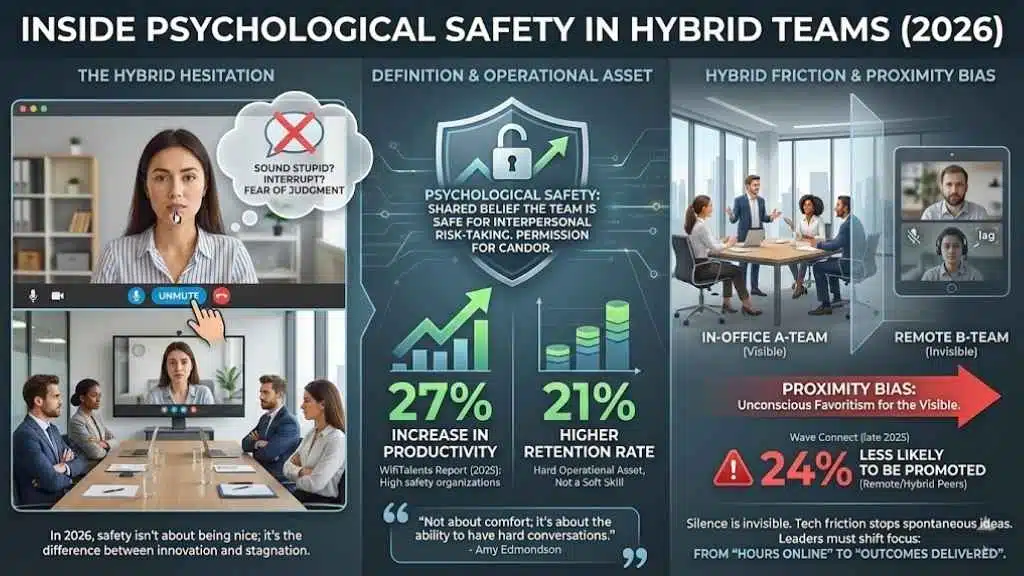
You know that feeling when you’re about to unmute yourself on a Zoom call, but you stop? That split-second hesitation—worrying that your idea sounds stupid or that you’ll interrupt the “important” people in the conference room—is exactly what we’re trying to fix. In 2026, psychological safety isn’t just about being nice; it’s the difference between a team that innovates and one that stagnates.
Let’s look at the data, what it’s actually telling us about hybrid friction, and then explore practical ways to build real trust.
Definition and importance of psychological safety
Psychological safety is the shared belief that a team is safe for interpersonal risk-taking. It means you can ask a “dumb” question, admit you messed up, or challenge a boss’s idea without fearing retaliation. Harvard professor Amy Edmondson, who coined the term, emphasizes that in 2025 and 2026, this concept has evolved. It is not about comfort or freedom from conflict. It is about “permission for candor”—the ability to have the hard conversations that actually move business forward.
In hybrid teams, this safety is your only defense against silence. When half your team is dialing in from home, silence is invisible. You can’t see the crossed arms or the confused looks. A 2025 report from WifiTalents found that organizations with high psychological safety see a 27% increase in productivity and a 21% higher retention rate. That data proves that safety isn’t a “soft skill”—it’s a hard operational asset.
How hybrid work environments impact psychological safety
Hybrid work creates a specific type of friction called “proximity bias.” This is the unconscious tendency for leaders to favor the people they physically see every day. It creates a two-tiered system: the “A-team” in the office and the “B-team” on the screen.
Data from Wave Connect in late 2025 revealed a startling statistic: remote and hybrid workers are 24% less likely to be promoted than their fully in-office peers. This reality kills psychological safety because remote workers feel they have to “perform” visibility rather than focus on actual work. They worry that if they aren’t constantly online or speaking up, they will be forgotten.
Tech friction adds to the stress. When a video cuts out or audio lags, it’s not just annoying; it stops people from sharing spontaneous ideas. Leaders must shift their focus from “hours online” to “outcomes delivered” to fix this. It’s the only way to prove to your remote staff that their output matters more than their physical location.
Challenges to Psychological Safety in Hybrid Teams
Hybrid teams run into unique roadblocks that shake a team’s sense of safety. These hurdles affect how people work together and share ideas, often without leadership even noticing until it’s too late.
Communication barriers in hybrid settings
Workflows get messy when half the team is digital and the other half is physical. The biggest barrier in 2026 is the “context gap.” People in the office have side conversations before and after the meeting that remote workers never hear. This leaves remote staff feeling paranoid that they are missing the full story.
Tech issues exacerbate this. According to a 2025 Owl Labs report, employees lose an average of 10 minutes per meeting just dealing with tech setup. That is ten minutes of frustration where psychological safety erodes before the meeting even starts. If you can’t hear the person at the end of the conference table, you stop trying to listen.
Unequal participation in meetings
We have all seen it: the “conference room huddle” where three people in the office banter while the five people on the screen sit in silence. This inequality is toxic. Recent data from Zoom highlights that Gen Z and Millennial workers report feeling excluded in hybrid meetings 2-3 times more often than their older colleagues.
When participation is unequal, innovation dies. The quietest voice on the call might have the solution to your biggest problem, but they won’t share it if they can’t get a word in. The 2026 playbook suggests using “round-robin” tactics where you specifically call on remote participants first to anchor the conversation in their perspective.
Building trust across in-person and virtual teams
Trust grows slowly in mixed teams because you miss out on “micro-interactions”—shared coffees, elevator chats, or lunch runs. Without these, trust becomes purely transactional (“Did you do the task?”) rather than relational (“Do I know you?”).
To bridge this, managers are turning to “intentional visibility.” This means using tools like Slack’s new AI-powered “Catch Up” features or Zoom’s AI Companion 3.0 to keep everyone aligned on decisions, not just those who were in the room. Consistent actions show that trust matters more than a badge swipe. When you document every decision as if everyone is remote, you level the playing field.
Key Strategies for Building Psychological Safety in Hybrid Teams
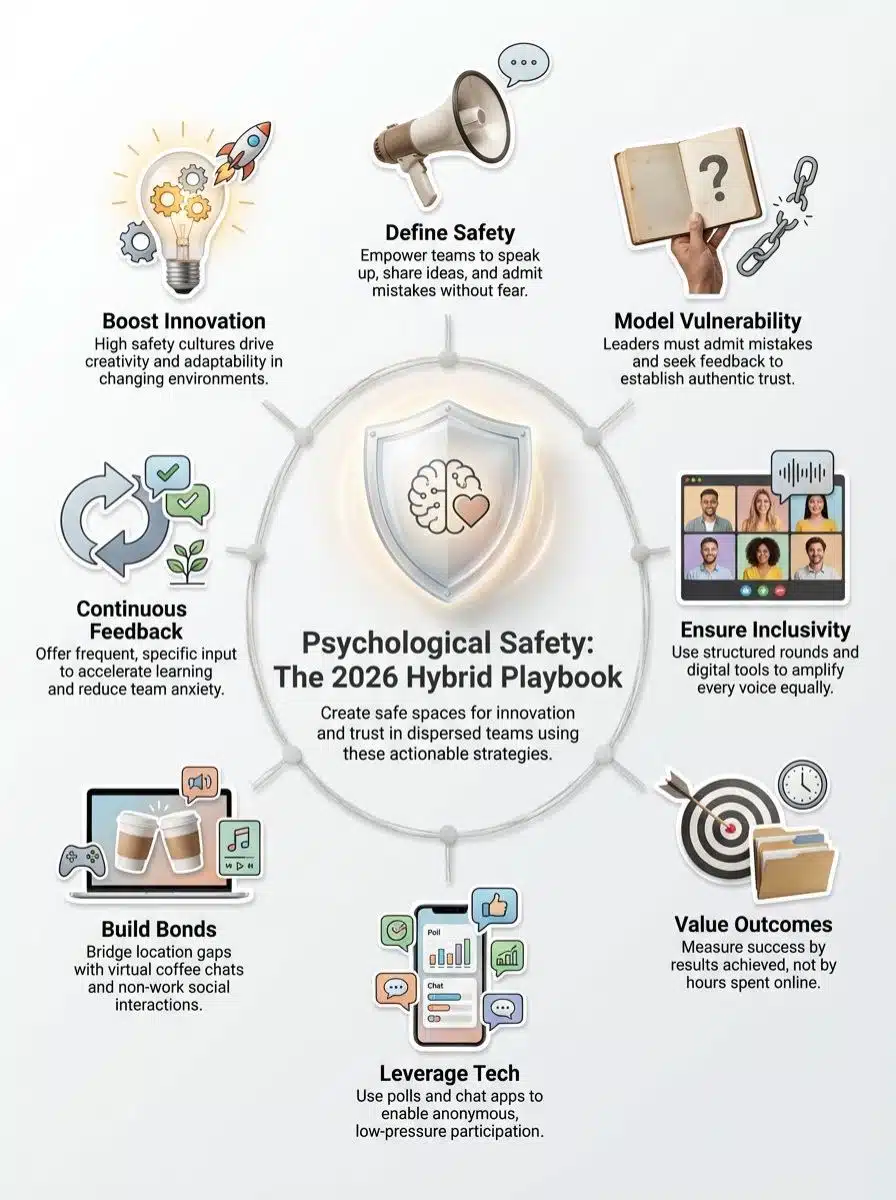
Simple changes shape how team members feel each day. Small steps make it easier for everyone to speak up and work well together, even across screens.
Encourage open communication and feedback
People need space to speak up. Open communication breaks down barriers and builds trust.
- Adopt the “Read-Only Friday” Rule: Many tech teams on Reddit swear by this 2025 trend—no big meetings or risky deployments on Fridays. It gives people a psychological break and safety to catch up without pressure.
- Normalize “I Don’t Know”: Trust grows fast when leaders admit mistakes. It sets a strong example that perfection isn’t the goal—learning is.
- Use Asynchronous Video Updates: Instead of another meeting, use tools like Loom or Slack Clips to share updates. This lets people watch at their own pace and process the info before reacting.
- Implement “Burstiness”: Coordinate hours where everyone is online for collaboration (e.g., 10 AM to 2 PM), and leave the rest for deep work.
- Feedback is Regular and Specific: Don’t wait for annual reviews. Use “micro-feedback” instantly after a task to help people adjust quickly.
- The “3-Minute Check-In”: Start meetings by asking, “How are you arriving today?” It’s a simple question that humanizes the screen.
- Burnout Protection: Teams with high safety report 30% lower burnout rates (WifiTalents 2025). Protect this by respecting “offline” hours religiously.
- Measure Outcomes, Not Activity: Judging people by their “green dot” status on chat apps destroys trust. Focus on what they deliver.
- Create “Frictionless” Feedback Channels: Use anonymous pulse polls in Microsoft Teams or Culture Amp to let shy members flag issues early.
- Listen Deeply: Leaders must prove they value input by acting on it. If you ask for feedback and do nothing, safety drops to zero.
Foster inclusivity and equal participation
Hybrid teams struggle with equal participation. Inclusivity is the engine of psychological safety.
- The “Remote-First” Speaking Rule: Always ask remote participants for their input before anyone in the room speaks. This prevents the “room” from setting the consensus.
- Assign a “Virtual Advocate”: Designate one person in the physical room to watch the screen and raise a hand if a remote person is trying to speak.
- Use Silent Brainstorming: Use tools like Miro or Mural to let everyone type ideas silently for 5 minutes. This equalizes the volume between loud and quiet voices.
- Rotate Meeting Facilitators: Let a remote employee lead the hybrid meeting. It forces the in-person team to focus on the screen.
- Standardize the Medium: If one person is on video, everyone should be on video—even those in the conference room. It puts everyone on the same pixelated playing field.
- Check Your Biases: Review your promotion data. If 90% of your promotions are in-office staff, you have a proximity bias problem to fix.
- Training on Bias Awareness: Companies that trained teams on inclusive practices saw over 30% higher innovation rates in 2025 surveys.
- Direct Solicitation: Encourage leaders to ask quiet members, “I’d love to hear your perspective on this,” to validate their expertise.
- Review Participation Data: Use meeting analytics to see who dominates the mic time and coach them privately to leave space for others.
- Share Wins Publicly: Celebrate the “invisible” work of remote teams in public channels to ensure they feel seen.
Create opportunities for team bonding
Team bonding builds the relational trust that makes work easier.
- Virtual “Fika” Breaks: Adopt the Swedish tradition of coffee and cake. Schedule 15 minutes a week purely for non-work chat.
- The “Manual of Me”: Have every team member write a short “user manual” on how they like to work, communicate, and receive feedback. It shortcuts months of guessing.
- Hybrid “Buddy” Systems: Pair a remote worker with an in-office worker for weekly syncs. It bridges the cultural divide.
- Gamify Connection: Use apps like Donut for Slack to randomly pair people for chats, or play quick games like Gartic Phone to induce laughter.
- celebrate Milestones: Send a physical item (like a cupcake or card) to remote workers’ homes for birthdays so they have a tangible connection to the celebration.
- Wellness Challenges: Run a step-count or hydration challenge that everyone can join, regardless of location.
- Casual “Open Door” Hours: Leaders can sit in an open video room for an hour a week where anyone can drop in to chat, mimicking the “stopping by the desk” dynamic.
Use technology to support collaboration
Smart use of technology can boost trust. The right tools stop people from feeling like second-class citizens.
- Zoom AI Companion 3.0: This tool, updated in late 2025, uses “Agentic AI” to proactively provide meeting agendas and live notes. It frees people from note-taking so they can focus on each other.
- Slack’s “Answer Agent”: This new feature helps teams find info across all their apps. It reduces the stress of asking “where is that file?” which can make new hires feel incompetent.
- Microsoft PowerPoint Live: Use the Meeting Coach feature (since the Teams Speaker Coach was retired in 2025) to get private feedback on your speaking pace and inclusivity.
- Async Video Tools: Loom or Vimeo let you record complex explanations. This helps non-native speakers or neurodivergent staff process info at their own speed.
- Digital Whiteboards: Miro allows for real-time collaboration that feels like a physical whiteboard, essential for creative safety.
- Anonymous Polling: Tools like Slido or Mentimeter give shy employees a safe way to ask tough questions without fear.
- Project Management Visibility: Tools like Asana or Monday.com make work visible. This ensures performance is judged by completed tasks, not by who yells the loudest.
- Noise Cancellation Software: Apps like Krisp remove background noise (dogs, traffic), making remote workers feel more professional and confident speaking up.
- Availability Indicators: Respect the “Do Not Disturb” status. It is a digital boundary that protects mental health.
- Analytics for Good: Use collaboration data to spot burnout risks (like late-night emailing) and intervene with support, not judgment.
The Role of Leadership in Promoting Psychological Safety
Leaders set the tone. If you are stressed and frantic, your team will be too. Your actions shape how safe people feel to speak up.
Leading by example through vulnerability and openness
Admitting you don’t have all the answers is a superpower. In 2026, the “know-it-all” leader is obsolete. Research confirms that top-performing hybrid teams are led by people who model vulnerability. When a manager says, “I missed that detail, thanks for catching it,” they instantly lower the risk for everyone else to admit their own gaps.
Listening with empathy is your other main tool. It shows you care about the person, not just the employee. This “human-first” leadership style is the only way to retain talent in a competitive market.
Providing consistent support and accountability
Support doesn’t mean lowering standards. Amy Edmondson’s research highlights that the “Learning Zone” creates high safety and high accountability. You want to challenge your team to be great, but give them the safety net to fail while they try.
Check in with your team often. Don’t just ask about tasks; ask about roadblocks. Clear expectations help everyone stay on track. When people know exactly what “good” looks like, they don’t waste energy worrying if they are doing enough. Celebrate the small wins loud and clear—it reinforces the behavior you want to see.
Developing emotional intelligence and adaptability
Emotional intelligence (EQ) is the ability to read the room—even when the room is virtual. Managers with high EQ can sense when a silence on a call is “thoughtful” vs. “fearful.” They intervene to draw people out.
Adaptability is just as key. The tools and rules of 2026 will change by 2027. Leaders who are willing to throw out the old playbook and try new methods (like changing meeting structures or testing new AI tools) show their teams that it is safe to experiment.
Benefits of Psychological Safety in Hybrid Teams
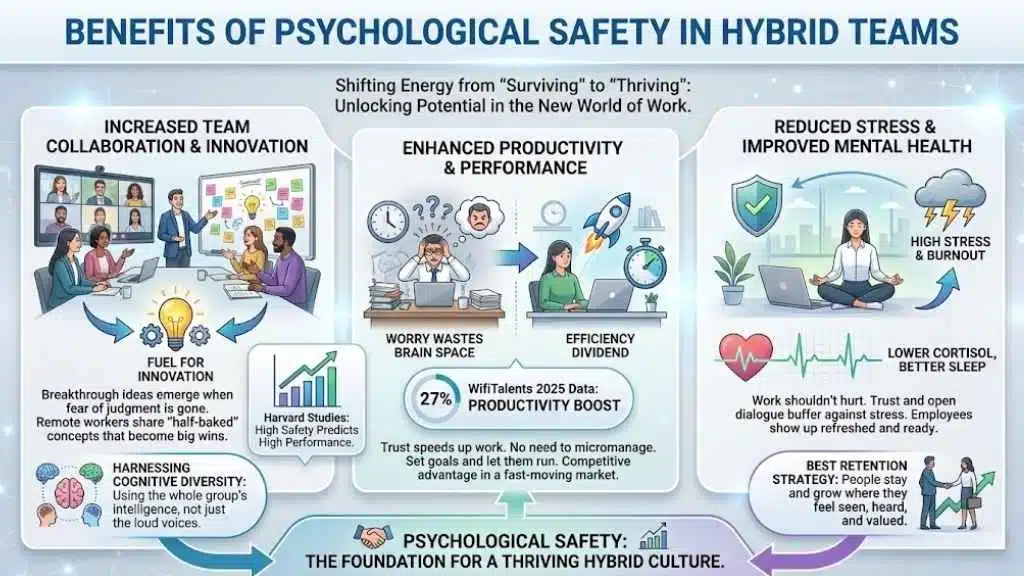
When teams feel safe, they stop protecting themselves and start solving problems. The energy shifts from “surviving” to “thriving.”
Increased team collaboration and innovation
Safety is the fuel for innovation. You cannot have a breakthrough idea if you are terrified of looking silly. In hybrid teams, safety means remote workers share that weird, half-baked idea that ends up becoming the quarter’s biggest win.
Harvard studies continue to show that high psychological safety predicts high performance. Teams that feel safe ask for help earlier, which prevents small errors from becoming million-dollar disasters. They harness the “cognitive diversity” of the entire group, not just the loud ones.
Enhanced productivity and performance
It’s simple math: worry takes up brain space. When employees don’t have to waste mental energy navigating office politics or wondering if their boss is angry, they pour that energy into their work. The WifiTalents 2025 data linking safety to a 27% productivity boost is proof of this efficiency dividend.
Trust speeds everything up. When you trust your team, you don’t need to micromanage or hold endless status meetings. You set the goal and let them run. This speed is a massive competitive advantage in a fast-moving market.
Reduced stress and improved mental health
Work shouldn’t hurt. Trust and open dialogue act as a buffer against the high stress of modern life. When employees know they won’t be punished for a mistake, their cortisol levels drop. They sleep better. They show up refreshed.
This directly impacts the bottom line by reducing sick days and burnout. A psychologically safe culture is your best retention strategy. People don’t leave jobs where they feel seen, heard, and valued—they stay and grow.
Final Thoughts
Building psychological safety in hybrid teams isn’t a one-time workshop; it’s a daily practice of small, intentional habits. From the “3-minute check-in” to the “Read-Only Friday,” these simple actions compound over time to create a culture of trust.
The data from 2025 is clear: teams that master this don’t just feel better—they perform better, innovate faster, and stick around longer. So, start small. Pick one strategy from this playbook—maybe the “Remote-First” speaking rule—and try it in your next meeting. You’ll be surprised at how quickly the energy in the room (and on the screen) changes for the better.
For those wanting extra help, looking into resources like the Fearless Organization Scan or updated leadership courses can provide a roadmap. Small changes today really do shape the stronger, safer teams of tomorrow.