In a quiet village tucked into the rolling hills of Tuscany, a silver laptop glows against a weathered oak table. Thousands of miles away, in the pristine air of Bhutan’s new Mindfulness City, another screen flickers to life. These are not just workers checking emails. They are the new foot soldiers of global economics. This surge in location-independent work is driven by the rise of the 2026 Digital Nomad Visa, a policy tool that has transformed remote professionals into a vital resource for national growth.
By early 2026, the traditional map has been redrawn. Forget physical fences or naval blockades. Today, national borders are defined by the strength of a Wi-Fi signal and the allure of a tax code. We have entered the era of the Visa Wars. In this high-stakes game, your laptop is the ultimate tool of soft power.
2026 Digital Nomad Visa: Portable GDP and the New Sovereign Service
For decades, countries fought over land or oil. Now, they are fighting over you. More than 55 nations have launched dedicated residency programmes to court the remote professional. This is a radical shift in how we view migration. The Digital Nomad is no longer a backpacker searching for cheap hostels. They are a portable piece of GDP.

The data paints a clear picture. The average remote professional in this bracket earns roughly $124,000 annually. They bring high-value skills and immediate spending power without requiring a single new factory or road. They represent talent spillovers that can revitalise a dying town or spark a tech revolution.
Nations are no longer just sovereign territories. They are competing service providers. They are desperate to attract your income and your intellect to counter aging populations and sluggish growth. As we navigate this new cartography, one thing is certain. Where you choose to plug in your charger is now a significant geopolitical act.
The Global Talent Hunt as a Modern Crusade
In the 2026 Visa Wars, the quiet revolution of remote work has graduated into a full-scale geonomic strategy. We are witnessing a transition from traditional statehood to a model that prizes intellectual agility over physical presence. This is not merely about filling empty villas in the Mediterranean; it is about securing the cognitive capital that will define the next decade of innovation. While the 20th century was defined by the extraction of physical resources, the 21st century belongs to the nations that can best curate and host the global mind.
Residency as a Service (RaaS)
Moving to another country used to be a heavy, permanent decision. It meant shipping containers, long goodbyes, and the slow grind of citizenship. In 2026, that permanence has dissolved. Residency has become a modular choice. It is a subscription you can toggle on or off based on your professional needs and lifestyle whims. This is the rise of Residency as a Service (RaaS).
Governments are now behaving like tech startups. They are iterating on their “product” to lure high-value users. Spain and Bhutan stand at opposite ends of this new market, yet both are playing the same game of global attraction.
The Spanish Gold Standard
Spain has refined its offer into a polished, high-tier service. In February 2026, the government updated the income requirements to stay in lockstep with the National Minimum Wage (SMI). To secure your place under the Spanish sun, you now need to prove a monthly income of €2,849.
But the real “premium tier” of the Spanish subscription is the Beckham Law. This legacy tax break has been adapted for the digital age. It allows remote workers to bypass the standard progressive tax rates, which can climb toward 47%. Instead, they pay a flat 24% tax on income up to €600,000 for their first six years. It is a clear, transactional offer. Pay your fee, enjoy the high-speed rail and the Mediterranean coast, and keep more of your global earnings.
The Bhutanese Boutique Experience
While Spain goes for scale, Bhutan has launched a boutique, brand-led residency that feels more like an exclusive club. On 3 February 2026, the kingdom unveiled its Gelephu Mindfulness City (GMC) programme. This is not just a visa; it is an invitation to join a “living laboratory” of sustainability.
Bhutan does not care as much about your monthly payslip. They care about your alignment with their values. To join, you pay an annual fee of $2,800. You must also maintain a $10,000 deposit in TER, a gold-backed digital asset used within the GMC ecosystem.
This is the ultimate evolution of RaaS. Bhutan is selling a vision of mindful prosperity, powered by green energy and spiritual heritage. They are not just offering a desk; they are offering a different path for development. In the 2026 Visa Wars, the question is no longer just where you can live, but which national brand you want to subscribe to.
Battle for the Demographic Winter
The urgency behind these visas is not about tourism; it is about survival. As we move through 2026, the global economy is grappling with a “demographic winter.” Birth rates in the West and East Asia have chilled. In nations like Italy and Japan, fertility rates have dipped below 1.5, creating a void in the local workforce that traditional migration cannot fix fast enough.
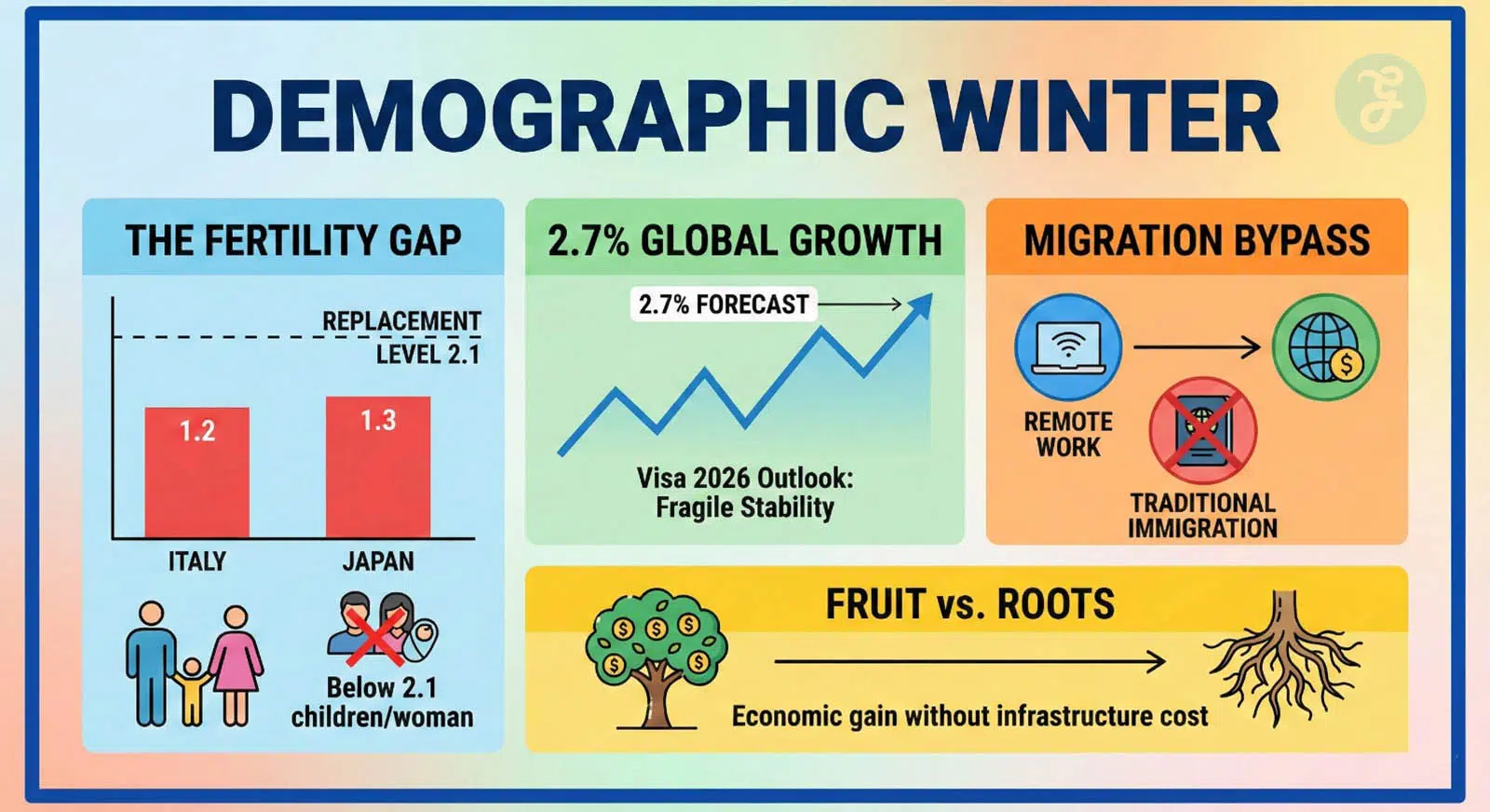
Visa’s 2026 Global Economic Outlook points to a steady but fragile 2.7% global growth. However, it warns that the aging of major economies is “quietly rewiring global commerce.” Countries are now looking at remote workers as a way to bypass the slow, expensive process of traditional immigration. They want the economic fruit without the infrastructure roots.
Italy: Reviving the Ghost Towns
Italy has become a primary laboratory for this experiment. By early 2026, the Italian government solidified its “Visto per lavoratore da remoto” with a monthly income threshold of roughly €2,500.
The goal is simple: rural revitalisation. Italy is filled with “ghost villages” that have the charm of the Renaissance but the pulse of a museum. By attracting nomads, the state injects immediate capital into these dying hubs. A remote worker rents a villa that has been empty for a decade. They buy their morning espresso from a local cafe and pay for high-speed fibre optic installation. They contribute to the local economy every single day, yet they do not take a job from a local resident or require the state to build a new primary school.
Japan: The High Tech Survivalist
Japan is playing a more targeted game. With its population shrinking by hundreds of thousands each year, the 2026 Japanese nomad programme focuses on “ICT professionals.” Leveraging treaties with 49 nations, Japan requires a substantial annual income of ¥10 million (approximately $67,000).
Japan is not just looking for shoppers; it is looking for “talent spillovers.” They want the global tech elite to rub shoulders with local entrepreneurs in Tokyo and Kyoto. They are betting that the presence of these “sovereign workers” will spark innovation in a stagnant domestic market.
Pure Profit Migration
In economic terms, the digital nomad is “pure profit.” Traditional migrants often require heavy upfront state investment in language training, social services, and housing. The 2026 nomad arrives fully formed. They bring their own health insurance, their own salary, and their own global network.
As of February 2026, data shows there are now over 40 million such workers worldwide. They are highly educated, with 91% holding higher degrees and earning an average of $124,000. For a country facing a demographic winter, this isn’t just a lifestyle trend. It is a vital economic injection.
The Global Marketplace Table
In 2026, the global marketplace for human capital has reached a fever pitch. Nations are no longer just competing on policy; they are competing on price and lifestyle. This is a buyers’ market where the buyer is the remote worker.
To understand the scale of this “Competitive Index,” we have to look at the different “tiers” of service currently on offer. Some nations sell pure financial efficiency, while others sell a long-term path to a second home.
The 2026 Competitive Index
| Country | Monthly Income | The Strategic “Pitch” |
| UAE | $3,500 | The Global Hub: 0% personal income tax and a one-year renewable “Virtual Work” visa. |
| Greece | €3,500 | The Long-Term Cut: A massive 50% income tax reduction for up to 7 years. |
| Croatia | €3,295 | The Total Exemption: 0% income tax on foreign earnings for up to 18 months. |
| Portugal | €3,680 | The Citizenship Play: A clear five-year pathway to permanent residency and EU passport. |
The UAE has positioned itself as the frictionless choice. With a requirement of $3,500 per month, they offer a zero tax environment and world-class infrastructure. It is the ultimate “Global Hub” for those who want to maximise their take home pay while living in a futuristic city.
Greece and Croatia are fighting for the European soul of the nomad. Greece offers a staggering 50% tax cut for those who commit to staying for more than six months. Croatia, meanwhile, has doubled down on its 0% tax offer for foreign income, making it the most affordable high-quality lifestyle play in the Mediterranean for 2026.
The New “Brain Gain” Profile
Who are these people the world is so desperate to host? According to DemandSage 2026 data, the global nomad population has surged past 40 million. This is not a fringe movement; it is a demographic shift.
The profile of the 2026 nomad has matured significantly. They are no longer just entry-level freelancers. Nearly 47% are in their 30s, often at the peak of their earning potential. Perhaps most importantly for the host nations, 90% of these individuals are highly educated, with the majority holding degrees and working in specialized fields like technology, engineering, or creative strategy.
When a nation attracts 10,000 such nomads, it isn’t just gaining 10,000 residents. It is gaining 10,000 experts. This is the “Brain Gain” that aging nations crave. These workers bring six-figure average incomes to local cafes and markets, without ever competing for a local job. In the 2026 Visa Wars, the table above isn’t just data. It is a scoreboard of national survival.
The Rise of the Sovereign Worker
In 2026, the traditional power balance between the state and the individual has been turned on its head. For centuries, governments held all the cards. If you wanted the protection and perks of a country, you followed its rules for life. Today, the 2026 digital nomad visa has handed the leverage back to the worker.
This is the era of reversed leverage. When you carry your income in your backpack, you are no longer a captive taxpayer; you are a customer. If a nation raises taxes or lets its infrastructure crumble, the sovereign worker simply closes their laptop and moves. Governments are now forced to pitch their value. They must prove why they deserve your presence and your high-value skills.
Reversing the Tech Drain
This shift is also redrawing the map of global talent. Historically, a “brain drain” meant ambitious engineers leaving Bangalore or Lisbon for the Silicon Valley bubble. Now, nomad visas allow nations to “capture” that talent without the worker ever leaving their home time zone.
Countries are essentially “stealing” expertise from traditional tech hubs like London or San Francisco. A software architect for a New York firm living in Tokyo brings their global network and innovative spirit to the Japanese ecosystem. They mentor local startups in cafes and share ideas at weekend meetups. This is the new soft power. It is not about owning the company anymore. It is about hosting the mind.
Geonomics over Globalisation
We are seeing a profound shift from traditional globalisation to what the Visa 2026 Global Economic Outlook calls “geonomics.” As global supply chains fragment and workforces become more distributed, the old models of centralized growth are fading.
In this geonomic era, national success depends on being a frictionless platform for mobile talent. By offering a 2026 digital nomad visa, a country ensures it remains relevant in a world where work is no longer a place you go, but a thing you do. Your laptop has become a tool of economic survival for nations desperate to stay ahead of the curve.
The Future of Choice
In early 2026, the global competition for talent has shifted from a series of scattered experiments to a permanent feature of the world economy. The rise of the 2026 digital nomad visa has proved that your choice of workplace is no longer a private matter. It is a significant political and economic act. When you decide where to open your laptop, you are deciding which nation’s vision of the future deserves your tax dollars and your intellectual capital.
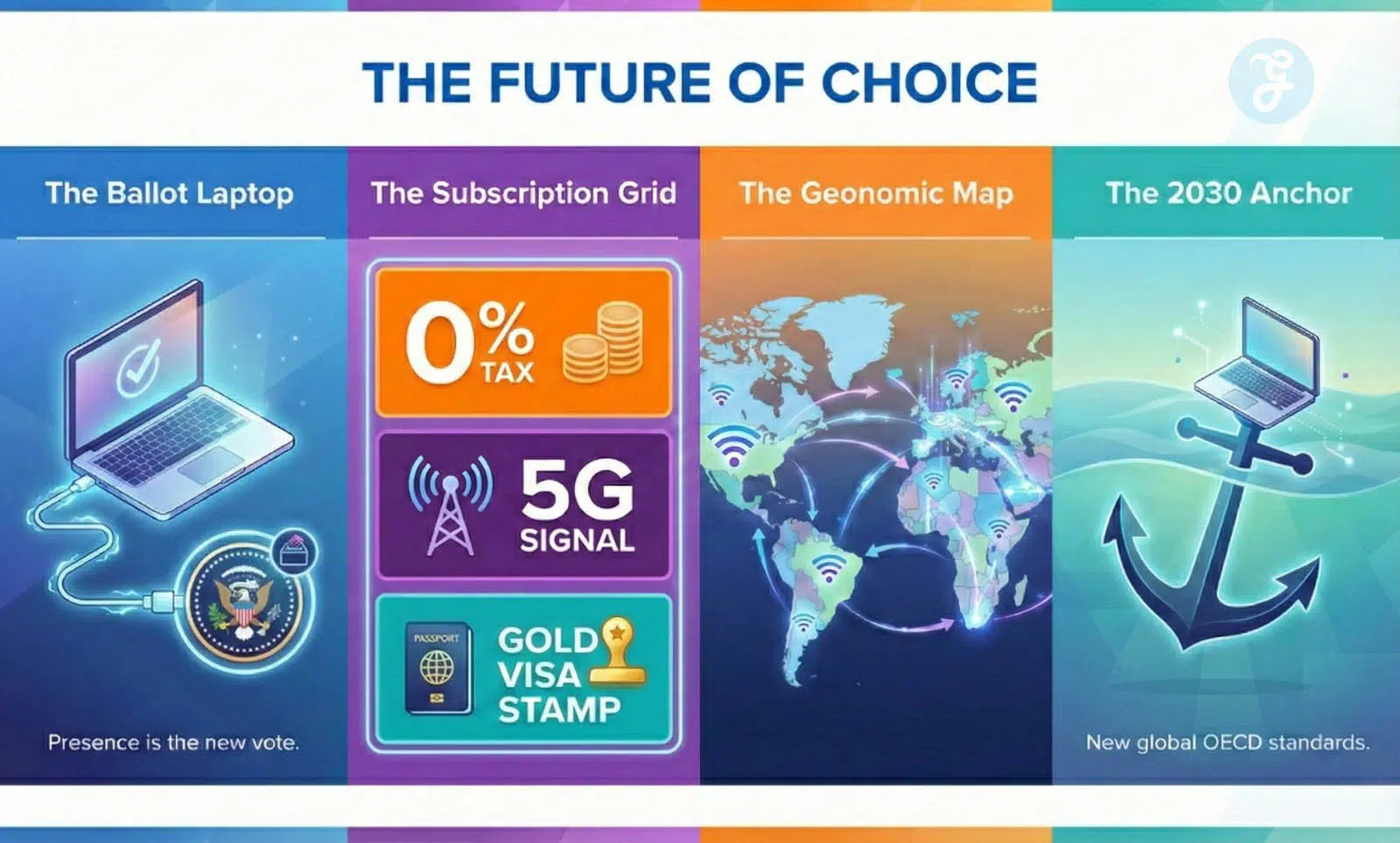 Looking toward 2030, this wild west of tax competition is already beginning to settle into a new global order. In January 2026, the OECD launched a major consultation on the tax challenges of global mobility. By 2030, we can expect these discussions to result in a new set of international standards.
Nations have realised that the high-value nomad is a finite resource. To prevent a race to the bottom on tax rates, the OECD is likely to introduce safe harbour rules. These would create universal thresholds, perhaps based on the 183-day rule or the new 50% working time benchmark, to simplify where a mobile professional owes their allegiance. The goal is to move from chaotic poaching to a structured, transparent marketplace for human capital.
The Power of the Plug
Ultimately, the Visa Wars have taught us that in a digital age, geography is a choice rather than a destiny. You are part of the first generation that can select its national operating system based on performance, safety, and tax efficiency rather than birthright.
The silver laptop glowing in a Mediterranean cafe or a Himalayan hub is more than just a workstation. It is a ballot box. Your presence is your vote for a government that understands the value of the Sovereign Worker. The laptop isn’t just code; it is a tool of economic survival for the nations that host you. As the 2026 Visa Wars mature, the prize remains clear. It is not the land or the oil. It is you. In this new era of competition, the 2026 Digital Nomad Visa is the primary vehicle through which you exert this unprecedented global leverage.