
Building wealth often feels like an uphill climb, especially with rising living costs and heavy taxes eating into your monthly salary. You work hard for your money, but keeping it is an entirely different game. One of the smartest ways to keep your cash out of the hands of the taxman and inside your own pocket is through a Retirement Annuity South Africa structure.
Many people brush off retirement funds as boring or restrictive, completely missing the incredible legal tax loopholes they offer. The government actually wants you to save for your later years, and they reward you handsomely for doing it. If you want to stop paying more tax than you need to, setting up a solid retirement plan is your first line of defense. We are going to look at exactly how this tool works, why it is a game-changer for your financial independence, and how recent changes in the law affect your money.
What Defines a Retirement Annuity in South Africa?
A retirement annuity is an individual, tax-efficient investment vehicle created specifically to help you save for the days when you finally stop working. Unlike a traditional company pension fund or provident fund that is permanently tied to your current employer, you own this account directly in your own name. This means you can keep it active no matter how many times you change jobs, start a new business, or take a career break. It is strictly governed by the Pension Funds Act, which ensures your money is invested safely and managed correctly by registered financial institutions.
You get to decide exactly how much you want to contribute each month, and you can even make lump-sum payments when you have extra cash on hand. Modern investment platforms allow you to pause or lower your premiums without charging you massive penalty fees, giving you incredible flexibility if your cash flow takes a hit. By committing your money to this structure, you essentially sign a contract to build long-term wealth in exchange for incredible tax incentives from the government.
| Feature | Description | Benefit to You |
| Ownership | You hold the account in your own name. | Total control over your savings even if you switch careers. |
| Tax Deductibility | Contributions reduce your taxable income. | You pay less income tax to the revenue service every year. |
| Flexibility | You can adjust, pause, or stop monthly premiums. | You do not get penalized if you face a tough financial month. |
| Legislation | Governed by Regulation 28 of the Pension Funds Act. | Your investments are protected from extreme, high-risk market crashes. |
Independence from Employers
Having your own fund means you do not rely on a company to dictate your financial future. Self-employed individuals, freelancers, and small business owners use these annuities because they do not have access to corporate provident funds. Even if you have a job with a pension, opening your own supplementary account gives you an extra layer of security. You decide the underlying unit trusts or exchange-traded funds your money goes into.
Regulation 28 Limits and Rules
The government places specific rules on where your money can be invested to protect you from losing it all before you retire. Regulation 28 limits your offshore exposure to forty-five percent and your equity exposure to seventy-five percent. Some investors dislike these limits, preferring total freedom, but the massive tax breaks you get in return make the trade-off highly worthwhile. Your money is forced into a balanced, risk-managed portfolio that grows steadily over time.
1: The Massive 27.5 Percent Tax Deduction Magic
One of the biggest reasons to open an account is the immediate tax relief you get on your annual earnings. The revenue service allows you to deduct up to twenty-seven and a half percent of your taxable income or remuneration, whichever is higher, straight off your tax bill. You can claim this deduction up to a maximum of R350,000 every single tax year, which runs from March to February. This means the money you put into your retirement fund actively lowers your tax bracket, giving you a much larger refund when you file your returns or a higher net take-home pay if you adjust your payroll.
If you are a high earner or a provisional taxpayer, this is arguably the single most effective legal method to slash the amount of money you owe the state. It essentially forces the government to co-fund your retirement using the exact tax money they would have otherwise taken from your bank account.
| Income Scenario | Annual Income | RA Contribution | Taxable Income | Tax Relief Impact |
| Standard Earner | R400,000 | R60,000 | R340,000 | Drops into a much lower tax bracket. |
| High Earner | R1,000,000 | R150,000 | R850,000 | Saves tens of thousands in marginal tax. |
| Business Owner | R1,500,000 | R350,000 (Max) | R1,150,000 | Maximizes the absolute limit of tax breaks. |
Maximizing the R350,000 Annual Limit
If you earn a high income, hitting that R350,000 limit should be your main priority every February before the tax year closes. Making a lump-sum top-up right before the deadline is a common strategy for wealthy individuals. It immediately shields a huge chunk of money from the highest tax brackets. You effectively force the government to fund a portion of your retirement through the tax they would have otherwise taken.
How Tax Refunds Build Extra Wealth?
The real magic happens when you file your tax return and get a fat refund from the revenue service. Smart investors do not spend this refund on a holiday or a new car. They immediately pump that refund into a tax-free savings account or back into their retirement fund. Doing this creates a loop of compound interest where you earn money on the tax you claimed back.
2: Zero Tax on Capital Gains, Dividends, or Income
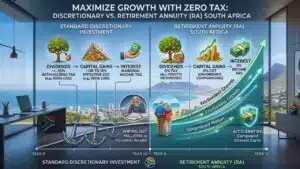
When you invest in a normal share portfolio or standard bank account, taxes constantly drag down your profits year after year and limit your compound interest. A Retirement Annuity South Africa completely shields your money from all of these typical growth taxes. You pay zero percent on the dividends your underlying companies pay out, zero percent on the interest your cash or bonds earn, and absolutely zero percent capital gains tax when your fund manager buys and sells shares to rebalance your portfolio. In a standard discretionary investment, you lose twenty percent of your dividends to withholding tax and up to eighteen percent on your capital gains.
Over a timeline of twenty or thirty years, these standard taxes act like a heavy anchor on your portfolio, wiping out millions of rands in potential wealth. Inside your retirement wrapper, your money grows in a completely frictionless environment, allowing your compound interest curve to accelerate far faster than any standard investment account could ever achieve.
| Tax Type | Discretionary Investment | Inside a Retirement Annuity |
| Dividend Withholding Tax | 20 percent | 0 percent |
| Capital Gains Tax | Up to 18 percent effective rate | 0 percent |
| Income Tax on Interest | Marginal rate after exemptions | 0 percent |
| Long-Term Drag on Returns | High | None |
Shielding Your Growth from SARS
Over a timeline of twenty or thirty years, ordinary taxes eat away a massive chunk of your wealth. Every time you rebalance a normal portfolio, you trigger capital gains tax. Inside your retirement wrapper, the fund manager trades, shifts assets, and collects dividends without ever declaring it to the taxman. Every cent stays inside the account.
The Power of Uninterrupted Compounding
Because no money leaks out to pay taxes, your compound interest curve accelerates much faster. A hundred thousand rand invested in a tax-sheltered fund will look vastly different after twenty years compared to the exact same amount in a taxable account. The longer you leave the money alone, the more obvious this tax-free advantage becomes.
3: The Incredible R550,000 Tax-Free Cash Bonus
Many people worry that they just pay all the saved tax back when they finally retire, but the rules actually offer a massive financial reward right at the finish line. When you reach the legal retirement age of fifty-five and decide to officially mature your fund, you are allowed to take up to one-third of the total value in a direct cash lump sum. The South African tax tables currently state that the first R550,000 of that cash lump sum is paid out to you completely tax-free. If you have been saving diligently your entire career, walking away with over half a million rand without paying a single cent in tax is a life-changing benefit.
People often use this massive cash injection to settle their primary residence bond, pay off all remaining vehicle debt, or transfer the funds into an accessible discretionary account to fund overseas travel and emergency medical expenses. The remaining two-thirds of your fund is then seamlessly transitioned into an income-generating product to pay your monthly salary.
| Lump Sum Withdrawal Bracket | Rate of Tax |
| R0 to R550,000 | 0 percent tax |
| R550,001 to R770,000 | 18 percent of amount above R550,000 |
| R770,001 to R1,155,000 | R39,600 plus 27 percent of amount above R770,000 |
| R1,155,001 and above | R143,550 plus 36 percent of amount above R1,155,000 |
What Happens at Age 55?
Fifty-five is the magic number in the South African retirement rulebook. Before this age, your money is mostly locked away to protect you from spending it prematurely. Once you hit this milestone, you officially have the right to access the one-third cash portion. You do not have to retire at fifty-five, though; you can leave the money growing tax-free until you are seventy or older.
Choosing Between a Living and Life Annuity
The remaining two-thirds of your money buys either a living annuity or a life annuity. A living annuity lets you choose your underlying investments and draw an income between two and a half and seventeen and a half percent each year. A life annuity is a contract with an insurance company that guarantees you a set monthly paycheck for the rest of your life, removing the risk of outliving your money.
4: Total Protection Against Estate Duty
Passing away is incredibly expensive in South Africa, and brutal estate taxes can easily wipe out a huge portion of the wealth you spent your entire life trying to build for your children. Estate duty currently sits at a heavy twenty percent for estates valued under thirty million rand, and executor fees can take another three and a half percent plus value-added tax straight off the top. The surprising truth is that the money sitting securely in your retirement fund falls completely outside of your formal estate calculation.
When you pass away, whether before or after you retire, your nominated beneficiaries get the money directly without it ever passing through the slow, expensive hands of the Master of the High Court. This legal bypass saves your family hundreds of thousands of rands in fees and taxes while providing them with fast, accessible cash right when they need it the most, instead of forcing them to wait years for an estate to finally wrap up.
| Estate Cost | Regular Assets (Property, Cash, Shares) | Retirement Annuity Assets |
| Estate Duty | 20 to 25 percent | 0 percent |
| Executor Fees | Up to 3.5 percent plus VAT | 0 percent |
| Payment Speed | Months to years depending on the estate | Fast tracked directly to beneficiaries |
| Master of the High Court | Must approve all distributions | Bypassed completely |
Bypassing the Master of the High Court
Winding up an estate in South Africa is notoriously slow. Families often wait years to access money tied up in properties or bank accounts while paperwork slowly moves through the system. Because your retirement fund has nominated beneficiaries, the fund administrators pay your family directly. This provides them with fast, accessible cash when they need it most.
Saving on Executor Fees
Executors charge up to three and a half percent just to process your assets. On a five million rand estate, that is a massive fee that your family loses. By moving your cash into a retirement wrapper, you legally remove that asset from the executor’s fee calculation. It is one of the smartest generational wealth transfer strategies you can use.
5: Unused Tax Deductions Roll Over Forever
Sometimes you have an incredibly successful financial year and want to dump a massive amount of cash into your savings, potentially pushing you way past the R350,000 annual deduction limit. You might think you permanently lose the tax benefit on that extra money, but the tax code is actually highly forgiving and strategic in this area. Under Section 11F of the Income Tax Act, any money you contribute over the limit automatically rolls over to the very next tax year. You can carry these unused deductions forward indefinitely to steadily reduce your taxable income in future years when your cash flow might be a bit tighter.
Even better, if you still have a pool of unacknowledged, rolled-over contributions when you finally reach retirement age, the taxman allows you to use those exact excess contributions to severely reduce the tax you pay on your cash lump sum withdrawal, ensuring absolutely no tax benefit ever goes to waste.
| Contribution Scenario | Deduction Claimed | Rolled Over to Next Year |
| Contribute R200,000 (Under Limit) | R200,000 | R0 |
| Contribute R400,000 (Over Limit) | R350,000 | R50,000 |
| Contribute R1,000,000 (Windfall) | R350,000 | R650,000 (Carried forward indefinitely) |
Section 11F of the Income Tax Act
This rollover rule is governed by Section 11F of the tax laws. It tracks every extra rand you put into the system. If you sell a business or get a massive bonus, you can inject that cash into your fund safely. The system effectively keeps a ledger of your over-contributions and credits them to you as time goes on.
Offsetting Tax During Retirement
If you reach retirement age and still have a pool of unacknowledged, rolled-over contributions, you still do not lose out. The taxman allows you to use those excess contributions to reduce the tax on your lump sum cash withdrawal. If there is still money left over, it can offset the income tax you pay on your monthly pension drawn from your living annuity.
6: Complete Legal Protection from Creditors

Running your own business, working as an independent contractor, or simply navigating life comes with severe and unpredictable financial risks. If things go completely wrong, you could face lawsuits, company liquidations, or even personal bankruptcy. The law fiercely defends your retirement savings from absolutely everyone you might owe money to. Under Section 37A and 37B of the Pension Funds Act, your creditors cannot attach, garnish, or seize the money safely locked inside your retirement wrapper.
Even if a bank forecloses on your family house or repossesses your vehicles, they cannot legally touch your long-term retirement savings. The government put this strict rule in place because they absolutely do not want to end up supporting bankrupt citizens through state welfare programs. This makes the fund an untouchable vault and the ultimate safety net for entrepreneurs who routinely take personal risks or sign dangerous sureties for business loans.
| Threat Level | Vulnerability of Regular Assets | Vulnerability of Retirement Savings |
| Business Liquidation | High (Can be seized) | Fully Protected |
| Personal Sequestration | High (Can be sold off) | Fully Protected |
| Lawsuits and Judgments | High (Assets attached) | Fully Protected |
| Maintenance Claims | High | Can be claimed under specific divorce/maintenance orders |
Section 37A and 37B Protections
These specific sections of the law make your retirement fund an untouchable fortress. Even if a bank forecloses on your house or repossesses your car, they cannot touch your long-term savings. The government put this rule in place because they do not want to end up supporting bankrupt citizens through state welfare.
A Safe Haven for Entrepreneurs
For business owners who sign personal sureties on business loans, this protection is priceless. You can take calculated risks in your company knowing that your financial future is locked away safely. If your startup fails, you start over with zero assets but your retirement money remains perfectly intact, waiting for you at age fifty-five.
7: Maximizing the New Two-Pot Retirement System
The landscape of South African savings changed dramatically on the first of September 2024 with the highly anticipated introduction of the Two-Pot retirement system. The government finally recognized that people frequently face severe financial emergencies and needed a structured way to access emergency cash without totally resigning from their jobs. Now, every single new contribution you make is automatically split between a designated Savings Pot and a locked Retirement Pot, completely changing how you interact with your money.
The Savings Pot gets one-third of your money and acts as an emergency fund, while the Retirement Pot gets two-thirds and remains totally locked until age fifty-five. However, any money you pull from your Savings Pot gets added directly to your taxable income for the year, meaning you will pay your absolute highest marginal tax rate on it. The smartest financial move is to pretend the Savings Pot does not exist and let your money compound entirely untouched.
| Pot Name | Funding Allocation | Access Rules | Tax Implications |
| Savings Pot | One-third of monthly contributions | One withdrawal per tax year (Min R2,000) | Taxed at your marginal income tax rate |
| Retirement Pot | Two-thirds of monthly contributions | Locked completely until age 55 | Follows standard retirement lump-sum tables |
| Vested Pot | Historical savings before Sept 2024 | Locked until age 55 | Follows old rules, pays out at retirement |
Emergency Access and the Tax Trap
The Savings Pot gives you a financial lifeline. You can pull money out once a year to fix a car or pay unexpected medical bills. However, this access comes with a massive penalty. Any cash you withdraw before you retire gets added to your taxable income for that year. You pay your absolute highest marginal tax rate on it, meaning you hand a massive chunk straight back to the revenue service.
Vested Pots and Historical Savings
If you had an account running before September 2024, all that money sits in a Vested Pot. The rules for that money stay exactly the same as they always were. To kick off the new system, they took ten percent of your Vested Pot, up to a maximum of thirty thousand rand, and dropped it into your new Savings Pot as seed capital. Smart investors leave the Savings Pot completely alone to avoid the nasty tax hits.
Why a Retirement Annuity South Africa Strategy Matters Now?
Living comfortably in South Africa requires serious, proactive financial planning and a deep understanding of economic reality. The state old-age grant provided by the government is incredibly tiny, offering barely enough cash to buy basic monthly groceries, let alone pay for expensive private medical aid premiums or secure, comfortable housing. You are completely on your own when it comes to funding your later years, making a solid Retirement Annuity South Africa strategy completely non-negotiable.
Between a highly volatile local currency, aggressively rising inflation rates, and the soaring cost of private healthcare, building a massive capital base is the only proven way to ensure you survive your old age without becoming a financial burden to your children. Using the government’s own tax laws to heavily shelter your money is the single most efficient way to build the millions of rands you will inevitably need to sustain your preferred lifestyle.
| Economic Challenge | Impact on Your Finances | How an RA Helps |
| High Inflation | Cash loses buying power rapidly. | Market-linked growth outpaces inflation over time. |
| Heavy Tax Burden | Less money to save and invest. | Immediate tax deductions put cash back in your pocket. |
| Lack of State Welfare | You must fund your own survival. | Forces disciplined, untouchable saving habits. |
| Emigration Costs | Moving abroad is incredibly expensive. | Strict withdrawal rules apply, requiring formal tax emigration. |
Shrinking State Support
The government simply does not have the tax base to support millions of retirees comfortably. If you do not lock away capital now, you face a massive drop in your living standards later. Using the government’s own tax laws to shelter your money is the most efficient way to build the millions of rands you need to sustain your lifestyle.
Creating Your Own Wealth Engine
You have to view your retirement contributions as paying your future self first. It is an automated wealth engine that runs quietly in the background. You get tax back today, zero tax on the growth tomorrow, and a massive tax-free payout at the end. Ignoring this vehicle means you willingly choose to pay more tax and retire with less money.
Final Thoughts
Taking total control of your financial destiny starts with deeply understanding the rules and actively using them to your clear advantage. A Retirement Annuity South Africa strategy is infinitely more than just a boring monthly savings account; it is a legally protected, highly fortified fortress built specifically for your long-term wealth. By consistently maximizing your annual tax deductions, completely ignoring the dangerous temptation of the new Two-Pot savings withdrawals, and actively letting uninterrupted compound interest do all the heavy lifting, you firmly secure your financial future.
The earlier you start funneling money into this structure, the less of your own actual cash you have to commit, simply because decades of tax-free growth will push your balance into the millions. Sit down with a calculator, run your personal income numbers, consult with an independent financial advisor to select the right low-fee funds, and start aggressively clawing your hard-earned tax money back from the government today.
Frequently Asked Questions (FAQs)
1. Can I transfer my retirement fund to another provider if I am unhappy with the fees?
Yes, you can easily move your money to a completely different company through a legal process called a Section 14 transfer. The Pension Funds Act specifically allows you to switch asset managers without paying any tax on the actual move. You just need to check if your current legacy provider charges any early cancellation or penalty fees before you formally initiate the transfer.
2. What happens to my RA if I emigrate and leave the country permanently?
You cannot just cash it out the day you pack your bags anymore. Current South laws strictly force you to formally cease your tax residency with the revenue service and actively maintain that non-resident status for three consecutive years. Only after that strict three-year waiting period expires can you finally withdraw the full amount, pay the required withdrawal tax, and take the cash completely offshore.
3. Do I have to retire my fund exactly at age 55?
No, fifty-five is simply the earliest age the current law allows you to access the money. There is absolutely no maximum age limit forced upon you. You can leave the money sitting securely in the fund to keep growing tax-free for as long as you want, whether that is age sixty-five or eighty. You only officially retire the fund when you actually need the monthly income.
4. Can my ex-spouse claim part of my retirement money in a messy divorce?
Yes, under the rules of the Pension Funds Act, a retirement fund can definitely be considered part of your joint assets during a formal divorce settlement. If you are legally married in community of property or with the standard accrual system, the court can specifically order the fund to pay out a portion of your accumulated pension interest directly to your ex-spouse.
If you hold a modern, unit trust-linked fund, you can safely pause or completely stop your monthly premiums at any time without facing any financial penalties. Your existing money simply stays fully invested and continues to grow quietly in the background. However, older, traditional insurance-style policies might charge a nasty penalty fee for stopping payments early, so you should carefully review your specific contract details.
6. How does Regulation 28 impact my offshore investment strategy?
Regulation 28 restricts your retirement fund from investing more than forty-five percent of its total value in offshore assets. While this limits your ability to heavily bet against the local currency, it forces a highly balanced approach. To counter this limit, many smart investors use their standard discretionary accounts to invest entirely offshore, perfectly balancing out the local exposure of their retirement annuity.
7. Is it better to contribute monthly or make one massive lump sum payment?
Both strategies work perfectly for claiming your tax benefits. Contributing monthly helps you consistently build wealth through the mathematical advantage of rand-cost averaging, softening the blow of volatile markets. Making a lump-sum payment at the end of February is ideal for highly variable earners or business owners who only know their exact taxable income right at the end of the financial year.