

In the modern search landscape, ranking at #1 is no longer the ultimate goal. The new gold standard is Position Zero. This is the Featured Snippet—the block of information that appears above the first organic result, providing users with an immediate answer to their query.
Being the “Snippet” means you occupy the most valuable real estate on the internet. It leads to higher click-through rates (CTR), establishes instant brand authority, and makes your content the primary source for voice search assistants like Alexa and Siri. However, winning this spot isn’t an accident; it requires a specific type of structural engineering.
The Position Zero Architect is a Micro SaaS tool designed specifically to help you draft, test, and optimize content for this elite spot. This guide will walk you through the science of snippets and how to use the Architect to dominate the SERPs.
What is Position Zero?
Position Zero (P0) is Google’s way of rewarding the most concise, helpful, and accurately structured answer to a user’s question. It usually appears in three formats:
- The Paragraph: A 40–60 word definition or explanation.
- The List: A numbered or bulleted set of steps or items.
- The Table: Data presented in rows and columns.
The Position Zero Architect focuses primarily on the “Paragraph Snippet”—the most common and competitive format.
How the Position Zero Architect Works
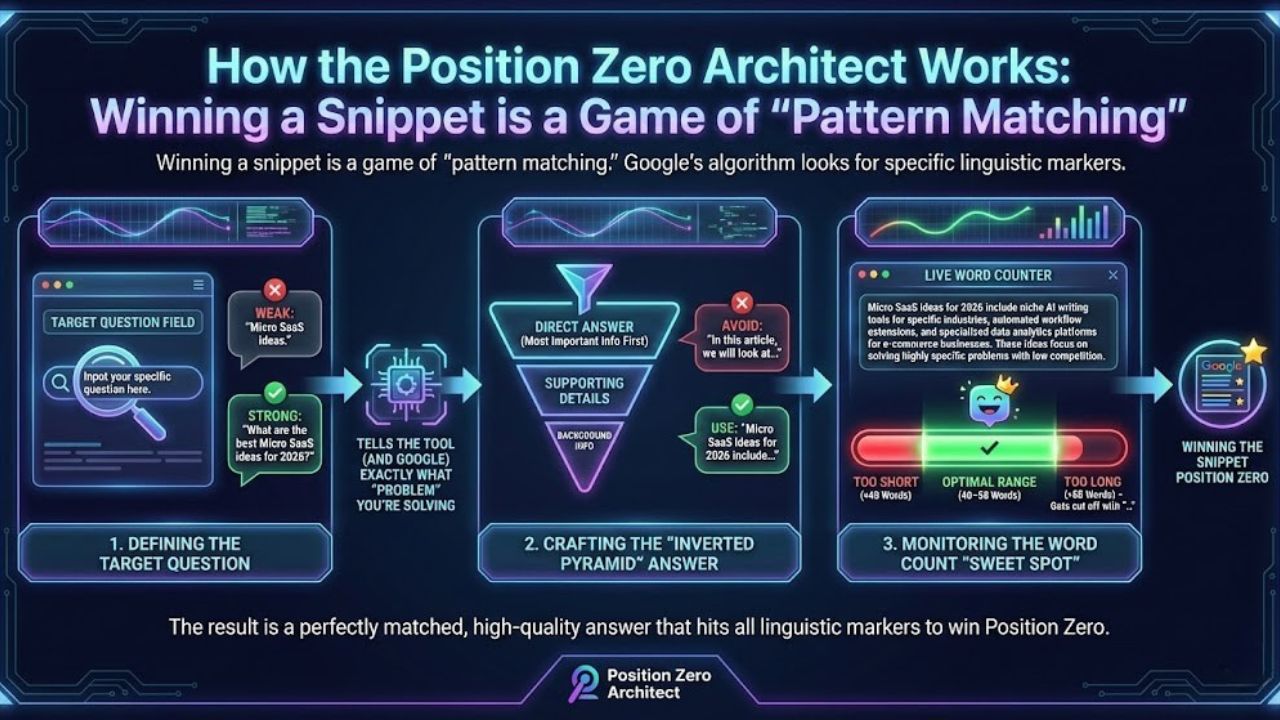
Winning a snippet is a game of “pattern matching.” Google’s algorithm looks for specific linguistic markers that indicate a high-quality answer. The Architect tool helps you hit these markers perfectly.
Step 1: Defining the Target Question
Before writing, you must identify the specific question your audience is asking.
- Weak: Micro SaaS ideas.
- Strong: What are the best Micro SaaS ideas for 2026?
Input your question into the Target Question field. This tells the tool (and Google) exactly what “problem” your snippet is solving.
Step 2: Crafting the “Inverted Pyramid” Answer
In journalism, the inverted pyramid puts the most important information at the top. For Position Zero, your first sentence should be the direct answer.
- Avoid: “In this article, we will look at…”
- Use: “Micro SaaS ideas for 2026 include…”
Step 3: Monitoring the Word Count “Sweet Spot”
One of the most critical features of the Position Zero Architect is the Live Word Counter. Data shows that the vast majority of paragraph snippets are between 40 and 58 words.
- Too Short: Google thinks the answer lacks depth.
- Too Long: The text gets cut off with a “…” which can hurt the user experience.
The tool will alert you with a green status bar when your answer falls within this optimal 40–58 word range.
The Structural Rules of a Winning Snippet
Using the tool’s built-in checklist, you must ensure your snippet follows these three structural laws:
Law 1: The Definition Rule
Google loves “Is/Are” statements. If the question is “What is a Semantic Gap?”, your snippet should start with: “A semantic gap is…” This linguistic clarity makes it easy for the algorithm to identify your text as a definition.
Law 2: Objective Tone
Position Zero is for facts, not opinions. The Architect encourages you to remove “fluff” words like amazing, incredible, or in my opinion. Stick to neutral, authoritative language.
Law 3: The “Snippet Bait” Logic
The tool helps you create “Snippet Bait”—a specific block of text, usually located at the very top of your article or under a clear H2 heading, that is formatted perfectly for Google to “scrape.”
[Image showing a live preview of a Google Featured Snippet, highlighting the bolded keywords and the concise answer structure]
The Power of the Live Preview
One of the most engaging features of the Position Zero Architect is the Google Search Preview. As you type, the tool generates a mockup of what your snippet will look like on a mobile and desktop screen.
This visual feedback is vital. It allows you to see:
- Which words will likely be bolded by Google (keywords that match the user’s query).
- If your URL and Page Title look authoritative beneath the answer.
- Where the text might be truncated if you exceed the word limit.
Integrating the “Dominance Suite” Workflow
The Position Zero Architect shouldn’t live in a vacuum. To ensure your snippet ranks and stays there, use it as the final step in your Editorialge workflow:
- Semantic Gap Finder: Ensure your full article covers all the technical entities related to the question.
- Cannibalization Compass: Check that you don’t already have another page fighting for this same snippet.
- Humanizer: Ensure the language is easy to read (90% score) so users don’t bounce after reading the snippet.
- Position Zero Architect: Reformat your core conclusion or summary into the perfect 50-word snippet block.
Strategic Resolution: What to do if you don’t win?
Even with the best tools, SEO is competitive. If your “Architected” snippet hasn’t appeared after two weeks:
- Check the Heading: Ensure the question is wrapped in an <h2> or <h3> tag directly above your snippet block.
- Improve the Page Rank: Google usually only pulls snippets from the Top 10 results. Use the Semantic Gap Finder to improve your overall page authority so you break into the Top 10.
- Check the Formatting: If the current winner is a “List,” change your Architect output from a paragraph to a bulleted list.
The Future: Voice Search and AI Overviews
By 2026, more than 50% of searches are expected to be screenless (voice search). When a user asks a smart speaker a question, the speaker almost always reads the Position Zero snippet.
Furthermore, Google’s AI Overviews (SGE) use featured snippets as the primary data source for their summaries. By using the Position Zero Architect, you aren’t just optimizing for a search result; you are training the world’s most powerful AI models to view your brand as the definitive source of truth.
Final Words
Occupying Position Zero is the ultimate “authority hack.” It allows a smaller site with great structure to outrank a giant site with poor formatting. The Position Zero Architect takes the guesswork out of this process, providing you with a scientific framework to draft content that Google’s algorithm simply cannot ignore.
Stop hoping for snippets and start building them. Use the Architect to frame your knowledge, and watch your traffic—and your authority—reach new heights.