

As we dig deeper into the mysteries of theoretical physics and the fundamental nature of reality, we’re left puzzling over the mind-bending questions that arise.
For instance, some physicists suggest that our universe might be nothing more than an illusion, a kind of hologram spun out from quantum processes happening in a lower-dimensional space.
But do these modern theoretical breakthroughs really provide us with revelations about the true nature of reality, or are they just mathematical tools we’ve invented to untangle complex scientific problems? When it comes to the latest, boundary-pushing theories in physics, how can we distinguish between what’s born from our imagination and what’s truly a product of the universe itself?
Black Holes May Prove
The intrigue really kicks off when we start talking about those eerie specters of the cosmos, black holes. At first glance (and you’ll appreciate the pun later), black holes seem straightforward. Material falls in and never comes back out. All the data about that material gets securely locked behind the event horizon, effectively disappearing. However, in the 1970s, renowned astrophysicist Stephen Hawking threw us a curveball. Turns out, black holes aren’t entirely black. They’re a smidge gray, slightly leaky even, letting off a small amount of radiation that leads black holes to slowly, but surely, evaporate away into nothingness.
But there’s a catch. This radiation doesn’t carry any information. Cue the paradox: information goes in, doesn’t come out, and the black hole eventually vanishes. The burning question then is, what on earth happens to all that information?
So, when we’re talking about information, we’re basically referring to the full details of all the characteristics of the particles that plunged into the black hole. In other words, it’s everything you’d need to recreate the original entities that toppled in. But what comes out of a black hole, courtesy of Hawking’s radiation, is simply a random smattering of particles. You couldn’t deduce what had tumbled in based on the radiation that’s coming out.
A critical piece of the puzzle surfaced in the years following Hawking’s monumental revelation. One method to gauge the amount of information is through entropy, a term in thermodynamics loosely connected to the degree of disorder within a system. Here’s where black holes throw us another curveball: their entropy is tied to their surface area, not their volume. This means that the information within a black hole is linked to its two-dimensional surface, not its three-dimensional volume. Quite the head-scratcher, isn’t it?
The concept of entropy: Entropy, in a nutshell, explains a system’s inclination to shift from a state of order towards one of disorder. The rationale here is that there are just so many more possibilities for a system to be in a state of disorder compared to a state of order. Think about tidying up your room – there’s only one way for the room to be considered spotless. However, there’s an almost infinite number of ways for the room to be messy, or to descend into chaos, like a single spot of dirt or a lone sock tucked away in a corner. So, over time, entropy is bound to increase. This rule doesn’t just apply to your room but to any system in the universe.
Now, this is pretty much unparalleled in the universe, and it piqued the interest of many physicists. They were suddenly drawn towards black holes, with big-shot physicists like Leonard Susskind spearheading the exploration into this novel concept known as the holographic principle. The name is borrowed from the concept of holography itself. Have you ever witnessed a hologram in real life and felt like the image was popping out at you? That’s because the hologram packs all the three-dimensional information onto a two-dimensional surface.
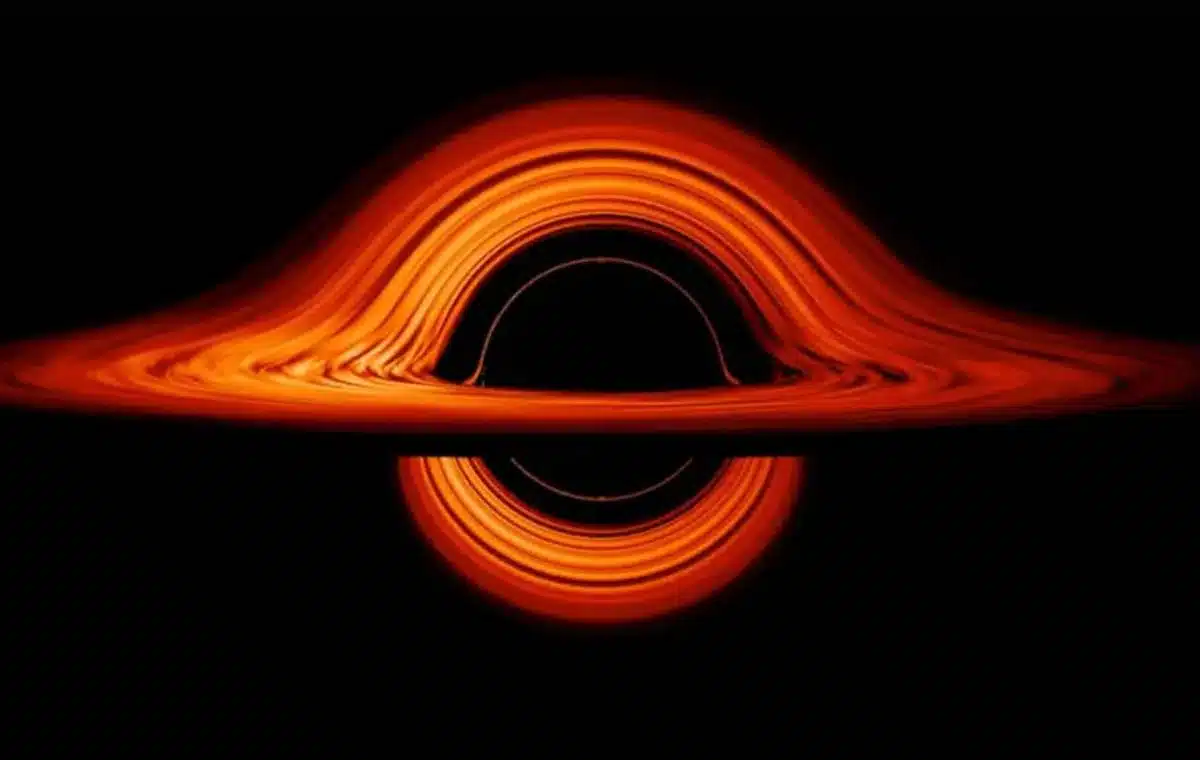
So, it seems like there’s something intriguing about black holes, with their information seemingly imprinted on their two-dimensional surfaces. Maybe the same logic applies to the entire universe.
A Two-Dimensional Universe?
This concept might not be as outlandish as it initially sounds, especially since we might already have a functioning example of the holographic principle in action. This is known as the AdS/CFT correspondence, an idea put forward by physicist Juan Maldacena in 1997.
Let’s try to understand this by constructing a unique type of universe with a few peculiar characteristics. Firstly, this universe has five spatial dimensions, not just three. Secondly, it’s totally devoid of matter and radiation. And thirdly, it contains a constant cosmological force that bends it inward. This kind of spacetime is referred to as a (five-dimensional) anti-de Sitter space.
Suppose you’re trying to solve a highly complex problem within this universe, like the workings of quantum gravity. Despite trying to solve quantum gravity for nearly a century, we don’t have definite answers yet. But we do have a collection of tools, known as string theory, which we hope will eventually lead us to the solution.
Let’s explain more complicated ideas
Quantum Gravity: Quantum gravity is all about comprehending gravity’s influence on the tiniest entities in the universe, such as subatomic particles. We’re pretty good at explaining the behaviors of these particles using quantum mechanics, but here’s the catch – when gravity gets really strong, say, inside black holes, our theories kind of fall apart. Quantum gravity is our bold attempt to patch up those theories and make sense of it all.
Quantum fields are things that can be found everywhere in the world. When some parts of the fields get energy, particles are made or forces are traded.
Conformal Field Theory: Quantum field theory is like this special mathematical toolkit that’s super handy in certain high-energy physics experiments, but isn’t exactly everyone’s go-to in other situations.
Here’s where Maldacena made a stunning breakthrough. He found a way to morph this problem – the puzzle of how to sort out quantum gravity in this peculiar universe – into a completely different conundrum residing on its four-dimensional boundary. Once you make this switch, all the gravity evaporates, making room for a special kind of quantum theory known as a conformal field theory (the ‘CFT’ in the correspondence). Over time, we’ve gotten really good at cracking quantum field theory problems, armed with a robust arsenal of tried-and-tested mathematical tools.
What Maldacena did was pure magic in the realm of theoretical physics: he took a problem that had us stumped (quantum gravity combined with string theory) and morphed it into one we can tackle (a conformal field theory using quantum fields).
Is this the Spacetime Origin?
This is where things get truly mind-bending. Some physicists have taken this concept beyond just being a problem-solving tool for tough gravity issues, and are using it to explain gravity itself. They claim they’ve found correlations where the quantum behaviour of all the fields at the boundary of this space-time triggers general relativity within it. General relativity is how we understand gravity – we see it as the warping and curving of space and time. So, in a nutshell, the holographic principle might be suggesting that quantum interactions on the edges of our universe are literally creating the space-time within it.
If they’re onto something, what we see as a three-dimensional universe, packed with all sorts of fascinating objects influenced by gravity, is actually just a two-dimensional surface buzzing with bizarre quantum antics from which everything else springs.
But, that’s a hefty ‘if’.
Despite years of intense research in this direction, the holographic principle is not without its flaws. For starters, its poster child, the AdS/CFT correspondence, is right now just a guess about what could be true, based on certain observed mathematical links. No one has actually proven this correspondence to be a fact. And even if it is proven, the universe described by this correspondence is nothing like our own. Our universe has three spatial dimensions, not five, and it includes a dimension of time. It’s not empty and self-contained, but is instead filled with matter and radiation, and it’s currently expanding at an accelerating rate. Most crucially, our universe doesn’t have a clear-cut boundary, which puts the entire foundation of the holographic principle into question.
Next, the vast majority of physical theories that explain real-world problems in the universe are definitely not conformal field theories. So, the practicality of the AdS/CFT correspondence isn’t a sure thing (although it has found some interesting applications).
And even though the nature of black-hole information is captivating, no one has been able to use the holographic principle to accurately describe what happens to actual black holes in our real universe. Not to mention, the odd entropy business with black holes doesn’t apply to other objects. For instance, if I cram information into you, your entropy increases in proportion to your volume.
However, let’s not forget that this is a young field of study. It took physicists and chemists over a hundred years to agree that atoms actually exist, so it feels a bit harsh to be hasty in judging these fresh insights into reality. But what if these physicists’ wildest dreams became a reality? What if we found a deep link between the physics of our three-dimensional universe and the physics happening at the boundary?
Is Our Universe a Hologram? Mathematical illusion?
The possible implications of the holographic theory are, to say the least, unclear. Some physicists have gone all in, stating that our reality is a mirage, that our perception of space, time, and gravity are just surface-level impressions of a deeper reality that exists in fewer dimensions. In short, they’re saying our universe is quite literally a hologram.
But just because a mathematical solution aligns with a physical theory doesn’t mean it reflects reality. One could argue, if the holographic principle proves to be valuable, then we’ve just stumbled upon a potent—perhaps even crucial—mathematical tool to comprehend our universe. But that doesn’t imply that the reality depicted by the math is true.
For instance, physicists regularly play around with a host of mathematical maneuvers to solve problems. At times, problems are cast into higher or lower dimensions, sometimes they morph into the realm of imaginary numbers, and sometimes we manipulate processes back and forth in time. We understand these methods for what they are: strategies to solve complex problems, not fresh articulations of the basic elements of reality.
On the flip side, occasionally these mathematical gimmicks become integrated into our understanding of the physical universe. Take general relativity, for example. Before Einstein’s contributions, we envisioned gravity as a typical force—a network of invisible strings that link all objects with mass. Now, we see gravity as alterations in the fabric of spacetime. We deem the perspective provided by general relativity to be more “real” than the pre-Einstein interpretations, because it gives us a more accurate understanding and insight into gravity. But you could also argue that it’s all a mathematical convenience, a mental construct created by our limited human brains to help us make sense of the world, which ultimately, is a fallacy. In the grand scheme of things, the universe simply does what it does.
If the holographic principle truly leads us to a groundbreaking understanding of our universe, it will ultimately be our call to decide if our current comprehension of reality is an illusion, or if it’s the physicists who need to roll up their sleeves and get back to work.






















