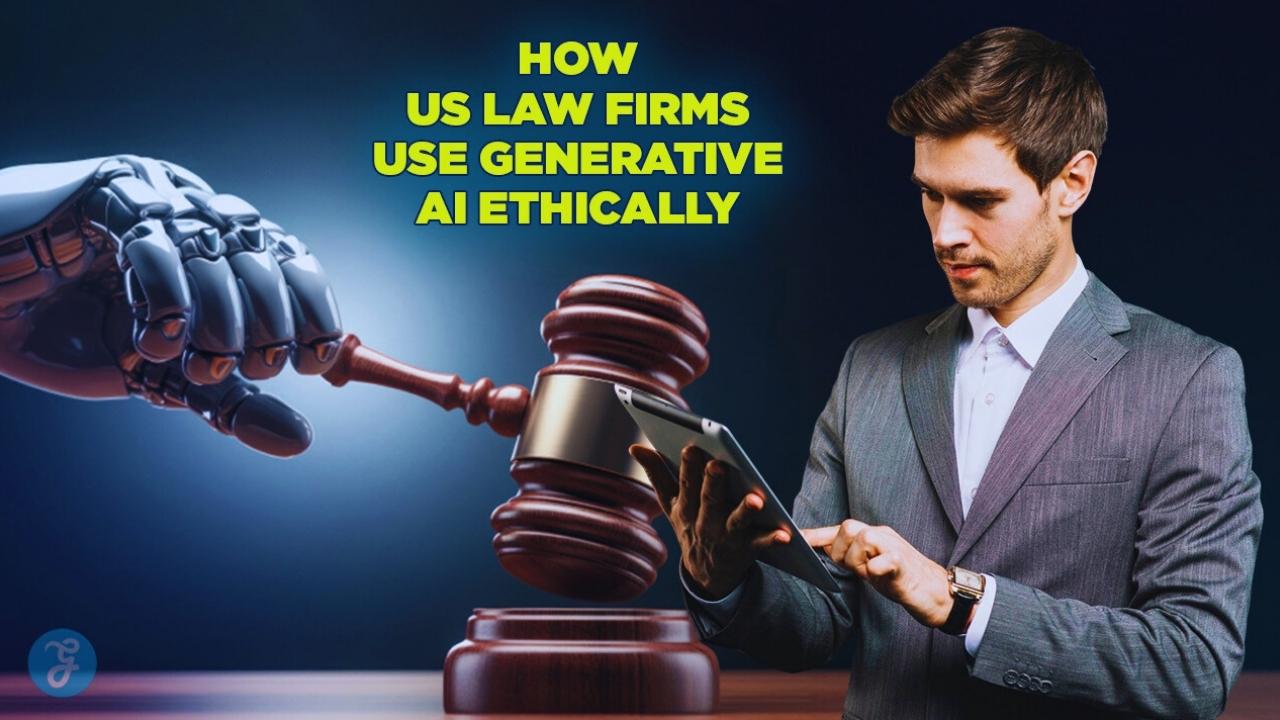
The legal profession is going through a massive transformation right now. For hundreds of years, practicing law meant endless hours of manual document review, digging through dusty library books, and pure human endurance. Today, artificial intelligence has completely rewritten the playbook on how attorneys handle their day-to-day operations.
Recent data from legal tech surveys shows that a massive majority of legal professionals now rely on some form of automation to get their work done faster. This incredible speed brings huge opportunities for law practices to scale, but it also creates a minefield of complex ethical hurdles. Lawyers operate under incredibly strict professional codes, and pasting a client’s sensitive data into a public internet chatbot is a guaranteed way to lose a law license. To survive and thrive, the legal community is actively building robust frameworks to make sure generative AI in law firms helps clients without putting their private information at risk. This comprehensive guide breaks down exactly how modern attorneys are navigating these new rules while staying profitable and compliant.
The Regulatory Framework Guiding AI in Law
State and national bar associations are working overtime to keep up with how fast software is moving. They are actively creating new frameworks to govern exactly how generative AI in law firms can operate safely and legally within everyday practice. The main goal is protecting the public while allowing lawyers to actually use these new tools to lower costs and speed up case timelines.
By taking existing professional standards and applying them to modern software, regulators make sure the core duties of an attorney never slip. Ethics committees across the country universally agree that ignoring modern technology is simply no longer an option for anyone claiming to offer competent legal representation.
1. The American Bar Association Formal Opinion 512 Sets the Standard
In July 2024, the American Bar Association released Formal Opinion 512 to serve as the ultimate guide for artificial intelligence in legal practice. This massive document does not actually rewrite the traditional rules of professional conduct that lawyers have followed for decades. Instead, it carefully maps those existing, long-standing rules directly onto new software capabilities. The opinion clearly states that lawyers must deeply understand the specific tools they use, rather than just blindly trusting a vendor’s marketing materials.
It places a massive emphasis on protecting client data and maintaining absolute honesty with the court system at all times. This ruling currently acts as the exact blueprint that law firms across the country are using to build their internal corporate technology policies. Legal professionals now look directly to Opinion 512 to navigate confusing issues surrounding basic competence, client communication, and how to structure their fee agreements.
| Feature of Opinion 512 | Practical Requirement for Lawyers | Goal of the Mandate |
| Vendor Vetting | Lawyers must read the software’s terms of service | Prevent accidental data sharing |
| Client Honesty | Lawyers must discuss AI use if it impacts the case | Maintain transparent communication |
| Billing Integrity | Prohibition on charging standard hourly rates for AI speed | Protect clients from unfair fees |
2. State Bar Associations Are Customizing Their Own AI Guidelines

While the national association provides a broad framework for everyone to follow, individual states actually govern their own attorneys and hand out the licenses. States like California, New York, and Florida issued specific, practical guidance regarding artificial intelligence long before the national board made a move. New York focuses heavily on putting up safe guardrails rather than handing down hard restrictions, encouraging tech innovation while demanding extreme caution regarding attorney-client privilege.
Because the rules vary so wildly by jurisdiction, nationwide law firms face a logistical nightmare trying to implement technology policies that comply with the strictest state standards where they operate. A law firm based in Texas might face completely different client disclosure requirements than a firm operating out of Illinois or Massachusetts. Lawyers practicing across state lines must constantly audit their software usage to ensure they do not accidentally violate a local ethics rule.
| State Jurisdiction Example | Core Focus of AI Guidelines | Approach to Innovation |
| New York | Deep emphasis on client confidentiality | Highly encourages safe technological adoption |
| California | Practical guidance for everyday use cases | Focuses on preventing unauthorized practice of law |
| Florida | Strict vendor confidentiality agreements | Demands heavy vetting of third-party software |
3. The Duty of Competence Now Includes Technology Literacy
Under Model Rule 1.1, every single lawyer owes their client competent representation from the moment they take the case. Historically, this just meant understanding case law, knowing courtroom procedure, and building a solid legal strategy. Today, competence explicitly and officially includes a high level of technological literacy. Attorneys certainly do not need to be full-stack software engineers, but they absolutely must understand how their chosen artificial intelligence tools operate on the backend.
They need to know exactly what limitations the software has, where it pulls its data from, and in what specific scenarios it might fail or hallucinate. Pleading ignorance about how a platform processes data is no longer accepted as a valid defense against ethical violations by any state bar. If a lawyer decides to use a tool to draft a contract, they assume full responsibility for understanding its internal mechanics and potential flaws.
| Area of Legal Competence | Traditional Definition | Modern AI-Era Definition |
| Legal Research | Knowing how to use law library books | Knowing how to craft specific software prompts |
| Case Preparation | Reading past judgments manually | Understanding how algorithms summarize documents |
| Tool Selection | Buying reliable office supplies | Auditing enterprise software security features |
Protecting Client Data and Confidentiality
Client confidentiality is the absolute bedrock of the entire attorney-client privilege system. The specific way artificial intelligence platforms consume, store, and train on user data poses the single biggest threat to this core legal principle. Law firms handle highly sensitive financial records, deeply personal family issues, and top-secret corporate trade secrets every single day. If this private data accidentally leaks into a public language model, the financial and reputational damage to both the client and the firm is completely catastrophic.
4. Boilerplate Consent Clauses Are No Longer Enough
Lawyers can no longer get away with hiding a generic technology consent clause deep inside a fifty-page initial engagement letter. If a law firm intends to use modern tools that might expose client information to third-party cloud servers, they must obtain genuine, informed consent from the client upfront. This means the attorney must actively and clearly explain to the client exactly which systems are being used to process their case files.
The lawyer has to outline what the specific digital risks are and detail exactly how the firm plans to handle and protect the data. Total transparency is quickly becoming a mandatory, heavily audited part of the standard client onboarding process. According to recent industry surveys, nearly eighty percent of corporate clients now explicitly want their outside counsel to disclose when and how they use automation.
| Type of Consent | Old Standard | New AI Standard |
| Location of Clause | Buried in the back of the contract | Placed upfront and discussed verbally |
| Specificity | “We use digital tools” | “We use closed-loop AI software Vendor X” |
| Client Options | Take it or leave it | Client can opt out of having their files processed |
5. Closed-Loop AI Systems Are Replacing Public Chatbots
Because public internet platforms often use user inputs to train their next generation of software models, law firms strictly prohibit their staff from using them for confidential matters. Instead, smart firms are investing heavily in closed-loop, walled-garden software systems designed specifically for enterprise use. These highly secure applications are built so that the sensitive data entered by a lawyer never actually leaves the firm’s private server environment.
The software provider legally guarantees that they will never use this sensitive information to train their public models or share it with other users. This secure approach allows lawyers to leverage the incredible drafting power of large language models while completely neutralizing the risk of accidental data leaks. Buying these specialized enterprise licenses is expensive, but it is the only way to ethically use the technology on active cases.
| Software Type | Data Training Policy | Ethical Risk Level for Law Firms |
| Public Chatbots | Uses inputs to train future models | Extremely High (Do Not Use for Client Data) |
| Basic Subscriptions | Might offer an opt-out toggle | Medium (Requires strict settings management) |
| Closed-Loop Enterprise | Zero data retention or training | Low (Safe for confidential matters) |
6. Anonymizing Data is a Strict Requirement
Even when using the most secure, expensive enterprise platforms available, best practices dictate that legal professionals must strip sensitive identifying information from documents before feeding them into an algorithm. Removing names, social security numbers, sensitive financial details, and specific home addresses drastically reduces the risk of a catastrophic data breach. This tedious process of redaction and anonymization adds a necessary, extra layer of security to the daily workflow.
It ensures that even if a vendor’s secure system is somehow compromised by hackers, the client’s actual identity remains completely protected. Many tech-forward firms now use secondary scrubbing software that automatically removes personally identifiable information before the text ever reaches the main prompt box. Lawyers are training their paralegals to treat AI prompts exactly like public court filings when it comes to redacting private details.
| Data Type | Action Required Before AI Prompting | Reason for Action |
| Client Names | Replace with generic terms (e.g., “Plaintiff”) | Prevents identity leakage |
| Social Security Numbers | Fully redact and delete | Major risk of financial fraud |
| Specific Addresses | Change to broad geographic regions | Protects physical privacy |
Ensuring Accuracy and Candor Toward the Tribunal
The entire judicial system relies entirely on the absolute honesty of the attorneys practicing before it. When machines start generating complex legal arguments, ensuring the truth becomes a highly scrutinized and often difficult process. Courts have absolutely zero tolerance for fabricated case law, fake quotes, or misleading citations generated by a computer. Generative AI in law firms must act strictly as a background assistant, never as a total replacement for human review and critical thinking.
7. AI Hallucinations Require Mandatory Human Verification
Generative artificial intelligence is completely notorious for hallucinating, which means the software sometimes invents facts, cases, and citations that look perfectly authentic but do not actually exist in reality. Several unfortunate attorneys have already faced massive public humiliation, national news coverage, and heavy financial fines for submitting court briefs filled with fake cases generated by a public chatbot. To prevent this exact scenario, ethics rules strictly require lawyers to independently verify every single output the machine gives them.
A human being must physically pull the actual case files from a trusted database and read the text to ensure the machine did not invent the quote. Uncritical, lazy reliance on computer-generated content is now officially considered professional malpractice by disciplinary boards. Every single sentence an algorithm writes must be treated with extreme skepticism until a human verifies it.
| Step in Verification | Action Performed by Lawyer | Goal of the Process |
| Case Citation Check | Pulling the actual docket from Westlaw/Lexis | Ensure the case actually exists |
| Quote Verification | Reading the judge’s original written opinion | Confirm the AI did not alter the context |
| Logic Review | Testing the legal argument against facts | Stop the software from making wild assumptions |
8. Courts Are Mandating Disclosures for AI-Generated Filings
Judges across the country are taking matters into their own hands to actively protect the integrity of the judicial system from lazy lawyering. Across the federal and state levels, individual courts and specific judges are issuing strict standing orders that require lawyers to formally disclose whether they used generative software to draft their pleadings. Some strict judges require a sworn, signed certificate attached to the back of the brief stating that a human attorney has manually verified every single citation in the document.
This bold move ensures that the ultimate responsibility for accuracy remains entirely on the shoulders of the human attorney filing the paperwork. It completely prevents lawyers from trying to blame the machine or the software vendor for sloppy, inaccurate legal work. If a fake case makes it to the judge’s desk, the lawyer takes the fall, not the computer.
| Type of Court Order | What the Lawyer Must Do | Penalty for Ignoring the Order |
| Blanket Ban | Do not use AI for any court documents | Immediate rejection of the filing |
| Mandatory Disclosure | Inform the judge on the first page of the brief | Judicial reprimand or fine |
| Verification Certificate | Sign a sworn oath that a human checked the facts | Disbarment for perjury |
9. AI Cannot Replace Independent Legal Judgment
Software is absolutely incredible at quickly summarizing thousands of pages of messy depositions or finding hidden patterns in massive mountains of corporate discovery documents. However, a computer completely lacks the basic human judgment required to actually practice law effectively. The ethical rules clearly state that lawyers cannot ever delegate their core advisory role to a machine, no matter how advanced it gets.
An algorithm can suggest a statistical legal strategy based on historical case data, but the human attorney must make the final call based on the nuanced, specific context of the client’s real life or business goals. Empathy, aggressive negotiation tactics, and complex moral judgment remain exclusively human domains that no code can replicate. A machine cannot cross-examine a hostile witness, read the emotional temperature of a jury, or hold a crying client’s hand during a tough deposition.
| Legal Task | AI Capability Level | Human Lawyer Necessity |
| Document Sorting | Excellent | Low (Best handled by software) |
| Strategy Formulation | Moderate (Can offer data trends) | High (Requires human context) |
| Client Empathy | Zero | Absolute (Core to the profession) |
The Financial Shift: Billing and Operations
The traditional, highly profitable business model of a law firm is built entirely on charging clients by the hour for human labor. When a drafting task that used to take ten grueling hours suddenly takes ten seconds, the financial structure of the firm faces an absolute existential crisis. Generative AI in law firms is forcing older partners to completely rethink how they generate revenue and pay their staff.
10. The Traditional Billable Hour is Facing Massive Disruption

If an algorithm drafts a highly complex, forty-page commercial lease in exactly thirty minutes, an attorney simply cannot ethically bill the client for the five hours it would have historically taken a junior associate to write it from scratch. The American Bar Association explicitly and firmly states that lawyers who bill an hourly rate must only bill for their actual, physical time spent working on the matter. As a direct result, firms are being forced to completely rethink how they generate revenue in a high-tech world.
The sheer, blinding efficiency of modern technology directly threatens the standard hourly billing model that has comfortably sustained the legal industry for decades. Partners are realizing that if they continue to bill by the hour while using fast software, their total revenue will actually plummet overnight. This is forcing a massive shift in how legal services are priced, packaged, and sold to the public.
| Task Example | Old Billable Time | New AI-Assisted Time | Billing Impact |
| Drafting a Will | 4 Hours | 45 Minutes | Massive loss of hourly revenue |
| Reviewing 100 Contracts | 20 Hours | 2 Hours | Client saves thousands of dollars |
| Initial Case Research | 8 Hours | 1 Hour | Forces firms to find new revenue streams |
11. Charging for AI Overhead is Strictly Regulated
Law firms cannot simply pass the general costs of learning new technology or buying software licenses directly onto their clients’ monthly invoices. Unless a client specifically requests the use of a highly specialized, incredibly expensive proprietary tool exclusively for their unique case, the cost of software subscriptions is generally considered standard, non-billable office overhead. Firms must carefully structure their accounting and invoicing practices to ensure they stay compliant with billing ethics.
They need to ensure they are only billing for the actual human time spent prompting the machine, refining the arguments, and reviewing the final outputs. They absolutely cannot just add an arbitrary five-hundred-dollar surcharge to a client’s bill to cover their shiny new software licenses. Ethics boards consider this to be charging an unreasonable fee, which is a fast track to a disciplinary hearing.
| Expense Type | Billing Category | Can It Be Charged to the Client? |
| Basic AI Software License | General Office Overhead | No (Absorbed by the firm) |
| Time Spent Learning to Prompt | Professional Development | No (Lawyers cannot bill to learn) |
| Highly Specialized Custom AI Tool | Direct Case Expense | Yes (If client agreed beforehand) |
12. Alternative Fee Arrangements Are Becoming the Norm
To survive the rapid death of the billable hour for routine contract and drafting tasks, law firms are aggressively shifting toward value-based pricing and flat-fee models. Instead of charging for the sheer amount of time it takes to slowly produce a document, forward-thinking firms now charge for the actual value of the final product and the years of legal expertise backing it up. This massive shift beautifully aligns the financial interests of the client and the law firm for the first time in history.
The client gets total cost predictability upfront without worrying about the clock running, and the firm is heavily rewarded for investing in efficient technology. This modern model highly encourages law firms to adopt better, faster software because doing the work faster directly leads to much higher profit margins under a flat-fee agreement.
| Fee Arrangement | How It Works | Why It Fits AI Better |
| Flat Fee | One set price for the whole project | Rewards the firm for finishing the job quickly |
| Value-Based | Price based on the money saved/won | Focuses on the outcome, not the hours typed |
| Subscription | Monthly fee for ongoing access | Provides steady cash flow for tech-heavy firms |
Firm Management and Future Outlook
Successfully integrating new technology requires a massive, sometimes painful cultural shift within established legal organizations. It affects the daily routines of everyone from the oldest senior partners down to the newest paralegals and legal secretaries. Generative AI in law firms is not just a simple IT issue to be outsourced; it is a fundamental, top-down management challenge.
13. Supervisory Rules Apply to AI Just Like Human Staff
Under existing, strict ethics rules, managing partners and supervising attorneys are held entirely responsible for the professional conduct of their junior staff. The American Bar Association recently clarified that this intense supervisory duty absolutely extends to the use of technology and outside cloud vendors. Firm leadership must quickly establish crystal-clear internal computer policies and conduct regular, unannounced tech audits.
They must ensure that everyone in the office, including non-lawyer administrative staff and file clerks, fully understands how to use these powerful tools safely. If a tired paralegal uses a public chatbot to quickly summarize a highly confidential client medical file, the supervising attorney is the one on the hook for the massive ethical breach. Partners can no longer claim they did not know what software their assistants were using.
| Firm Hierarchy | Responsibility Regarding AI | Ethical Liability |
| Managing Partner | Creating firm-wide safety policies | High (Responsible for the whole firm’s conduct) |
| Senior Associate | Checking the work of junior staff | Medium (Must catch hallucinations before filing) |
| Paralegal | Redacting data before using software | Direct (Must follow firm policy exactly) |
14. Firms Must Actively Monitor for Algorithmic Bias
Algorithms are exclusively trained on massive sets of historical human data pulled from the internet and court records. Unfortunately, historical data contains decades of ugly human bias, racism, and systemic inequality. Whether a firm uses software to screen potential new legal hires, analyze the statistical likelihood of a legal victory, or review housing contracts, they must actively monitor the computer’s outputs for hidden prejudice.
Blindly trusting an algorithm could easily lead to discriminatory practices in hiring or client selection. This directly violates the core, fundamental ethical mandates against harassment and discrimination in the legal profession. Lawyers must remain incredibly vigilant and test their systems constantly to ensure their shiny new digital tools do not accidentally perpetuate systemic inequalities.
| Area of Potential Bias | How AI Might Fail | Firm Protection Strategy |
| Hiring Software | Rejecting resumes from certain zip codes | Human HR review of rejected applications |
| Predictive Justice | Assuming higher guilt for certain demographics | Never using AI to make final sentencing arguments |
| Contract Terms | Generating unfair clauses based on old data | Manual attorney review of final agreements |
15. Law Schools and Firms Are Mandating AI Ethics Training
To prepare for a totally unrecognizable future, the traditional legal education system is currently evolving faster than it has in a century. Traditional law schools and mandatory continuing legal education programs are rushing to introduce mandatory courses specifically focused on the dangerous intersection of modern technology and legal ethics. Massive law firms are actively hiring dedicated chief technology officers to run internal workshops and constantly train their older partners.
The ultimate goal is to create a brand new generation of legal professionals who view software not as a magic, foolproof solution, but as a powerful, dangerous tool. This tool requires strict human oversight, continuous daily learning, and an unwavering ethical commitment to the client. The highest-paid lawyers of tomorrow will need to be just as skilled at engineering software prompts as they are at aggressively cross-examining witnesses in a courtroom.
| Training Initiative | Target Audience | Core Curriculum Focus |
| Law School Classes | Incoming students | The basics of prompt engineering and logic |
| CLE Seminars | Practicing veteran attorneys | Updates on new state bar rulings and billing ethics |
| Internal Workshops | Firm staff and paralegals | Safe data handling and anonymization techniques |
Final Thoughts
The rapid integration of generative AI in law firms represents the single most significant operational shift in the legal profession since the invention of the internet and digital research databases. We are finally moving away from a system based on brute-force manual labor and shifting toward a modern reality where human legal judgment is heavily augmented by incredible computational power. However, no matter how advanced the software becomes, the core, fundamental duties of a practicing lawyer remain exactly the same. Client confidentiality, technological competence, and absolute honesty toward the tribunal are just as critical today as they were a hundred years ago.
Firms that stubbornly ignore these new tools risk becoming totally obsolete and outpriced by their competitors, while those that adopt them recklessly without guardrails face severe ethical sanctions and the loss of their licenses. The careful, measured middle path is the only sustainable way forward for the modern attorney. By strictly adhering to common-sense guidelines like ABA Formal Opinion 512, investing heavy capital in secure closed-loop networks, and transitioning to transparent value-based billing, attorneys can protect their clients while maximizing their own daily efficiency. Generative AI in law firms is not here to replace the human lawyer. It is simply here to replace the tedious, soul-crushing administrative tasks that keep lawyers from actually practicing law and helping people.