

In the race to publish high-volume content, many digital publishers fall into a hidden trap: Self-Sabotage. As your content library grows, the risk of “Keyword Cannibalization” skyrockets. This occurs when your own articles fight each other for the same spot on Google, leading to fluctuating ranks and diluted authority. The Cannibalization Compass is your tactical solution—a Micro SaaS tool designed to detect and resolve these conflicts before they tank your traffic.
Understanding the “Search Intent” Crisis
Google doesn’t just rank words; it ranks Intents. If you have three articles that all answer the question “How to start a Micro SaaS,” Google doesn’t know which one to reward. Instead of one page ranking at #1, you might find three pages languishing on Page 2.
The Cannibalization Compass uses a sophisticated similarity heuristic to determine if two pieces of content are targeting the same mental model of a user.
Operating the Cannibalization Compass
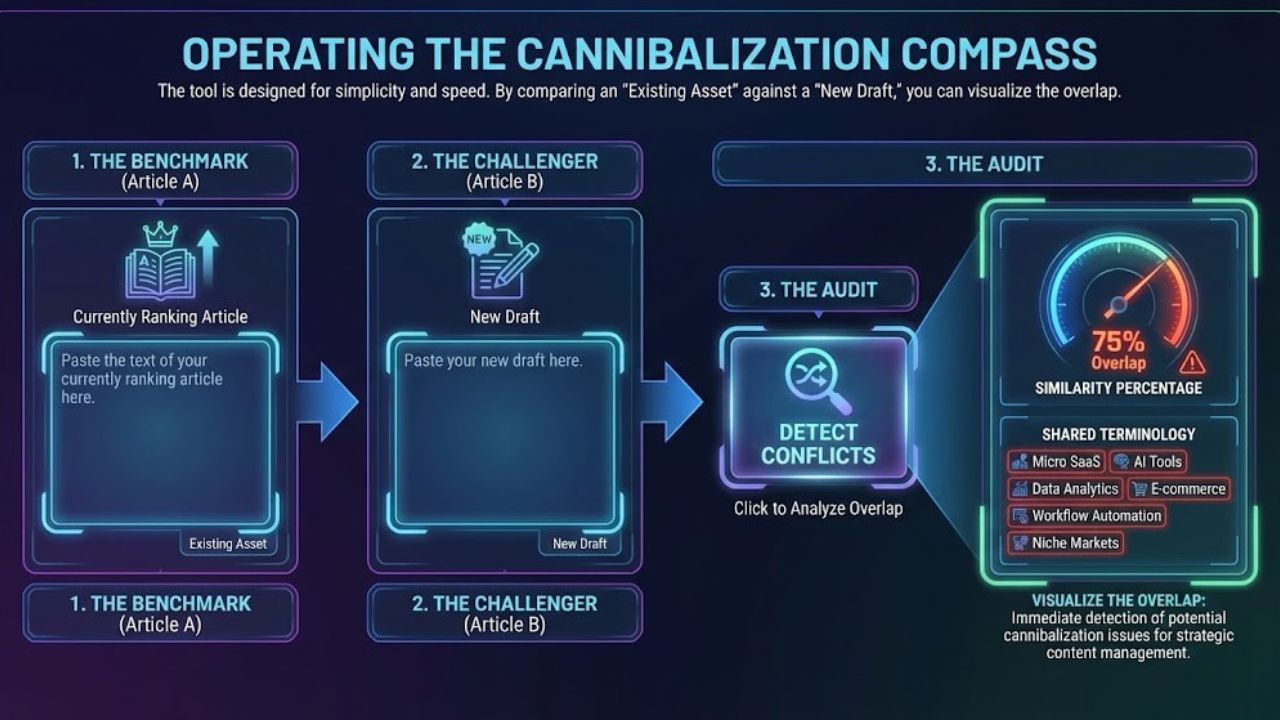
The tool is designed for simplicity and speed. By comparing an “Existing Asset” against a “New Draft,” you can visualize the overlap.
Step-by-Step Execution:
- The Benchmark (Article A): Paste the text of your currently ranking article.
- The Challenger (Article B): Paste your new draft.
- The Audit: Click “Detect Conflicts.”
The tool will immediately return a Similarity Percentage and a list of Shared Terminology.
Interpreting the Data: Three Common Scenarios
Scenario A: The “Accidental Clone” (Similarity > 75%)
This happens when you’ve essentially rewritten an old post.
- The Risk: Google will swap these pages back and forth, preventing either from gaining “age authority.”
- The Resolution: Consolidate. Merge the best parts of the new draft into the old post. Use a 301 Redirect to point the new URL (if already published) to the old one.
Scenario B: The “Intent Split” (Similarity 40% – 60%)
Your articles are about different things, but they use the same core headers and keywords.
- The Risk: Google might rank the “wrong” page for your target keyword.
- The Resolution: Differentiate. Use the Semantic Gap Finder to find unique entities for the new draft. For example, if both mention “SaaS Pricing,” move the new draft to focus specifically on “Freemium Models” while the old one remains a general guide.
Scenario C: The “Keyword Bloat” (Low Similarity / High Shared Terms)
The articles are distinct, but they both obsessively mention a secondary keyword.
- The Risk: You are diluting your authority for that secondary term.
- The Resolution: Pillar Linking. Pick one article to be the “Master” for that term. On the other page, reduce the keyword frequency and add an internal link pointing to the Master page.
The “Dominance Suite” Workflow
To truly dominate the SERPs in 2026, you shouldn’t use the Compass in isolation. It is part of a three-step Editorialge Power Workflow:
- Compass Check: Ensure the new draft isn’t fighting old content.
- Gap Analysis: Use the Semantic Gap Finder to inject missing entities that your competitors have, ensuring you outrank them.
- Humanize: Run the final version through the Humanizer to ensure a 90% readability score and a human-grade feel that satisfies Google’s “Helpful Content” algorithms.
Strategic Resolution Cheat Sheet
Compass Metric | Diagnosis | Recommended Action |
High Overlap / Short Text | Thin Content | Merge & Redirect |
High Overlap / Long Text | Redundant Pillar | De-optimize & Canonicalize |
Medium Overlap / Different H1s | Intent Confusion | Niche-Down the Headers |
Low Overlap / Shared Terms | Authority Dilution | Internal Linking (Anchor Text) |
Final Words
In SEO, your greatest competitor isn’t always the other guy—sometimes, it’s you. The Cannibalization Compass provides the clarity needed to ensure every page on your site has a unique purpose and a clear path to the #1 spot.
By identifying conflicts early, you save crawl budget, preserve link equity, and build a site architecture that Google respects.