Have you ever clicked a link on someone’s website, only to land on a blank error page? It’s a frustrating little dead end, and it happens more than you’d think. If you run a website or work in SEO, broken links are a real problem. They hurt your user experience, and Google notices them too.
Here’s the part that surprises most people: those dead links are actually a goldmine for broken link building. By finding these errors and offering helpful replacement content to site owners, you can earn high-quality backlinks while helping someone else fix a real problem on their site.
This guide walks you through how broken link building works, step by step, from spotting the errors to crafting content that wins the link. I’ll keep it simple and practical so you can start using this SEO strategy right away.
Still wondering if it actually works in 2026? Keep reading. The answer might surprise you.
What is Broken Link Building?
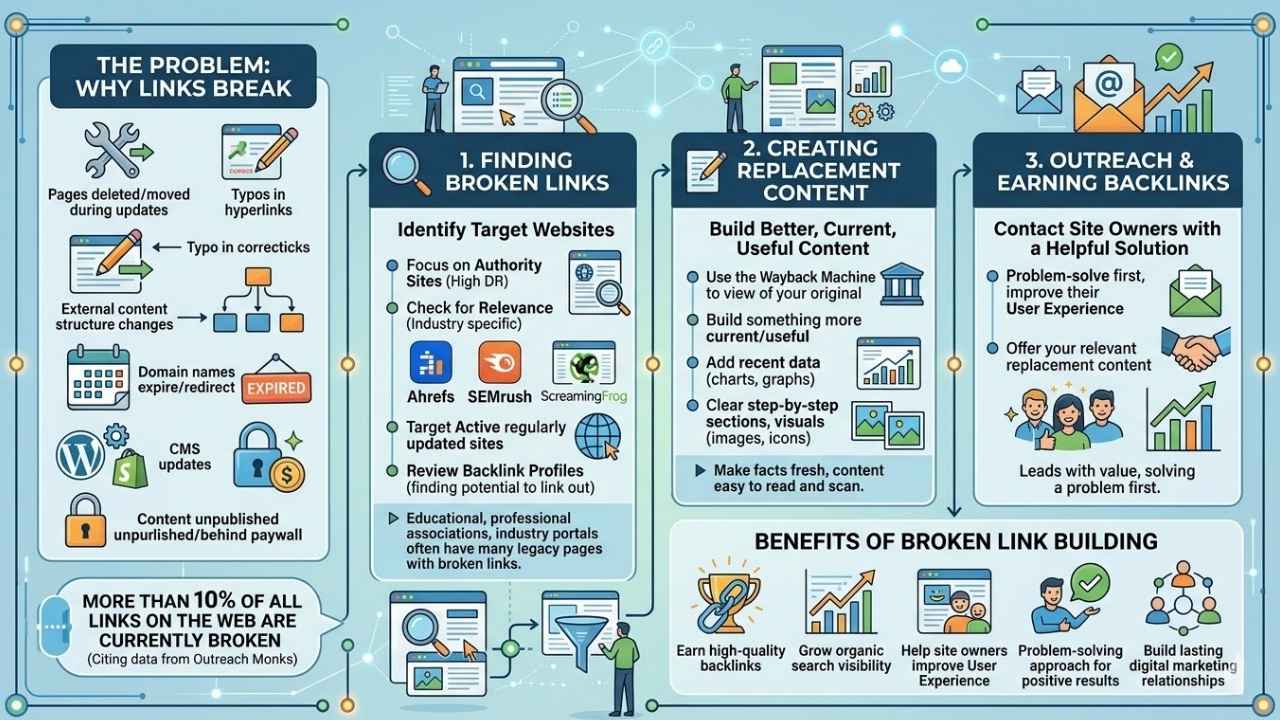
Broken link building is a whitehat technique used in off-page SEO. You find dead or outdated links on other sites, then offer your own updated content as a replacement. The goal is to help site owners improve their user experience while earning high-quality backlinks for yourself.
Contentellect has been using this method for several years, calling it both practical and profitable for growing organic search visibility.
Think of every broken link as a small gap on the web. Websites change constantly, so these gaps pop up all the time. When you step in with a better, working resource, you match exactly what Google wants: pages that are helpful, relevant, and error-free.
According to data cited by Outreach Monks, more than 10% of all links on the web are currently broken. That’s a massive, ongoing supply of link building opportunities sitting right in your niche.
This strategy stands apart from basic link outreach because it leads with value. You are solving a real problem first, then earning the link as a natural result. That kind of goodwill also builds lasting digital marketing relationships, which pay off long after the first link goes live.
Why Do Links Break?
Links vanish for many reasons. A web page might get deleted, a URL changes without a redirect, or a domain expires entirely. These broken links create headaches in your SEO strategy and send users into digital dead ends.
Causes of Broken Links
Broken links can drive visitors away and hurt your SEO performance. These issues pop up for many reasons, and every website deals with them sooner or later.
- Website pages get deleted or moved during site updates, causing URLs to disappear.
- Typos sneak into hyperlinks, sending users straight to a 404 error instead of the right spot.
- External websites change their content structure, breaking any backlinks that once pointed to them.
- Domain names expire, sell, or redirect elsewhere, leaving old links pointing at empty spaces.
- Updates to platforms like WordPress or Shopify can shuffle URLs without warning site owners.
- Content gets unpublished or moved behind a paywall, causing previously open resources to vanish.
Common Issues with Broken Links in SEO
Dead links frustrate users fast. Google picks up on these errors and can push your site lower in search results as a result.
A single broken link can cost you quality backlinks and organic traffic. The good news? Marketers see this as an ongoing opportunity. Contentellect has noted that lost links create regular openings for others to step in with better content, improving their own SEO strategy in the process.
It’s also worth knowing that 63% of broken link building opportunities are found on resource pages that haven’t been updated in over a year, according to data from Digital World Institute. That means older resource pages in your niche are one of the best places to start your search.
How Broken Link Building Works
The process is more straightforward than most people expect. You find broken links on relevant sites, create content that fills the gap, and then reach out to the site owner with a helpful solution. Here’s how each step plays out.
Identifying Target Websites
Finding the right websites is the first step. Not all sites offer equal value for SEO, so it pays to be selective.
- Focus on authority sites: Look for domains that rank well in search engines. A backlink from a high-authority site moves the needle far more than one from a low-traffic blog.
- Check for relevance: The site should cover topics, products, or services close to yours. Relevance matters to Google and to the readers who will eventually click your link.
- Use Ahrefs or SEMrush: These tools help you spot domains with lots of outgoing links and healthy organic traffic, which signals that the site owner actively maintains their content.
- Target active, regularly updated sites: Your outreach has a much better chance of getting a response when the site owner is already engaged with their content.
- Review the backlink profile first: Check if the site links out to third-party sources regularly. Publishers who already link out often are far more open to swapping a broken link for a fresh one.
One pro tip worth knowing: educational websites, professional associations, and information-rich industry portals tend to have many legacy pages with broken external links. They are some of the best targets for this strategy.
Finding Broken Links
Spotting broken links is the core skill in this whole process. The good news is that the right tools make it much faster than you’d expect.
Your two best tools for this job are Ahrefs and Screaming Frog. In Ahrefs, you can use the Site Explorer to enter a competitor’s domain, filter by “404 not found,” and instantly see which dead pages still have backlinks pointing to them. Those are your prime targets. In Screaming Frog, switch the mode to “List,” paste your target URLs, and let it crawl the external links. Filter the results by status code and you’ll have a clean list of 404 errors to work from. The free version of Screaming Frog crawls up to 500 URLs, which is plenty to get started.
A smart filter to apply: focus on broken pages with a Domain Rating above 40 and organic traffic above 1,000. Those quality thresholds, highlighted by Editorial.link’s 2026 guide to broken link building, help you skip low-value targets and zero in on links that will actually improve your site’s authority.
You can also use a free browser extension called Check My Links to quickly scan individual pages as you browse. It highlights broken links in red, making it easy to spot opportunities without opening a separate tool.
A helpful search trick: type your keyword plus “resources” into Google and browse the results. Resource pages pack in lots of external links, which means a higher chance of finding broken ones in your niche.
Creating Replacement Content
Your replacement content needs to be genuinely better than what the dead page used to offer. That’s what makes the site owner say yes.
Use the Wayback Machine at web.archive.org to look up what the original page contained. Then build something more current and more useful. Add recent data, clear step-by-step sections, and visuals where you can. This shows site owners you care about their readers’ experience, which is exactly what Google’s ranking algorithm also rewards.
Contentellect has seen real success with this approach over the years. The key insight from their experience: update facts from recent sources and make your content easy to read and scan. A page that feels fresh and well-organized is much easier for a webmaster to justify adding as a replacement link.
Benefits of Broken Link Building
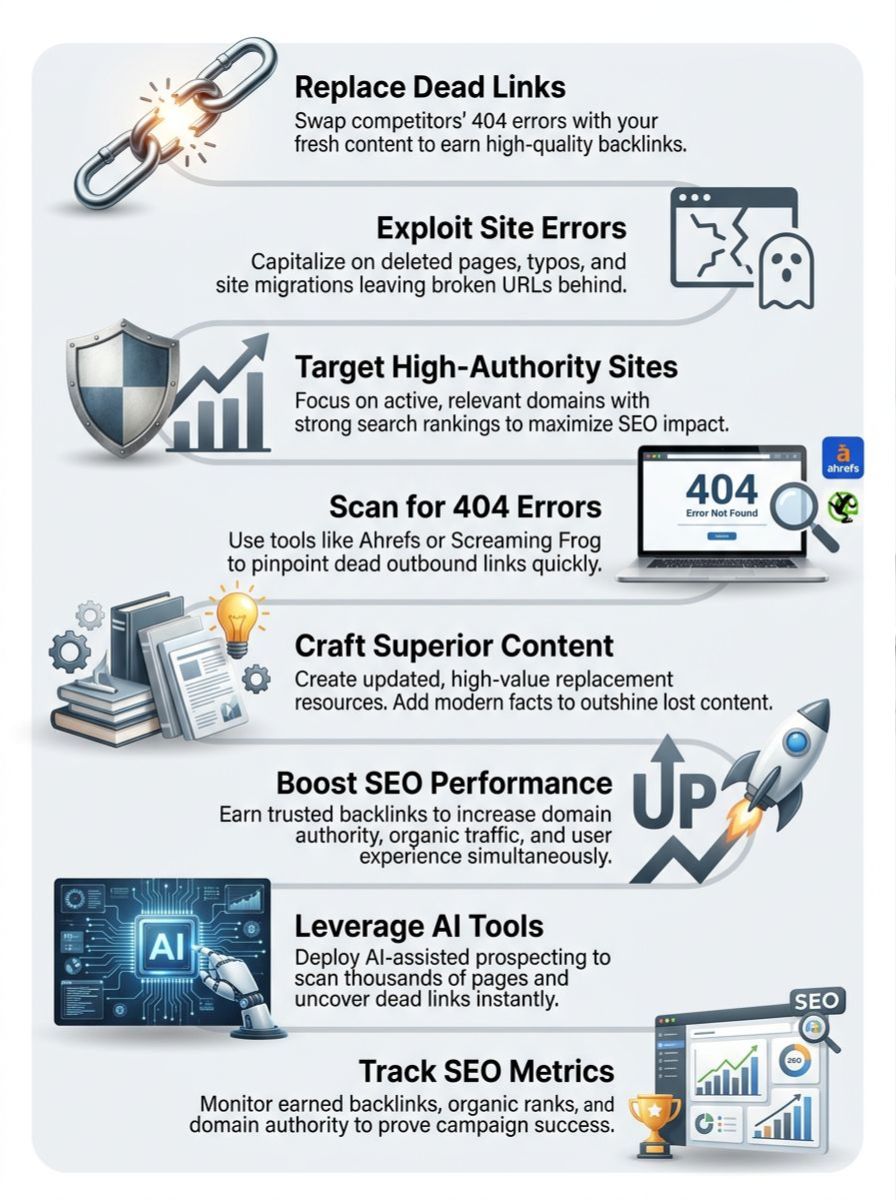
Broken link building opens up several real advantages, both for your SEO and for the relationships you build along the way.
Improved User Experience
Users hit a dead end fast when they click a 404 error. That frustration makes them leave, and a high bounce rate is a signal Google takes seriously. Swapping broken links with working ones is like fixing a pothole on a busy road: smoother for everyone traveling through.
Google’s ranking algorithm places strong weight on user experience and relevance. Broken link building helps websites deliver reliable content, so visitors don’t bounce away empty-handed. Both users and search engines benefit when a dead page gets replaced with something genuinely helpful.
Boost in SEO Performance
A single high-quality backlink from an authority website can lift your rankings significantly. Google values websites that offer working, helpful links, and backlinks remain one of the top two factors in Google’s ranking algorithm, according to research cited by THM SEO Agency.
Contentellect has proven this over several years by securing valuable backlinks for clients using this method. Broken pages pop up constantly due to page removals and URL changes, which means fresh opportunities appear all the time.
According to data from BetterLinks, studies show that 91% of content fails to rank without quality backlinks. That single stat makes the case for broken link building as a direct SEO investment, not just a nice-to-have tactic.
High-Authority Backlinks
High-authority backlinks can lift your site’s status fast. Google values links from trusted, popular sites like major news outlets, respected industry blogs, and established platforms. Earning these through broken link building sends strong trust signals to search engines about your site’s reliability.
Content marketers love this SEO strategy because it does more than boost rankings. It gets your content in front of larger, more relevant audiences. Broken link building can even land you links from high-DA sites like .edu or .org domains, according to BuzzStream’s link building analysis, which are among the hardest types of backlinks to earn through traditional outreach.
Challenges of Broken Link Building
Reaching out for broken link building can feel like fishing in a crowded pond. Every SEO professional wants the big catch, and the process takes real time and patience. Knowing the challenges upfront helps you plan for them.
Competition in Outreach
More marketers catch on to broken link building every year. Hundreds of site owners send out outreach emails hoping to replace dead links with their fresh content. Contentellect has used this tactic for years and seen strong results, but the landscape has grown more competitive.
Webmasters get flooded with similar pitches, so yours needs to stand out. Research from a Backlinko survey found that personalized emails have a 32% better response rate than generic ones. That gap is significant. A short, specific email that mentions the exact broken URL and explains clearly why your content is a strong match will almost always outperform a copy-paste template.
Simple subject lines also help. Practitioners in the field consistently note that direct subject lines like “Broken link on your resources page” tend to perform best. Keep it clear, keep it short, and lead with the value you’re offering them, not what you want in return.
Time-Consuming Process
Broken link building eats up hours, sometimes days. You scan websites for dead links, craft personalized emails for each site owner, and then write replacement content that genuinely adds value. Every step takes effort.
Most digital marketing pros know there’s no quick fix here. Patience matters as much as strong outreach. Contentellect reports that this SEO strategy works well over the long run but demands real organization. Tracking your contacts, responses, and link placements in a tool like BuzzStream or a simple spreadsheet keeps the workflow from becoming overwhelming.
One thing that helps: data from THM SEO Agency shows it typically takes about 3.1 months for new links to show their impact on rankings. Setting that expectation early keeps you motivated through the slower parts of the process.
Advanced Broken Link Building Strategies
Once you have the basics down, there are a few sharper tactics worth adding to your toolkit. These approaches can help you find higher-value opportunities and move faster.
Using Expired Domains
Expired domains often hold valuable backlinks and search engine authority. SEO professionals use these domains for broken link building because they once featured content relevant to a niche and may still attract traffic or links from high-authority sites like Forbes or HubSpot.
The play here is straightforward. Find an expired site with old links about a topic in your space. Restore or redirect similar content to reclaim those lost backlinks, boosting your digital marketing efforts without starting from scratch. This whitehat technique strengthens your backlink profile without bending any of Google’s guidelines.
AI-Assisted Prospecting
AI-assisted prospecting tools speed up the search for broken links dramatically. Tools like Ahrefs and Screaming Frog can scan thousands of web pages in minutes, flagging 404 errors and even surfacing contact details for site owners. What used to take days of manual browsing now takes a fraction of the time.
Using these tools means you spend less time hunting and more time reaching out to real prospects. With content updating across the web daily, having a smart scanning system in place means you never run out of opportunities to pursue.
Guest Post Replacement Tactics
Many websites use guest posts to build links, but editors sometimes delete those posts or remove their links over time. You can spot removed guest post backlinks with a site audit using Ahrefs or SEMrush.
Instead of letting that lost link opportunity disappear, reach out to the site owner and suggest your content as a replacement. Show them how your updated resource keeps their readers happy and fixes the 404 error on their page. Site owners appreciate fast solutions because broken links hurt both user experience and search rankings.
Contentellect has used this tactic since 2020, finding it both profitable and efficient in digital marketing campaigns, especially within competitive outreach strategies and content marketing plans.
Measuring the Success of Broken Link Building
Tracking your results is what separates a scattered effort from a real strategy. The right metrics show you what’s working, what to adjust, and where your time is best spent.
Key Metrics to Track
Keep an eye on these numbers from the start. They give you a clear, honest picture of your progress.
- Number of Broken Links Identified: More opportunities mean more chances for backlinks. Volume here is the starting fuel for your whole campaign.
- Outreach Response Rate: Count how many site owners reply. A good benchmark to aim for: personalized outreach campaigns report response rates around 16%, according to a case study by Mangools. Low rates are a signal to tighten your emails.
- Link Placement Success Rate: Track what percentage of your pitches become live links. If 10 suggested links result in 3 placements, that’s a 30% win rate, which is a solid result.
- Number of Backlinks Earned: Each gained backlink builds your website authority. Pages that rank number one on Google have 3.8 times more backlinks than lower-ranking pages, according to data from Backlinko.
- Referral Traffic from New Links: Watch the traffic coming from new backlinks in Google Analytics. Spikes in visits prove your content marketing efforts are paying off.
- Growth in Organic Search Rankings: Check position changes for target keywords after placing new links. Higher rankings confirm that broken link building is contributing to stronger SEO performance.
- Domain Authority Improvement: Keep an eye on third-party scores like Moz Domain Authority or Ahrefs DR after several months of work to see your site’s broader ranking potential grow.
Tools for Monitoring Results
The right tools save you significant time and show clearly which moves are working. Here’s what most experienced practitioners rely on:
| Tool | Primary Use | Cost |
|---|---|---|
| Google Search Console | Track backlinks, organic traffic, and crawl errors | Free |
| Ahrefs | Monitor new and lost backlinks, spot competitor broken links | Paid |
| SEMrush | Reveal backlink profiles and pinpoint toxic links | Paid |
| Screaming Frog | Crawl websites to uncover broken links and run detailed audits | Free up to 500 URLs |
| Moz Link Explorer | Domain authority scores and real-time inbound backlink tracking | Free & Paid tiers |
| BuzzStream | Manage outreach campaigns and track link placement over time | Paid |
| Majestic | Gauge quality of new backlinks using Trust Flow metric | Paid |
According to Editorial.link’s State of Link Building report, Ahrefs is chosen as the top all-in-one SEO tool by 59.1% of practitioners, making it the most widely trusted starting point for most campaigns.
Does Broken Link Building Still Work in 2026?
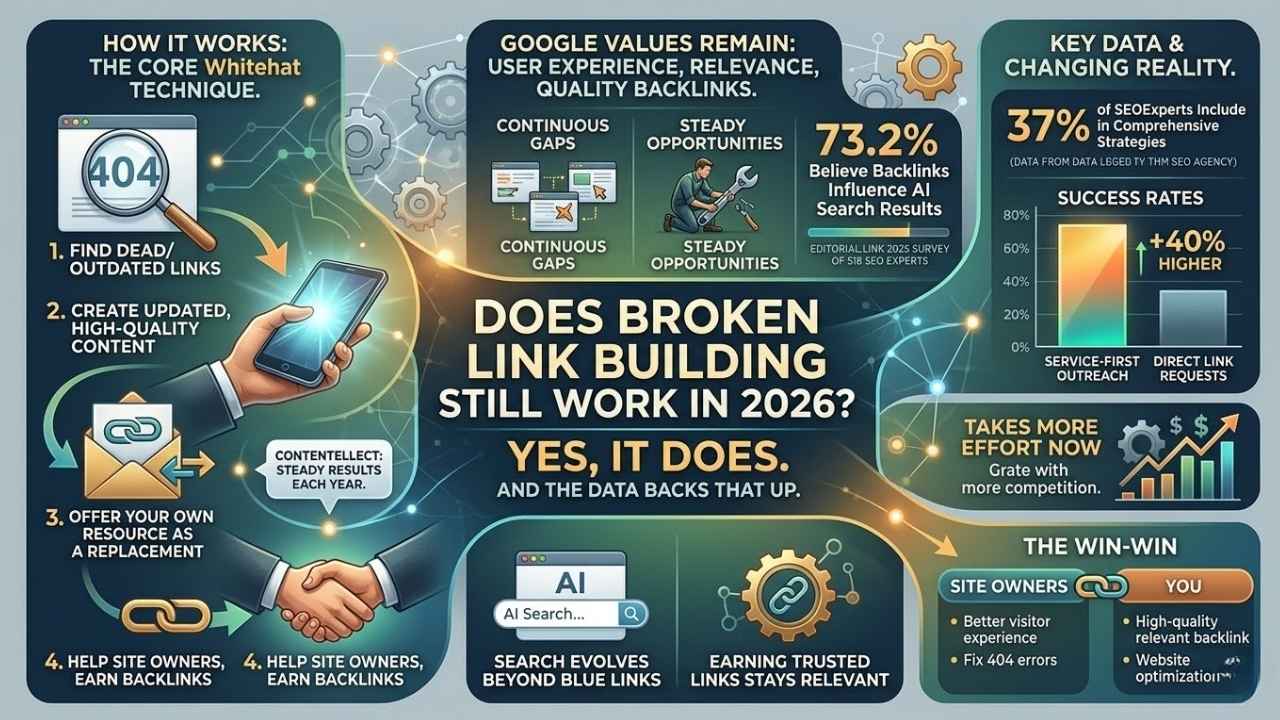
Yes, it does. And the data backs that up.
Google still values user experience, relevance, and quality backlinks. Websites keep updating their content and structure, which means broken links pop up constantly across the web. SEO specialists at Contentellect see steady results each year from this whitehat technique, earning high-authority backlinks while helping site owners fix real errors.
A 2025 survey of 518 SEO experts by Editorial.link found that 73.2% believe backlinks influence the chance of appearing in AI search results. That finding matters for 2026. As search evolves beyond the traditional blue-link results, earning trusted links stays relevant.
The honest reality is that the strategy takes more effort now than it did a few years ago. Competition has grown. But according to data from THM SEO Agency, 37% of SEO experts still include broken link building in their comprehensive link strategies, and campaigns using a service-first outreach approach report success rates over 40% higher than direct link requests.
Offering replacement content for dead links remains a genuine win-win. Website owners get a better visitor experience without ugly 404 errors dragging down their search scores. You get a high-quality, relevant backlink. The road takes work, but the opportunities for website optimization are real and steady for those willing to put in the effort.
Final Thoughts
Broken link building is still one of the sharpest tools in your SEO strategy toolkit. You find dead links, offer helpful content, and build both backlinks and website authority at the same time. The steps are clear and practical. Anyone can start with a little patience, good outreach skills, and the right tools.
The results speak for themselves: better online visibility, more organic traffic, and stronger digital marketing momentum. Give it a shot. You might be surprised how much one fixed error can do for your site’s success.