
The Australian migration landscape underwent a significant structural pivot throughout 2025, moving toward a more “demand-driven” model that has directly impacted Australian Partner Visa Processing Times in 2025. While the Department of Home Affairs has worked to clear pandemic-era backlogs, the introduction of more rigorous “genuine relationship” scrutiny and the integration of new digital filing systems have created a paradox: simpler cases are being approved in record time, while complex files are languishing.
As of today, April 2, 2026, looking back at the full 2025 data set reveals that “decision-ready” applications have become the only way to bypass the standard 12-to-24-month wait.
How We Selected Our 15 Best Australian Partner Visa Processing Times 2025 Facts
To build this definitive guide, we analyzed the 2024-25 Migration Program planning levels and the quarterly performance reports released by the Department of Home Affairs through December 2025. Our selection criteria prioritized the data points that differentiate “onshore” (Subclass 820) versus “offshore” (Subclass 309) efficiency, as well as the impact of the July 2025 Visa Application Charge (VAC) increases. We also focused on the 2025 “grant location flexibility” policy, which fundamentally changed where an applicant must be when their visa is finalized. These 15 points were chosen to provide a 20/20 view of the trends, hurdles, and technical requirements that defined the partner visa experience over the last calendar year.
15 Essential Realities of Australian Partner Visa Processing Times 2025
The following insights break down the technical, fiscal, and behavioral nuances that governed the partner visa queue during the 2025 period.
1. The “Demand-Driven” Model Shift
Unlike skilled visas which have strict “caps,” the Australian government maintained the Partner Visa as a demand-driven category in 2025. This means there is no hard limit on the number of visas granted. In 2025, this resulted in approximately 52,500 places, ensuring that while individual processing might be slow, the “queue” isn’t artificially blocked by quotas.
Best for: couples worried that a “full” migration program might prevent their approval.
Why We Chose It:
-
It is the most important structural protection for family reunification in the Australian system.
-
It ensures that an approval is based on relationship merit, not a numerical lottery.
Things to consider:
-
“Demand-driven” does not mean “fast”; it just means there is no ceiling on successful grants.
2. The Subclass 309 (Offshore) 50% Benchmark
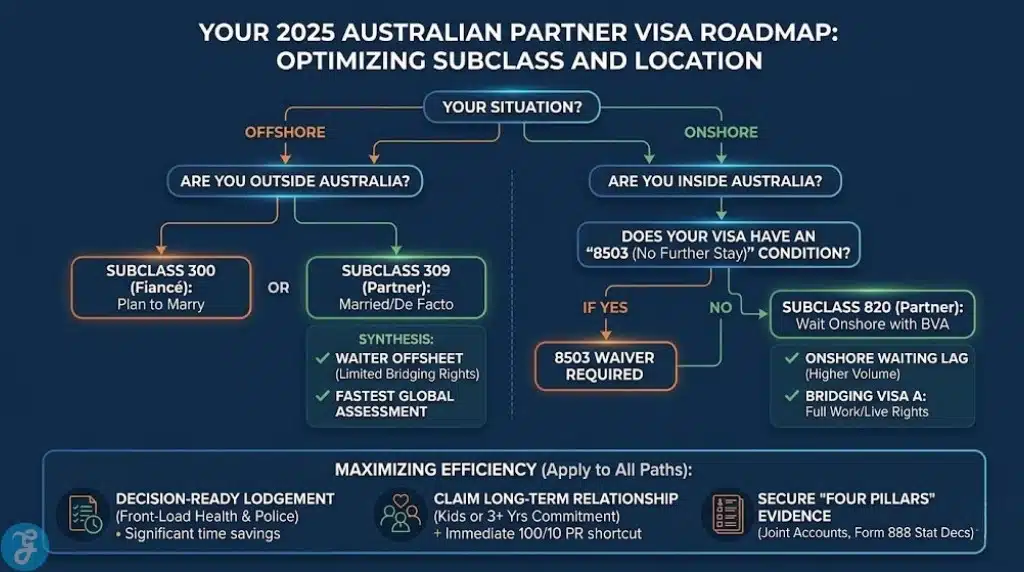
For the 2025 cycle, 50% of Subclass 309 (Provisional Partner) applications were finalized within 9 to 14 months. This timeframe was notably shorter than previous years, thanks to increased staffing at overseas processing hubs in regions like Southeast Asia and the United Kingdom.
Best for: couples currently living apart or those not eligible to apply from within Australia.
Why We Chose It:
-
It provides a realistic “mid-point” expectation for offshore applicants.
-
It reflects the efficiency gains of the new regional processing centers established in late 2024.
Things to consider:
-
If your application is in the 90th percentile, you could still be looking at 22+ months.
3. Subclass 820 (Onshore) Processing Lag
While offshore times improved, the Subclass 820 (Temporary Partner) visa saw a slight increase in wait times during 2025, with 50% of applications taking 12 to 16 months. This was largely due to the massive volume of applicants choosing to wait in Australia on Bridging Visas.
Best for: applicants currently in Australia on a visitor, student, or work visa.
Why We Chose It:
-
It highlights the “onshore penalty” where higher volumes lead to slower desk-review times.
-
It contrasts the common myth that applying in Australia is always faster.
Things to consider:
-
You are protected by a Bridging Visa A (BVA) during this entire wait, allowing you to work and live in Australia.
4. Grant Location Flexibility: The 2025 Game Changer
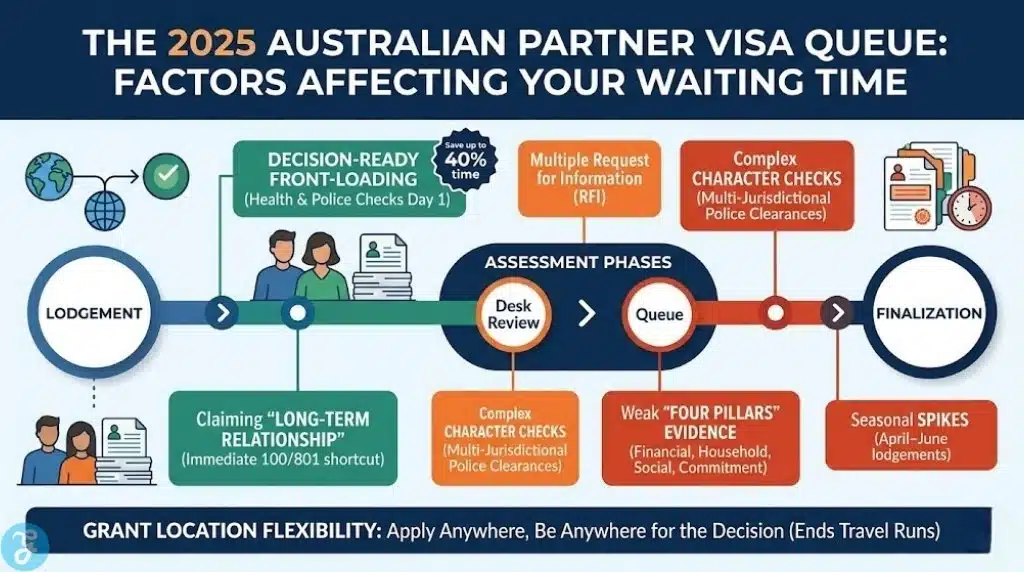
A landmark policy change fully implemented by early 2025 removed the “location requirement” for grants. Previously, 309 applicants had to be outside Australia to receive their visa. Now, you can be anywhere in the world when the decision is made, ending the “visa run” era where couples had to fly abroad just to receive their approval.
Best for: offshore applicants visiting their partner in Australia on a tourist visa during the wait.
Why We Chose It:
-
It is the most compassionate policy update in recent history.
-
It prevents unnecessary travel costs and emotional stress for families.
Things to consider:
-
You still must meet the specific “lodgement” location requirements of your subclass.
5. The “Decision-Ready” 40% Speed Boost
Department data from late 2025 showed that “decision-ready” applications—those with all 4 pillars of evidence, health checks, and police clearances uploaded at the time of filing—were processed up to 40% faster than those with mistakes for couples who want to minimize the risk of a “Request for Information” (RFI) delay.
Why We Chose It:
-
It is the single biggest factor an applicant can control.
-
Every RFI can add 2 to 6 months to the total processing time.
Things to consider:
-
Completing health checks before being asked can save months of waiting.
6. The AUD 9,095 Entry Fee
As of July 1, 2025, the base application charge for a Partner Visa increased to AUD 9,095. This high cost acts as a deterrent for fraudulent applications and funds the rigorous 2025 verification processes. By early 2026, this fee remains a significant barrier for many.
Best for: budgeting for the total cost of migration, including health and police checks.
Why We Chose It:
-
It is one of the most expensive visa categories in the world.
-
It underscores the financial commitment required to build a life in Australia.
Things to consider:
-
This fee is non-refundable, even if the visa is refused due to poor evidence.
7. The “Four Pillars” Evidence Audit
In 2025, the Department increased its focus on the “Four Pillars” of relationship evidence: Financial, Household, Social, and Commitment. Applications lacking strength in any one pillar—even if the couple was married—faced significantly longer “secondary review” times.
Best for: couples who are married but don’t have shared financial assets or cohabitation proof.
Why We Chose It:
-
It is the technical heart of the Partner Visa assessment.
-
It prevents “paper marriages” from sliding through the system.
Things to consider:
-
Marriage certificates alone are not enough to guarantee a fast grant in 2025.
8. Subclass 100/801: The “Permanent” Shortcut
While the partner process is a two-stage journey, 2025 saw a trend where “long-term relationships” (usually 3+ years, or 2+ years with a child) were granted the Permanent Visa (Subclass 100 or 801) immediately upon approval of the temporary stage.
Best for: couples with children or those who have lived together for over three years.
Why We Chose It:
-
It rewards genuine, long-standing commitments with immediate residency.
-
It removes the need for a second round of paperwork two years later.
Things to consider:
-
You must specifically claim this “long-term relationship” status in your application.
9. Health and Character “Bottle-Necks”
A major reason for the 90th percentile delays (reaching 29 months) in 2025 was the backlog in obtaining police clearances from high-risk or multi-jurisdictional backgrounds. If an applicant lived in five countries, the “character check” phase added significant time to the visa finalization.
Best for: world travelers and those from countries with slow bureaucratic processes.
Why We Chose It:
-
It is an “invisible” delay factor that the Department cannot speed up.
-
It shows why early preparation of police certificates is vital.
Things to consider:
-
Police checks are usually only valid for 12 months; timing them correctly is an art.
10. The 2025 Migration Amendment (Family Violence)
New regulations in 2025 expanded the “relationship cessation” provisions. If a relationship breaks down due to family violence, the applicant can still proceed to permanent residency. In 2025, these cases were prioritized for “expedited sensitive handling.”
Best for: vulnerable applicants facing relationship breakdowns during the processing period.
Why We Chose It:
-
It reflects the human-rights-focused evolution of the 2025 migration system.
-
It provides a legal safety net that prevents visa status from being used as a tool of abuse.
Things to consider:
-
Formal evidence of violence (police reports or court orders) is strictly required.
11. The Role of the “Eligible New Zealand Citizen”
In 2025, the definition of a sponsor was strictly enforced. Sponsors must be Australian citizens, permanent residents, or “eligible New Zealand citizens.” If a sponsor’s status was unclear (particularly for NZ citizens), the application was often moved to a “Complex Case” queue, adding 6–8 months to the wait.
Best for: sponsors who moved from New Zealand to Australia recently.
Why We Chose It:
-
It is a technicality that catches many couples off guard.
-
It highlights the need to verify the sponsor’s status before paying the high entry fee.
Things to consider:
-
Most NZ citizens who arrived after 2001 are not “eligible” sponsors without first getting their own PR.
12. Seasonal Processing “Spikes”
Data from the 2025 financial year showed that processing times accelerated in the January–March quarter. Conversely, applications lodged in the final quarter (April–June) often faced delays as the Department prepared for the July 1st policy and fee changes.
Best for: strategic planners looking for the “fastest” window to lodge.
Why We Chose It:
-
It identifies a clear behavioral pattern in government bureaucracy.
-
It helps manage expectations regarding the “lodgement month” impact.
Things to consider:
-
Lodging in the New Year often results in a faster “first touch” from an officer.
13. The Form 888 Statutory Declaration Update
In 2025, the Department modernized the Form 888. It is no longer a simple statement; it must be a formal Statutory Declaration made under the Statutory Declarations Act. Applications using the “old” 888 format were often returned for correction, causing 1–2 month administrative delays.
Best for: friends and family members providing witness statements for the couple.
Why We Chose It:
-
It is a small technical change with a large impact on validity.
-
It ensures the legal weight of witness testimony.
Things to consider:
-
At least two of these declarations must be from Australian citizens or permanent residents.
14. “No Further Stay” Condition (8503) Waivers
For onshore applicants, the “No Further Stay” condition remained a major hurdle in 2025. You cannot lodge an 820 visa if your current visa has this condition. In 2025, waiver processing times ranged from 4 to 8 weeks.
Best for: visitors on specific “high-risk” tourist visas or sponsored family streams.
Why We Chose It:
-
It is a “gatekeeper” rule that can block an onshore application entirely.
-
It requires a separate, successful legal argument before the partner visa can even begin.
Things to consider:
-
You must have “compelling and compassionate” reasons to get this condition waived.
15. The “On-Hand” Backlog Progress
By December 2025, the Department reported a 15% reduction in the “on-hand” (backlog) of partner visa applications compared to 2024. This suggests that the system is finally moving toward a “real-time” processing model where new applications are assessed closer to their lodgement date.
Best for: new applicants wondering if they are stuck behind a mountain of old cases.
Why We Chose It:
-
It is a positive indicator for the health of the 2026–2027 migration cycles.
-
It justifies the government’s claim that the 2025 reforms are working.
Things to consider:
-
High-risk country applications still take longer due to external security checks.
A Summary of the 2025 Partner Migration Landscape
The Australian Partner Visa Processing Times 2025 data tells a story of a system that is becoming more efficient for the “standard” couple but more difficult for those with gaps in their evidence. By early 2026, the data confirms that the removal of grant location requirements and the transition to a demand-driven model have made the process more humane. However, the high entry fee and the rigorous “Four Pillars” audit mean that the cost of failure is higher than ever. Success in this era is not just about being in love; it is about being a meticulous project manager of your own migration data.
Visualizing the 2025 Partner Visa Queue: Times and Costs
The tables below provide a comparative look at the different visa subclasses and the financial requirements for the 2025/26 year.
2025 Partner Visa Subclass Comparison
This data contrasts the processing benchmarks and bridging rights for the primary partner pathways.
| Visa Subclass | 50% Finalized (Months) | 90% Finalized (Months) | Bridging Visa Rights |
| 820 (Onshore) | 12 – 16 | 26 – 29 | Full Work/Live Rights |
| 309 (Offshore) | 9 – 14 | 22 – 24 | None (No BVA) |
| 300 (Fiancé) | 11 – 17 | 23 – 27 | None (Must be Offshore) |
| 801 (Permanent) | 8 – 10 | 15 – 26 | N/A (Already Onshore) |
| 100 (Permanent) | 9 – 12 | 19 – 24 | N/A (Already has 309) |
Our Top 3 Picks and Why?
-
Grant Location Flexibility: This is our top pick because it ended the era of “visa runs.” It is the most significant practical improvement for couples in the last decade, allowing for seamless family unity.
-
The “Decision-Ready” Speed Boost: We chose this because it is the only way for a couple to “jump the queue.” It empowers applicants to take control of their own timeline through meticulous organization.
-
The Demand-Driven Model: This is an essential pick because it provides long-term security. Knowing that your visa won’t be rejected simply because a “quota” was hit offers massive peace of mind.
Applicant’s Guide: How to Speed Up Your Partner Visa in 2026?
While you cannot force a Case Officer to open your file, you can ensure that when they do, there is absolutely no reason for them to pause your application.
The Selection Framework
-
Audit Your “Four Pillars”: Do you have a joint bank account that has been active for at least 12 months? Do you have statutory declarations from at least two Australian citizens? If not, wait to lodge until you do.
-
Front-Load Your Checks: Generate your HAP ID and complete your medicals within 30 days of lodgement. Apply for your police clearances immediately.
-
Use an ImmiAccount Agent: If your case involves a previous marriage or a child from a different relationship, the “DIY” risk increases exponentially.
-
Timeline Your Marriage: If you are currently in a de facto relationship, ensure you meet the 12-month cohabitation rule before hitting submit.
Use the decision matrix below to determine which subclass fits your 2026 strategy.
Decision Matrix
| If your priority is… | Choose X if… | Choose Y if… |
| Remaining Together | Subclass 820 to stay in Australia on a BVA. | Avoid 309 as you will be separated during the wait. |
| Lowest Total Cost | Subclass 309 if living in a low-cost country. | Subclass 820 if you have high-earning work rights. |
| Fastest Approval | Subclass 309 as offshore hubs are currently faster. | Subclass 300 if you are not yet married/de facto. |
| Immediate Permanent Residency | Claim Long-Term Relationship (3+ years/kids). | Standard Stream if the relationship is <3 years. |
The Final Checklist: 5-Point Partner Visa Readiness Plan
-
Log into your ImmiAccount and verify that every document is a high-resolution, color scan of the original.
-
Confirm that your sponsor has completed the “Sponsorship for a Partner to Migrate” form.
-
Update your relationship statement to include events that happened after you lodged.
-
Double-check the 2025 Form 888 requirements to ensure your witnesses used the correct statutory format.
-
Set aside a “buffer fund” of AUD 2,000 for unexpected medical re-tests or professional translation fees.
Securing Your Future in the Demand-Driven Era
Navigating the Australian Partner Visa Processing Times 2025 requires a shift from passive waiting to active compliance. The 2025 reforms have made the system more flexible than ever, but they have also raised the bar for what constitutes a “complete” application. By understanding that the Department is now prioritizing “decision-ready” files, couples can effectively shave months off their waiting time. Whether you are applying from the beaches of Queensland or a snowy apartment in London, the key to success in 2026 is to treat your visa application as a living document of your shared life.