The 2026 document release has finally exposed how Epstein network soft power functioned as a currency of silence among the global elite. The final 3.5 million pages of the Epstein files aren’t a revelation of names; they are a confession of a system. Jeffrey Epstein didn’t just hide from the law, he used billionaire-backed “soft power” to make himself the law’s favorite neighbour. Until we dismantle the industry of elite enablers, the next Epstein is already being protected by the same shield.
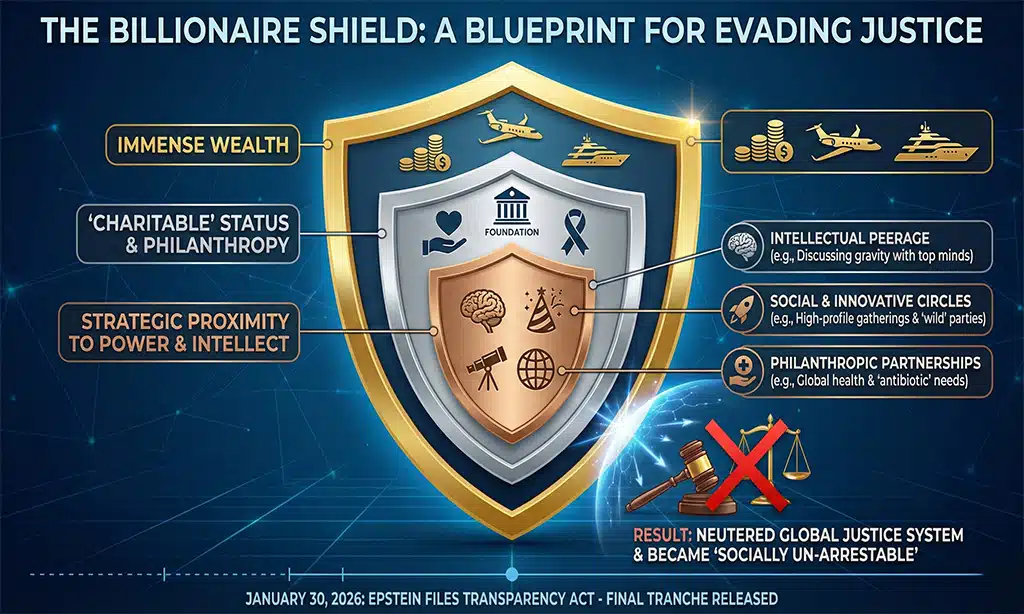
The January 30, 2026, release of the final tranche of documents under the Epstein Files Transparency Act has finally laid bare the mechanics of the “Billionaire Shield.” While the internet scavenges for celebrity names, we at Editorialge.com are looking at something far more dangerous: the blueprint of how immense wealth, “charitable” status, and strategic proximity to power can effectively neuter the global justice system.
Epstein wasn’t a shadow-dweller. He was a front-row guest at the theatre of human progress. Whether it was discussing gravity with Stephen Hawking, “wild” parties with Elon Musk, or the “antibiotic” needs of Bill Gates, Epstein understood that if you are seen as an intellectual or philanthropic peer to the world’s “saviours,” you become socially un-arrestable.
The Royal Connection: Diplomacy as a Weapon
Nowhere was the “Billionaire Shield” more visible than in Epstein’s relationship with Prince Andrew (Andrew Mountbatten-Windsor). The January 2026 document dump included undated photographs of the former prince in compromising positions, images that federal investigators suggest were part of a broader “kompromat” strategy.
By hosting Epstein at Buckingham Palace and accepting his financial assistance to clear family debts (as seen in the Sarah Ferguson correspondence), the British Royal Family provided the ultimate diplomatic cover. To the outside world, Epstein wasn’t a sex offender; he was a guest of the Crown. This “soft power” didn’t just open doors; it closed the mouths of witnesses and law enforcement alike. This toxic fusion of royal prestige and financial leverage defined the Epstein Network Soft Power, turning global landmarks into safe havens for exploitation.
High-Profile Names & Context of Appearance (Verified 2026)
| Name | Role/Context in Files | Status of Allegation |
| Donald Trump | 38,000+ mentions; mostly social/geographical (Mar-a-Lago proximity). | No charges; denied close friendship after 2004. |
| Prince Andrew | Photographs released 2026; 500+ mentions in emails/flight logs. | Stripped of titles; settled civil suit with Virginia Giuffre. |
| Bill Gates | Emails regarding medical “antibiotics” and extramarital “Russian girls.” | Denied all claims; called association a “huge mistake.” |
| Elon Musk | 16+ emails regarding helicopter rides and “wildest parties” on the island. | Denied visiting; stated correspondence was limited. |
| Howard Lutnick | Emails planning a 2012 lunch on Epstein’s island. | Denied wrongdoing; stated interactions were professional. |
| Michael Jackson | Observed at Epstein’s Palm Beach home by witnesses. | Mentioned as a visitor; no allegations of participation. |
| Kathy Ruemmler | Correspondence regarding Goldman Sachs and legal/social meetings. | Professional association; no criminal allegations. |
Beyond the Files: 2026’s Final Reckoning
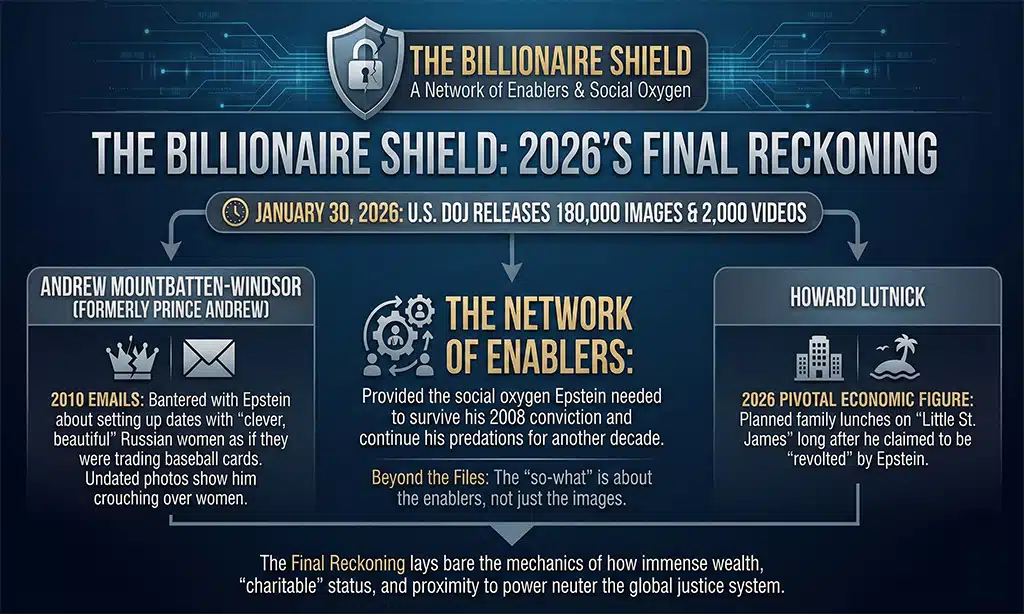
The U.S. Department of Justice just released 180,000 images and 2,000 videos, marking a long-awaited turning point in the Epstein saga. The “so-what” isn’t just about the undated photos of Andrew Mountbatten-Windsor (formerly Prince Andrew) crouching over women; it’s about the 2010 emails where he and Epstein bantered about setting up dates with “clever, beautiful” Russian women as if they were trading baseball cards. It’s about the discovery that Howard Lutnick, now a pivotal figure in the 2026 U.S. economic landscape… planned family lunches on “Little St. James” long after he claimed to be “revolted” by Epstein. These connections illustrate how Epstein Network Soft Power transformed personal relationships into a formidable barrier against criminal accountability.
This is the “Billionaire Shield” in action: a network of enablers who provided the social oxygen Epstein needed to survive his 2008 conviction and continue his predations for another decade.
The Human and Economic Cost of Impunity
When a billionaire network protects one of its own, the cost isn’t just moral, it’s economic. Impunity for the “investor class” creates a meso-level of systemic corruption. As research from the University of Exeter (2025) and current Brookings Institution reports suggest, when elite networks are allowed to operate outside the law, it erodes faith in democratic institutions, causing a flight of moral capital that is harder to replace than any GDP deficit.
The victims of the Epstein network weren’t just the girls on the island; they are every citizen who now believes the law is a suggestion for the rich and a cage for the poor.
Winners vs. Losers: The Economics of Accountability
| Stakeholder | Under the Status Quo (The Shield) | Under My Proposed Solution (Total Transparency) |
| Ultra-High-Net-Worth Individuals | High: Can trade “reputational laundered” donations for legal immunity. | Low: Donations do not buy a “get out of jail free” card; scrutiny increases. |
| Global Philanthropy | Tainted: “Big Tech” and foundations become shields for bad actors. | Credible: Funds are vetted, and “prestige washing” is criminalized. |
| Survivors of Human Trafficking | Silenced: Victims are intimidated by the “power” of the accused. | Empowered: Legal systems prioritize victim-centered evidence over social status. |
| Public Faith in Democracy | Declining: Perception that the system is “rigged” for the 1%. | Stabilizing: Equal application of the law regardless of flight logs. |
The Architecture of the Shield
To understand why this is a “shield,” we have to look at the sub-themes of his influence:
- The “Prestige Laundering” of Science: By funding MIT and Harvard, Epstein bought the silence of the world’s smartest people. They didn’t see a predator; they saw a checkbook.
- The Diplomatic “Get-Out” Clause: Royalty like Prince Andrew and political titans like Bill Clinton provided a level of state-sponsored legitimacy that local Florida police couldn’t touch.
- The Silicon Valley “Cool” Factor: Emails with Elon Musk and Bill Gates show Epstein tried to pivot into the tech-utopian world, where “disruption” is a buzzword that often includes disrupting legal norms.
The Counter-Punch: Why “Association Isn’t Guilt” Is a Weak Defense
The standard defense for those named in the files is that “association isn’t guilt.” Legally, simply appearing in a flight log or an email chain does not equate to criminal conduct. However, in the 2026 landscape, this minimalist defense no longer holds water. For a CEO of a global tech firm or a former world leader, social capital is not a private luxury… It is a public asset.
Knowingly granting social legitimacy to a convicted sex offender constitutes enablement; a notable example is Sarah Ferguson’s decision to solicit media advice from Epstein after his 2008 imprisonment. Under the Systemic Corruption Framework (2025), enabling is recognized as the engine that allows such crimes to persist. The final documents reveal these men didn’t just “know” Epstein; they treated him as a trusted consigliere, consulting him on everything from high-level politics to the management of their own personal scandals. By providing him with a seat at the table, they provided the cover he needed to continue his operations.
The Cost of Inaction: 2026 vs. 2030
| Area of Impact | Status in 2026 (Post-Release) | Predicted 2030 (If Shield Remains) |
| Legal Precedent | “Too Big to Jail” still applies to enablers. | Private “Justice” systems for the elite become the global norm. |
| Tech Accountability | CEOs like Musk/Gates face PR heat but no policy change. | AI-driven personal security allows elites to bypass state surveillance entirely. |
| Human Rights | Survivors are still fighting for non-redacted names. | Disillusionment leads to a total collapse of reporting in high-profile cases. |
The Moral Solution: A Roadmap for Change
Anger alone won’t dismantle the “Billionaire Shield”; we must translate that energy into legislation. To ensure the 2026 data release leads to lasting justice, we propose a roadmap for reform:
- Criminalize Institutional Enabling: Universities and foundations must be held to a higher standard. If an institution knowingly accepts funds from a convicted predator to facilitate “reputation laundering,” it should face racketeering charges. Accountability cannot stop at the individual; it must extend to the organizations that provide them cover.
- The “Lobbyist” Standard for Social Proxies: We need to close the “advisor” loophole. High-profile public figures should be required to disclose formal advisory relationships with convicted felons, mirroring the transparency standards required for political lobbying. If you are taking counsel from a predator, the public has a right to know.
- A “Global Benchmark” for Elite Justice: No one should be “too big to jail.” We need an international standard for handling “High-Value” suspects to prevent diplomatic status or royal titles from being used as a shield against criminal investigation.
Global Benchmark: How Nations Handle Elite Impunity
| Country/Entity | Current Approach (2026) | Effectiveness Rating |
| United Kingdom | “Royal Prerogative” and slow title-stripping (Prince Andrew). | Low: Public pressure is the only driver, not law. |
| Estonia (E-Residency) | High digital transparency; business ties are public & traceable. | High: Harder to hide “shell” associations. |
| United States | Mandated transparency via Act, but with “redaction loopholes.” | Moderate: The truth is out, but the “redactors” are still in power. |
| European Union | Tightening “Anti-Money Laundering” (AML) to include social capital. | Rising: Focus on “Enabler Liability” is gaining traction. |
Fact Sheet: The 2026 Epstein Data Landscape
- 3.5 Million: Total pages released by the DOJ as of January 30, 2026.
- 180,000+: Images seized from Epstein’s various devices (including homemade material and commercial pornography).
- 38,000+: Mentions of Donald Trump (largely composed of news clippings, gossipy emails, and unverified FBI tips).
- 200,000: Pages still withheld or redacted under “Attorney-Client” or “Victim Privacy” claims; the “Black Hole” of the 2026 release.
- Feb 2, 2026: The date the DOJ was forced to temporarily take down thousands of files after accidentally leaving victim names and sensitive images unredacted, a move critics call “institutional incompetence.”
- 0, The “Impunity Index”: The number of new criminal charges filed against elite enablers in the last 12 months, despite 3.5 million pages of evidence.
The Digital Paper Trail: Why Your Data Privacy Matters Less Than Theirs
The 2026 data dump isn’t just about famous names; it’s about the digital fingerprints left behind. For years, the public was told that encrypted servers and high-priced legal teams made these billionaires untouchable. We now see that wasn’t true. The DOJ’s release of 180,000 images, including files seized directly from Epstein’s private devices proves that even the most powerful people in the world leave a trail.
While the average citizen is tracked by cookies and GPS for advertising, these elites were using the same technology to coordinate “advisory” meetings that bypassed official government logs. This creates a terrifying double standard in the digital age. We are expected to live in a glass house of data, while the “Billionaire Shield” allows the ultra-rich to operate in a lead-lined bunker.
This isn’t just a privacy issue; it’s a security flaw in our democracy. When Bill Gates or Elon Musk exchange emails about “wild parties” on the island or “antibiotics” needed for secret medical treatments, they aren’t just chatting. They are building a private network of influence that operates outside the reach of the law. The 2026 files show us that “Big Tech” didn’t just provide the tools for communication; it provided the cloak.
By dismantling this shield, we aren’t just seeking gossip. We are demanding that the same digital accountability applied to a shoplifter or a small-business owner applies to the man who owns the satellite network. Transparency shouldn’t stop at the gates of a private estate, and it certainly shouldn’t be undermined by the same institutional incompetence that led the DOJ to “accidentally” leak survivor identities on February 2 while carefully redacting the elite’s most damaging correspondence.
The “Good Guy” Myth: How Charity Becomes a Weapon
We need to talk about “Prestige Laundering.” For decades, the public has been conditioned to forgive the “eccentricities” of the rich because they write big checks to charity. Epstein mastered this. By donating to MIT and Harvard, he didn’t just buy a tax break; he bought a moral insurance policy. This is the heart of the “Billionaire Shield.” When a titan of industry spends $100 million on a climate change initiative, we tend to stop asking who they spent their weekend with. The 2026 documents show that Epstein used these philanthropic ties as a “social pass” to gain access to the highest levels of global diplomacy.
This creates a dangerous “hero” narrative. We stop seeing these men as humans subject to the law and start seeing them as “saviors” too important to fail. This is exactly what happened with Prince Andrew and the Sarah Ferguson correspondence. The association with the “Crown” or “Global Health” provided a level of soft power that acted as a shock absorber for legal consequences. But the 2026 files show that charity cannot be a substitute for character. If we allow “good deeds” to erase “bad actions,” we aren’t living in a justice system; we are living in a marketplace where you can buy your way out of a conscience. It is time to stop measuring a person’s innocence by the size of their foundation’s endowment.
The Takeaway: What Happens Next?
We have seen power move in circles before, but 2026 feels different. The data is too vast, the photos are too clear, and the collective public is too exhausted by the “Billionaire Shield.” We are entering an era of Radical Transparency, where the walls of elite insulation are finally beginning to crumble.
Our prediction? Within the next six months, we expect at least two of the business titans mentioned in these files will be forced to step down. This won’t necessarily stem from a specific crime occurring on the island, but because the ‘social cost’ of their enabling has finally exceeded their value to their shareholders.
The question we must all face is this: If our neighbour was a known predator, we would call the police without hesitation. Why, then, when that neighbour owns a private island and a tech conglomerate, do we collectively label him “misunderstood”?
Read Part 1: Beyond the List: Why the Epstein Files Are Testimony, Not Tabloid
Read Part 2: Epstein Unsealed Documents Analysis: The Myth of the List and the Reality of Elite Complicity