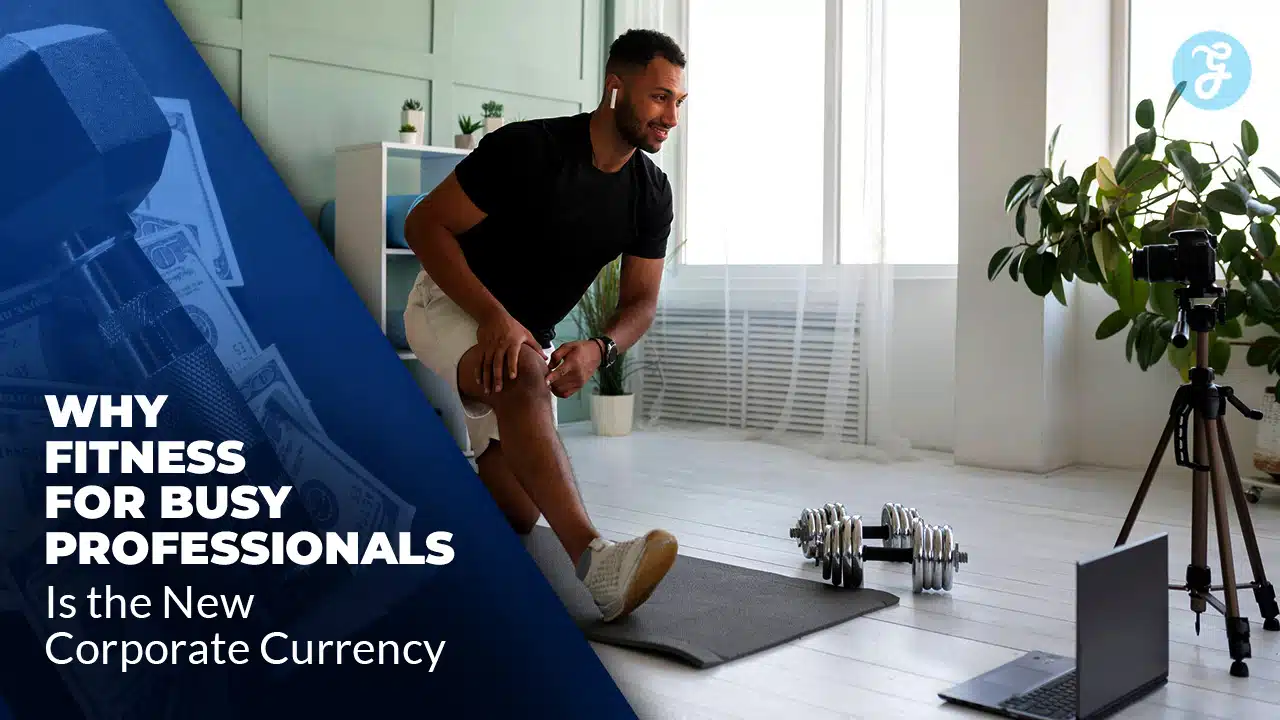
In the high-stakes corridors of modern industry, we often talk about ‘scaling’ systems, ‘optimizing’ workflows, and ‘leveraging’ assets. Yet the most critical asset in any professional’s portfolio, the human body, is often neglected. Maximize your ROI with our ultimate workout plan for fitness for busy professionals and stay healthy and productive even with limited time using high-impact, efficient routines.
The traditional image of the ‘gym rat’ spending two hours under a barbell is fundamentally incompatible with a calendar packed with back-to-back Zoom calls and cross-continental travel.
However, a shift is occurring in the global leadership landscape. High-performing CEOs and entrepreneurs are no longer viewing health as a hobby to be pursued “when things slow down.” Instead, they are treating fitness for busy professionals as a strategic necessity, a form of “biological compound interest” that pays dividends in cognitive clarity, stress resilience, and career longevity.
The Professional’s Pivot: A Weekly Fitness Blueprint for Busy Professionals
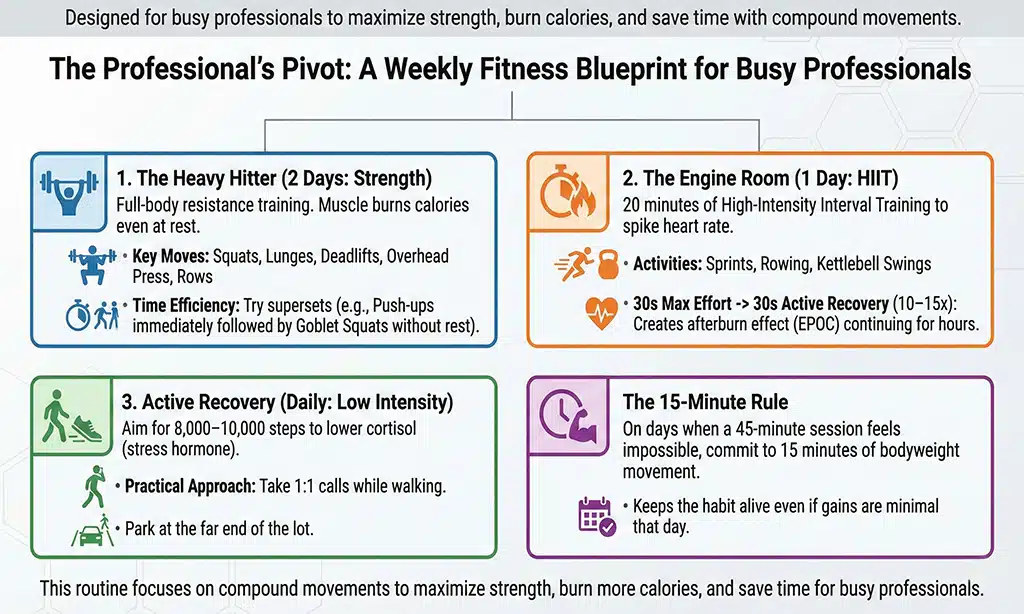
This routine is designed for busy professionals, focusing on compound movements, exercises that engage multiple muscle groups simultaneously, to maximize strength, burn more calories, and save time.
1. The Heavy Hitter (2 Days: Strength)
Full-body resistance training. Muscle is metabolically active; it burns calories even while you’re sitting in meetings. Key moves include squats or lunges, deadlifts (or hinges), overhead press, and rows. For time efficiency, try supersets; perform a set of push-ups immediately followed by goblet squats without resting between.
2. The Engine Room (1 Day: High-Intensity Interval Training)
20 minutes of HIIT using sprints, rowing, or kettlebell swings. This spikes your heart rate and creates an afterburn effect (EPOC) that continues for hours. Perform 30 seconds of maximum effort followed by 30 seconds of active recovery, repeated 10–15 times.
3. Active Recovery (Daily: Low Intensity)
Aim for 8,000–10,000 steps to help lower cortisol, the stress hormone. A practical approach is to take 1:1 calls while walking or park at the far end of the lot.
The 15-Minute Rule
On days when a 45-minute session feels impossible, commit to 15 minutes of bodyweight movement. This keeps the habit alive even if the gains that day are minimal.
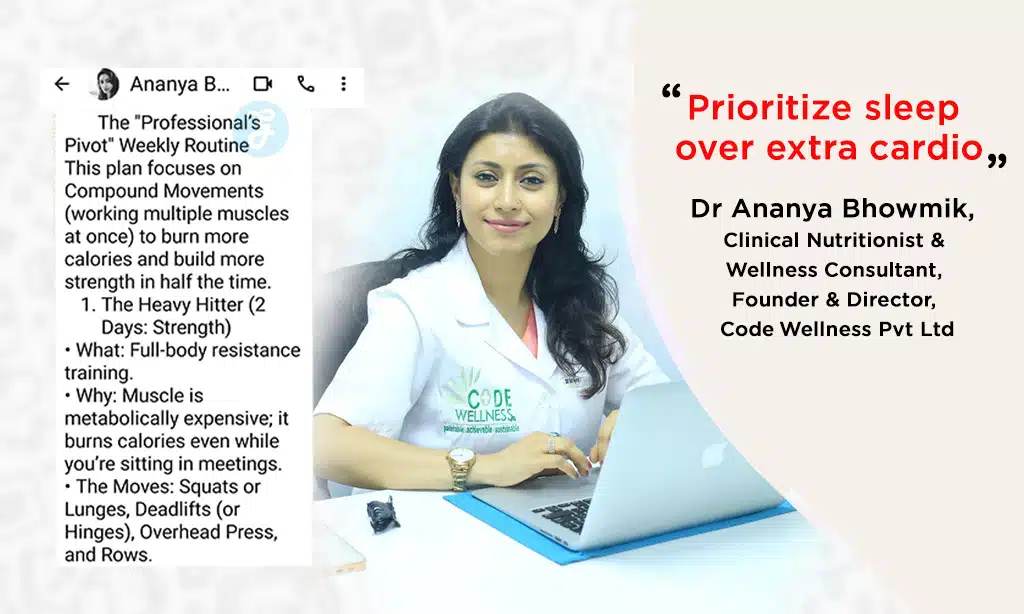
According to Dr Ananya Bhowmik: Clinical Nutritionist and Wellness Consultant, Founder & Director, Code Wellness Pvt Ltd
Pack the night before. If you workout in the morning, have your bag ready by the door and your coffee prepped. Decision fatigue is your biggest enemy.
Prioritize sleep over extra cardio. If you have to choose between five hours of sleep plus a run or seven hours of sleep, choose the sleep. Chronic sleep deprivation combined with high-intensity exercise is a recipe for burnout and injury.
Create a “home base” setup. If commuting to the gym is why you miss workouts, invest in two dumbbells or a heavy kettlebell for home. Eliminating the friction of travel is a game-changer.
The Strategy: Integrating Wellness into the Workflow
To rank as a high performer, one must treat health with the same rigor as a P&L statement.
| Habit Hack | Business Application | Long-term Benefit |
| Walking 1:1s | Take internal calls while pacing the office. | Reduced sedentary inflammation. |
| Hydration Sprints | Drink 500ml of water between major meetings. | Sustained cognitive focus. |
| Protein Automation | Pre-set healthy snacks to avoid “vending machine” lunch. | Stable blood sugar and mood. |
A Human Thought
“I’ve seen it time and again: the brilliant mind trapped in an exhausted body. For fitness for busy professionals, sustainability isn’t just a business term; it’s a personal necessity. We often neglect our own health while optimizing everything else, forgetting that you are not a robot meant to produce output until the body fails. You are a friend, a partner, and a leader,” adds Dr. Bhowmik.
Dr. Bhowmik’s “Professional’s Pivot” isn’t just a workout plan; it’s a plea to start treating yourself like the primary asset you are. It’s about realizing that a 15-minute sweat session in your living room is a more powerful “reset button” than any double espresso could ever be. You don’t need more time; you just need a better system.
So, here is my final question to leave you with: If your body were a company you were looking to invest in, would you put your money behind its current management, or is it time for a radical restructuring?
The Anatomy of the Professional’s Dilemma
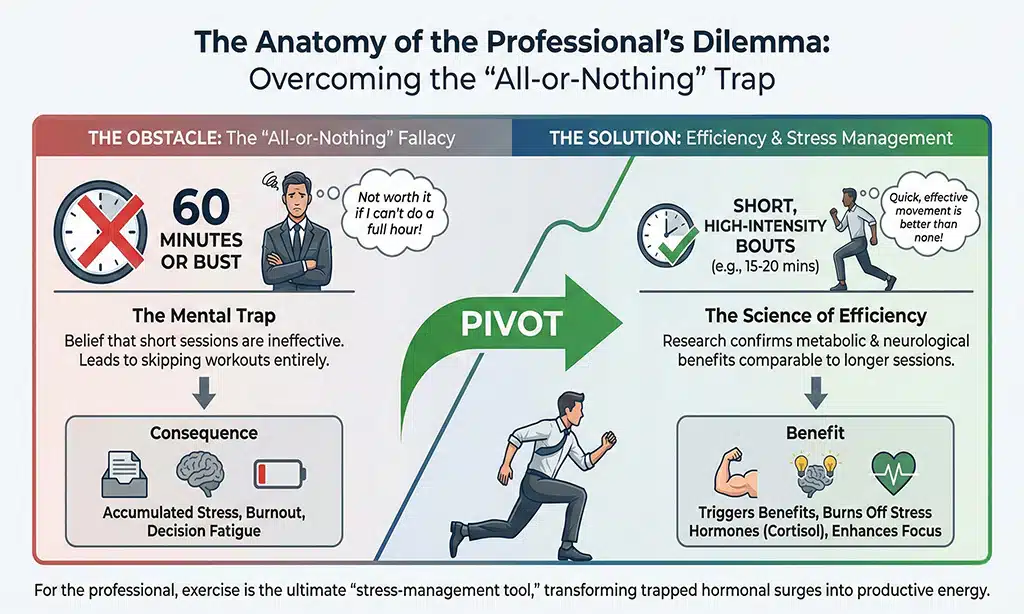
The primary obstacle for the time-crunched professional is the “all-or-nothing” fallacy. This is the mental trap that suggests if you cannot commit to a 60-minute session, the workout is not worth doing. In reality, the science of exercise physiology has pivoted toward efficiency. Research now confirms that short, high-intensity bouts of movement can trigger metabolic and neurological benefits comparable to much longer, moderate sessions.
For the professional, exercise is the ultimate “stress-management tool.” When cortisol levels spike during a high-pressure negotiation, the body is primed for a “fight or flight” response. Without a physical outlet, this hormonal surge remains trapped, leading to burnout and decision fatigue. By integrating a structured workout plan, you aren’t just building muscle; you are “burning off” the chemical residue of a stressful workday.
The Strategic Workout Plan for Busy Professionals: 4 Modular Routines
The following workout plans are designed to fit the four most common “professional scenarios.” These are modular, meaning they can be swapped depending on where your career takes you today. They prioritize compound movements, exercises that recruit multiple muscle groups to ensure you get the maximum metabolic “bang for your buck.”
1. The “Boardroom Break” (10 Minutes, No Equipment)
Best for: In-between meetings or during a brief office lull.
- 60 Seconds Air Squats: Keep your chest up and weight on your heels. This wakes up the largest muscle groups in the body, surging blood flow to the brain.
- 45 Seconds Desk Push-ups: Place your hands on the edge of a sturdy desk. This targets the chest, shoulders, and triceps without needing a gym floor.
- 45 Seconds Standing Calf Raises: Do these while reading a brief or checking an email.
- 60 Seconds High Knees: Jog in place, bringing your knees to hip height to spike the heart rate.
- Repeat the circuit twice.
2. The “30-Minute Executive” (Gym-Based)
Best for: When you can slip away to the building gym or a local club.
- Warm-up (3 Mins): Fast walk or light jog.
- Superset A: Goblet Squats & Overhead Press. Perform 12 squats followed immediately by 12 dumbbell presses. Rest 45 seconds. Repeat 3 times.
- Superset B: Dumbbell Rows & Lunges. Perform 10 rows per arm followed by 10 lunges per leg. Rest 45 seconds. Repeat 3 times.
- The Finisher (5 Mins): Interval sprints. 30 seconds of maximum effort, followed by 30 seconds of slow walking.
- Cool-down (2 Mins): Static stretching of the hamstrings and chest.
3. The “Jet-Setter’s Suite” (Hotel Room Circuit)
Best for: Business travel where gym access is uncertain.
- 15 Minutes AMRAP (As Many Rounds As Possible): Set a timer and move through the following list continuously.
- 10 Burpees: The ultimate full-body calorie burner.
- 15 Glute Bridges: Lying on your back, lift your hips. This counteracts the “tight hip” syndrome caused by long flights.
- 20 Mountain Climbers: Great for core stability and cardiovascular endurance.
- 30-Second Plank: Focus on a straight line from head to heels.
- 10 Tricep Dips: Use the edge of the hotel bed or a sturdy chair.
4. The “Weekend Warrior” Recovery (Outdoor/Active)
Best for: Saturday or Sunday to reset the central nervous system.
- 45-Minute Zone 2 Cardio: A brisk walk, light jog, or steady cycle where you can still hold a conversation. This promotes aerobic capacity without adding “intensity stress.”
- Mobility Flow: 10 minutes of “World’s Greatest Stretch” (lunging with a thoracic rotation) and “Cat-Cow” poses to undo the postural damage of a week spent hunched over a laptop.
- Mental Reset: No podcasts, no news—just movement in nature. This acts as a “moving meditation” to clear the cache of the previous week.
Gender-Neutral Workouts for Strength and Endurance
When it comes to fitness for busy professionals, the core principles of effective exercise remain largely the same for both men and women. While physiological differences in muscle mass, hormone profiles, and recovery patterns exist, these do not fundamentally change the exercises that produce strength, endurance, and metabolic benefits. Across age groups, including 25 to 40, 45 to 60, and 60 and above, both men and women benefit from the same foundation of compound movements such as squats, lunges, deadlifts, overhead presses, and rows, with intensity and volume adjusted to individual capacity.
These exercises target multiple muscle groups simultaneously, making them efficient and universally effective for fitness for busy professionals. High-intensity interval training (HIIT) is also beneficial for both men and women across age groups when appropriately scaled, as it improves cardiovascular health, supports metabolic efficiency, and triggers an afterburn effect that continues for hours after the session.
“From a clinical and practical standpoint, workout structures for men and women do not differ as much as people assume. What truly matters is consistency, proper load management, and recovery, not gender-specific routines,” adds Dr Ananya Bhowmik
Mobility, Recovery, and Efficient Programming
Mobility work, core stabilization, and active recovery practices such as walking or light cycling are critical for everyone, helping reduce stress, maintain posture, and support long-term joint health. Programming adjustments such as weight selection, rep ranges, or recovery time can be individualized based on personal strength levels, fitness goals, or prior injuries, but the structure of the workouts does not need to differ drastically.
Evidence from sports science shows that women respond equally well to strength and interval training when intensity is scaled appropriately, and men gain similar benefits from incorporating mobility and recovery practices into their routines. For busy professionals, the takeaway is clear: gender does not dictate the type of exercise, but efficiency, intensity, and consistency do.
By embracing a common framework for both men and women, this approach ensures that fitness for busy professionals integrates seamlessly into demanding schedules while maximizing cognitive clarity, energy levels, and overall well-being.
Efficiency Over Duration: The New Standard
To truly master fitness for busy professionals, one must adopt the mindset of a “minimalist.” It is not about how long you are in the gym; it is about the intensity and intention you bring to those minutes. By focusing on high-return movements and scheduling these “appointments” with yourself into your calendar, fitness ceases to be a chore and becomes a performance enhancer.
The most successful leaders of the next decade will not be the ones who worked the most hours, but the ones who managed their energy with the most precision. Start with one of these plans today. Your career and your body… will thank you.