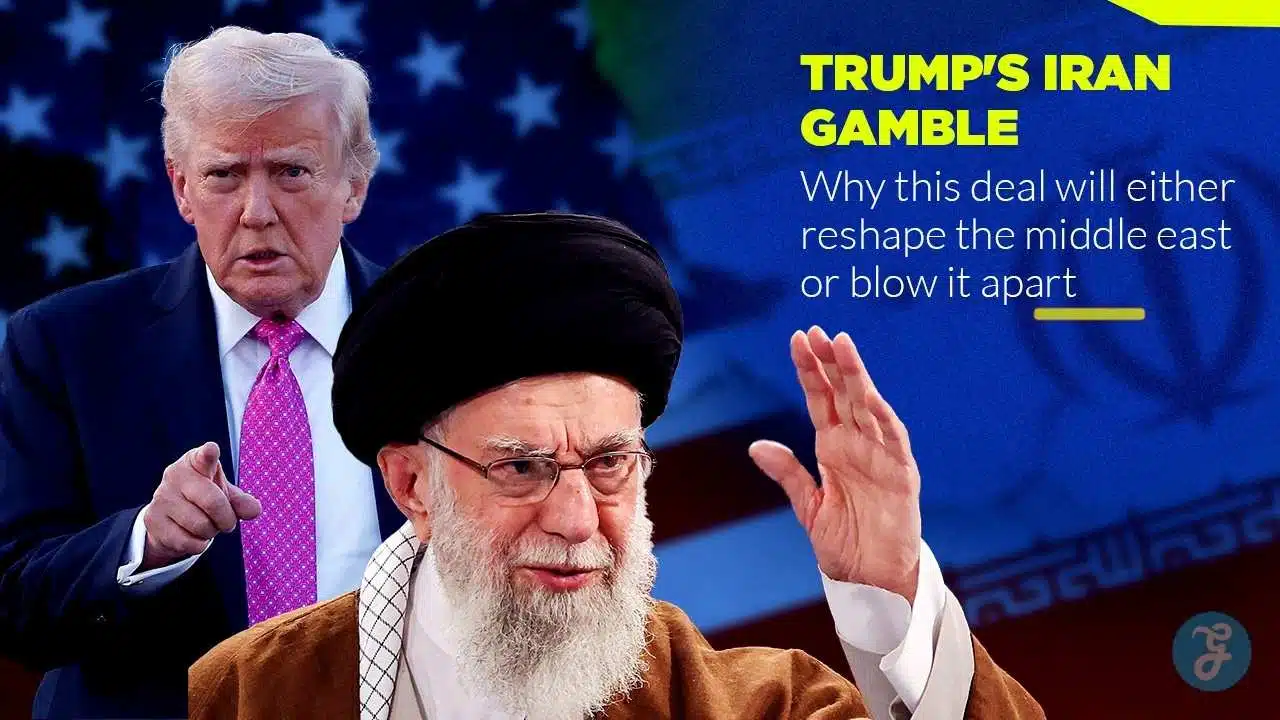
The Trump Iran Strategy 2026 has shifted from rhetorical pressure to a kinetic ultimatum, and the silence from Tehran is deafening. On February 2, the White House confirmed that the USS Abraham Lincoln Carrier Strike Group, accompanied by a flotilla of Arleigh Burke-class destroyers, had taken up station just outside Iranian territorial waters. President Trump, never one for subtlety, described the force as a “massive armada,” explicitly comparing the moment to the Cuban Missile Crisis. But unlike 1962, the adversary is not a superpower peer but a theocracy on the verge of nervous breakdown.
We are witnessing the culmination of a high-stakes gamble that began in the first days of Trump’s second term. It is a strategy that goes beyond the “Maximum Pressure” of 2018. This is “Maximum Pressure 2.0,” or what strategists at Chatham House are now calling “Strategic Submission.” The objective is no longer just a better treaty; it is the forced restructuring of the Middle Eastern security architecture by holding a gun to the head of a regime that may finally be too weak to slap it away.
But history in the Middle East is a graveyard of “sure things.” By backing the Islamic Republic into an existential corner, the President risks one of two outcomes: a historic capitulation that reshapes the region for fifty years, or a chaotic explosion that drags the United States back into the desert wars he promised to end.
The Road to the Brink: How We Got Here
To understand the ferocity of the current moment, one must look at the debris of the last twelve months. The timeline of escalation has been relentless, driven by a White House convinced that the Iranian regime is a “paper tiger” waiting to be folded.
Operation Midnight Hammer: The Kinetic Turning Point
The turning point was undoubtedly Operation Midnight Hammer in June 2025. Frustrated by the slow pace of indirect talks and alarmed by intelligence suggesting a breakout time of mere days, the U.S. and Israel launched a series of coordinated strikes on the Fordow and Natanz nuclear facilities. While the Pentagon declared the operation a success, post-strike assessments painted a murkier picture.
We destroyed centrifuges, but we did not destroy knowledge. In fact, the strikes had the perverse effect of driving the program deeper underground and convincing the hardliners in the IRGC (Islamic Revolutionary Guard Corps) that a nuclear deterrent was their only guarantee of survival.
The Silent Front: Cyber-Siege Before the Storm
While the world watches the aircraft carriers, a quieter, deadlier war is already raging in the digital domain. Intelligence sources confirm that alongside the naval deployment, US Cyber Command has initiated “Operation Olympic Fire”, a persistent campaign targeting Iran’s command-and-control infrastructure.
Unlike the Stuxnet attacks of the 2010s, which were surgical and slow, these new incursions are designed for immediate paralysis. Reports from Tehran suggest widespread disruptions to the national power grid and inexplicable “glitches” in the radar systems protecting the Bushehr nuclear plant.
This “softening of the battlefield” serves a dual purpose: it blinds the regime’s defenses in preparation for a potential strike, and it serves as a psychological weapon, proving to the Ayatollah that his walls have no ears, and his bunkers have no secrets. Trump is not just surrounding Iran’s borders; he is already inside its nervous system.
The Winter of Rage: Internal Collapse and Economic Crisis
Then came the internal collapse. The “Winter of Rage” in late 2025 was not an ideological movement like 2009 or 2022; it was a hunger revolt. With the Rial losing 60% of its value against the dollar and inflation hitting a staggering 52%, the Iranian street exploded. The regime’s response was predictable but fatal: a crackdown that left over 3,000 dead.
The Trump Doctrine Evolved: Red Lines on Human Rights
It was here that the Trump Doctrine evolved. In January 2026, the President issued a specific, red-line warning: any further mass execution of protesters would trigger “direct and overwhelming” U.S. intervention. It was a pivot from protecting oil tankers to protecting human rights, weaponized for geopolitical leverage. When reports surfaced of impending mass trials in Tehran, the Abraham Lincoln was ordered to the Gulf.
The Anatomy of “The Deal”
So, what is the endgame? Washington is not looking for regime change in the Iraq style, an expensive, messy occupation. Instead, the administration is seeking to turn Iran into a defanged nation-state.
The “Three Nos”: Demanding Total Capitulation
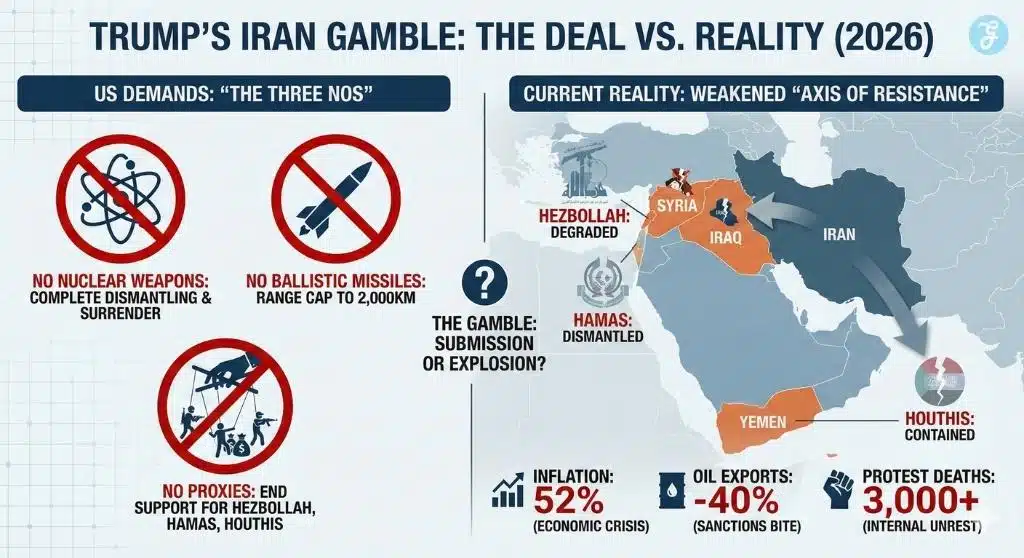
The demands, communicated via Omani backchannels, are known as the “Three Nos”:
- No Nuclear Weapons: Not just a freeze, but the complete dismantling of the fuel cycle and the surrender of all enriched uranium stockpiles.
- No Ballistic Missiles: A cap on missile ranges to 2,000km, effectively neutralizing their ability to threaten Europe or high-value U.S. assets.
- No Proxies: The total cessation of funding and arming of the “Axis of Resistance,” including Hezbollah, Hamas, and the Houthis.
Transactional Diplomacy: The “Grand Bargain” Offer
In exchange, Trump is offering a transactional lifeline. He has hinted at a “grand bargain” that would lift all sanctions, allow Iran to sell oil freely, and even invite U.S. investment into Iran’s crumbling energy sector. “We can make Iran great again,” Trump tweeted on January 30, “but only if they stop being a terror state.”
Beyond the JCPOA: A Corporate Restructuring of a Theocracy
This offer is fundamentally different from the JCPOA. It treats the Islamic Republic not as a revolutionary cause to be accommodated, but as a failing corporation to be acquired and restructured. Trump is betting that the Supreme Leader, Ayatollah Khamenei, now frail and facing a succession crisis, will choose the survival of his regime over the purity of his revolution.
The Case for Submission: Why It Might Work
There is a compelling, cold logic to the administration’s confidence. For the first time in forty years, Iran is truly alone.
Isolation of the Regime: The End of the “Ring of Fire”
The “Ring of Fire” that Tehran built to encircle Israel has been extinguished. Hezbollah is a shadow of its former self after the 2024-2025 conflicts; Hamas has been dismantled as a governing force in Gaza; and the Houthis in Yemen have been degraded by relentless coalition airstrikes. Iran can no longer fight to the last Arab; it must now fight with its own blood, a prospect the regime dreads.
The Riyadh-Jerusalem Pincer
Crucially, Trump is not acting in a vacuum. The 2026 strategy is built on the tacit, unprecedented coordination between Saudi Arabia and Israel, the unwritten “Abraham Alliance.”
While Riyadh publicly calls for de-escalation, Crown Prince Mohammed bin Salman (MBS) has privately greenlit the use of Saudi airspace for US logistics, a concession that was unthinkable a decade ago. Simultaneously, Israeli intelligence is providing the real-time targeting data that makes the US ultimatum credible.
This pincer movement changes the calculus for Tehran. In previous standoffs, Iran could exploit divisions between Arab Gulf states and the West. Today, they face a unified front where the wealthiest Arab nation and the strongest military power in the region are effectively functioning as the wings of the American eagle.
Global Fatigue: Why China and Russia Won’t Intervene
Furthermore, the geopolitical cavalry isn’t coming. China, wrestling with its own economic slowdown and trade wars, has signaled it will not underwrite a confrontation with the U.S. in the Gulf. Beijing’s oil purchases from Iran have dropped by 7% in 2025, not a total embargo, but a clear signal that Xi Jinping is hedging his bets. Russia, bogged down in its own long war, has little hard power to spare.
The “Gorbachev Scenario”: Choosing Survival Over Ideology
If the IRGC leadership is rational, they will see the Abraham Lincoln not just as a threat, but as an off-ramp. A deal would secure their economic empire, allow them to crush domestic dissent without foreign interference, and ensure a stable transition of power when Khamenei passes. It is the “Gorbachev Scenario”, reforming the foreign policy to save the domestic system.
The Catastrophic Downside: The “Cornered Rat”
However, the Middle East rarely adheres to Western concepts of rationality. The gravest risk in Trump’s gamble is psychological. The Islamic Republic was founded on the rejection of American hegemony.
The Psychological Barrier: Why Submission Equals Death
For the hardliners who control the guns, “submission” is synonymous with death. They look at Libya’s Muammar Gaddafi, who gave up his nuclear program and was subsequently toppled, as the ultimate cautionary tale. If Tehran concludes that Trump is bluffing, or worse, that he intends to overthrow them regardless of a deal, they may decide to flip the table.
The “Samson Option”: Closing the Strait of Hormuz
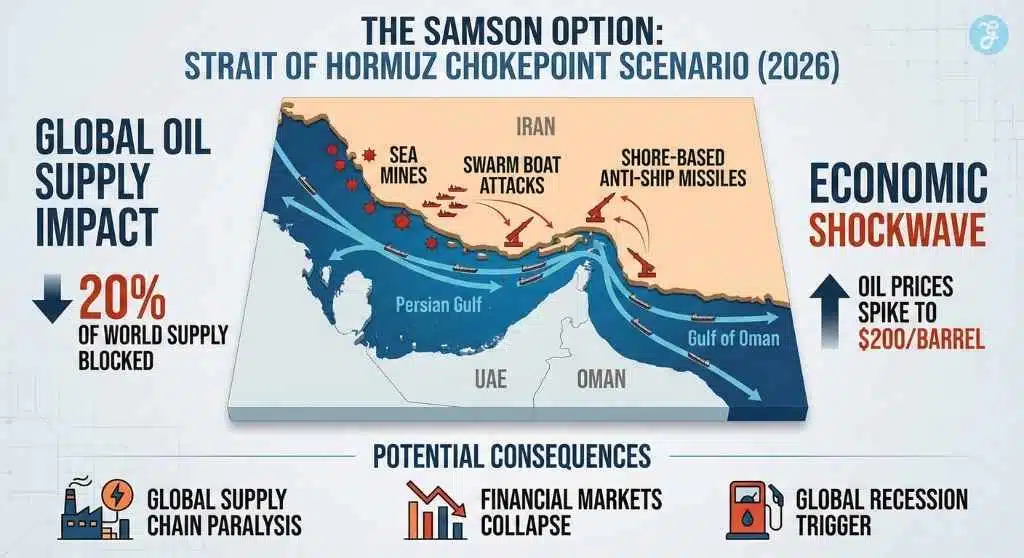
The “Samson Option” for Iran is not nuclear (yet), but economic. On February 1, IRGC commanders hinted that if they are attacked, the Strait of Hormuz will be closed. “If we cannot export oil, no one will,” warned Major General Hossein Salami. This is not an idle threat. Despite the presence of the U.S. Navy, the Strait remains a choke point where asymmetric warfare favors the defender. A campaign of sea mines, swarm boat attacks, and missile barrages could spike oil prices to $200 a barrel overnight, shattering the fragile global economic recovery.
Asymmetric Warfare: Sleeper Cells and the “Forever War” Trap
Moreover, the regime could activate its remaining sleeper cells. We could see attacks on Saudi desalination plants (rendering cities uninhabitable), drone strikes on Dubai’s airport, or terror attacks against U.S. embassies in Baghdad and Amman. The goal would be to drag the U.S. into a “forever war,” betting that the American public has no stomach for a third massive intervention in the Middle East.
The Vacuum of Power
Perhaps the most terrifying scenario is not war, but collapse. The “Maximum Pressure” campaign assumes that if the regime breaks, something better will replace it. This is the same fallacy that led to the disasters in Iraq and Libya.
The Fallacy of Regime Change
There is currently no organized, unified opposition in Iran. The protest movement is brave but leaderless. If the Islamic Republic implodes under the weight of sanctions and strikes, the result will likely not be a secular democracy, but a fractured civil war.
A Fractured Map: The Risk of Balkanization
We could see the country split along ethnic lines: Kurds in the west, Baluchis in the southeast, and Arabs in the southwest, all vying for autonomy while IRGC warlords carve out fiefdoms. A “Syria-style” civil war in a country of 88 million people, one that sits on the Caspian Sea and the Persian Gulf, would generate a refugee crisis that breaks Europe and a terrorism vacuum that empowers groups far worse than the current regime.
The MAGA Paradox: Isolationism with Aircraft Carriers
Perhaps the most fascinating element of this crisis is the domestic tightrope President Trump is walking. His movement was built on the promise of ending “forever wars,” yet he has deployed more firepower to the Persian Gulf than any President since George W. Bush.
This is the “MAGA Paradox.” To his base, Trump justifies this armada not as an act of war, but as the ultimate act of deal-making, using extreme leverage to secure a victory without firing a shot. It is the “Madman Theory” resurrected: convince the enemy you are crazy enough to burn the house down, so they hand over the keys.
However, the political risks are catastrophic. A quick, bloodless victory cements his legacy as a peacemaker. But if Abraham Lincoln takes a missile hit, or if American troops are dragged into a ground war, the “America First” coalition could fracture overnight. Trump is gambling his entire political mandate on the assumption that the Ayatollah will fold before the first body bag comes home.
The Verdict of History
We are currently in the eye of the storm. The backchannel talks in Muscat are reportedly tense, with Iranian diplomats oscillating between defiance and desperation.
The 30-Day Window: Diplomacy on the Edge
The next 30 days will likely define the Middle East for the next half-century. President Trump is betting everything on the idea that strength commands respect. He believes he can bully a revolutionary theology into becoming a transactional state.
Final Words: A Legacy in the Balance [Triumph or Tragedy]
It is a gamble of breathtaking audacity. If he succeeds, he will have achieved what Carter, Reagan, Bush, Clinton, Obama, and Biden could not: the neutralization of the Iranian threat without a full-scale invasion. But if he fails, if he misreads the pride of the mullahs or the volatility of the street, the “massive armada” currently sitting in the Gulf will be the opening act of a tragedy that will consume the presidency and the region alike.
The gun is cocked. The world is waiting to see who blinks first.