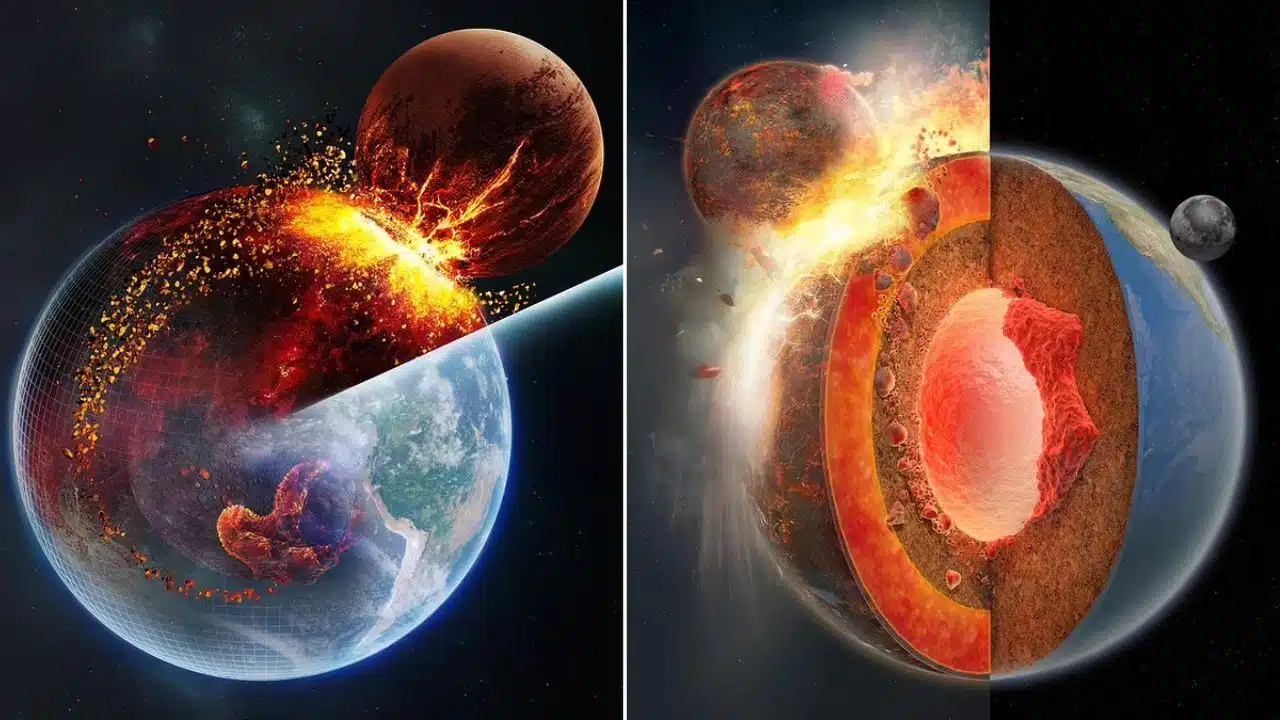
The gleaming moon orbiting our planet contains many mysteries. Where did it come from? Why is it so large compared to other moons? An intriguing theory proposes that a collision between proto-Earth and a Mars-sized planet called Theia formed the moon billions of years ago. New evidence suggests Theia’s remnants may actually still exist within Earth’s mantle. Uncovering the moon’s origins could reshape our understanding of our planet’s formation.
The Widely Accepted Giant Impact Hypothesis
Most experts agree on the giant impact hypothesis to explain the moon’s creation. As early Earth formed 4.5 billion years ago from accumulating space debris, scientists believe a planetoid the size of Mars called Theia struck the still-molten Earth. This violent collision would have ejected tons of material into space. Gravity then pulled these fragments together to form the moon.
The giant impact hypothesis elegantly explains many fundamental moon mysteries. It accounts for the large size of the moon compared to Earth. Their nearly identical oxygen isotope composition also matches, since both originated from the same starting materials. The hypothesis also explains why the moon has less iron than Earth – lighter rocks were ejected into the moon while denser iron sank into Earth’s core during the collision. In addition, you can also read an article on- Scientists Make 3 Incredible Discoveries on the Moon
But One Big Question Remained: Where is Theia?
The giant impact hypothesis leaves a major question – what happened to Theia? Logically, remnants of the Mars-sized planet should exist somewhere in the solar system. But no rocky fragments with Theia’s expected composition have ever been found in asteroid surveys. Given the violence of the collision, scientists assumed Theia’s material was vaporized or fully incorporated into the molten Earth.
Until now, no convincing evidence of Theia has emerged. This left a gaping hole in the giant impact hypothesis. But fresh thinking and new research may have finally uncovered Theia’s fate.
A Eureka Moment: Could Buried Blobs Be Remains of Theia?
When geophysicist Dr. Qian Yuan attended a seminar on the moon’s origins, he had an insight. As an expert on Earth’s interior, he was familiar with mysterious structures deep in the mantle called LLVPs (large low velocity provinces). Seismic waves move more slowly through these dense, iron-rich blobs under Africa and the Pacific. Though discovered in the 1980s, their origin stumped scientists.
In a flash, Yuan connected the dots – could these buried structures actually be surviving pieces of the planet Theia? No one had proposed this revolutionary possibility before. Yuan meticulously scoured the literature but found no prior suggestion linking LLVPs with Theia. He was hesitant to share his wild idea at first, fearing ridicule. But the pieces fit too perfectly to ignore. Additionally, you can also read about- Moon Lovers Treat: Skywatchers to be Observed 4 More Special Moon in this Year
Interdisciplinary Team Creates More Detailed Collision Models
To prove his theory, Yuan collaborated with geophysicists, astrophysicists, and modelers. Earlier simulations of the Earth-Theia impact lacked sufficient detail to show if parts of Theia could remain intact. But new high-resolution modeling explored more precise collision parameters. These simulations increased resolution 100x to 1000x, incorporating better estimates of Theia’s size, speed, and angle when it struck Earth.
To the team’s excitement, the advanced modeling showed it was indeed possible for portions of Theia’s mantle to survive as solid structures post-impact. The simulations demonstrated how chunks of Theia could sink through Earth’s molten mantle and accumulate to form the detected LLVP layers. Moreover, the modeled composition aligned perfectly. Theia’s debris would contain just the right amount of dense iron to match the LLVPs’ properties.
This interdisciplinary work combined state-of-the-art impact modeling with geoscience data analysis to create a novel but convincing scenario for Theia’s fate.
You May Find Interest: Scientists Discover New Structure in Earth’s Inner Core
A Tantalizing Theory Needs Further Exploration
The study makes a compelling case that the ancient collision that spawned the moon also left remnants of Theia intact deep inside Earth’s mantle. This groundbreaking theory elegantly ties together the moon’s creation with the mysterious LLVP structures. Some experts already find the hypotheses elegant and even obvious in retrospect.
However, lively debate continues around LLVPs’ origins, with other ideas postulated. More research across multiple disciplines will be needed to fully test the proposal that our planet holds physical traces of the long-lost Theia. If proven true, the theory would forever change our understanding of Earth and moon formation. For now, the search for Theia’s fate continues, with increasing evidence that the key may lie buried within the world under our feet.